
Andrew G. Stanton - Nov. 19, 2025
Every era tells a story about why its system works. But some patterns are so old — so deeply rooted in human history — that they reappear in every empire under new names.
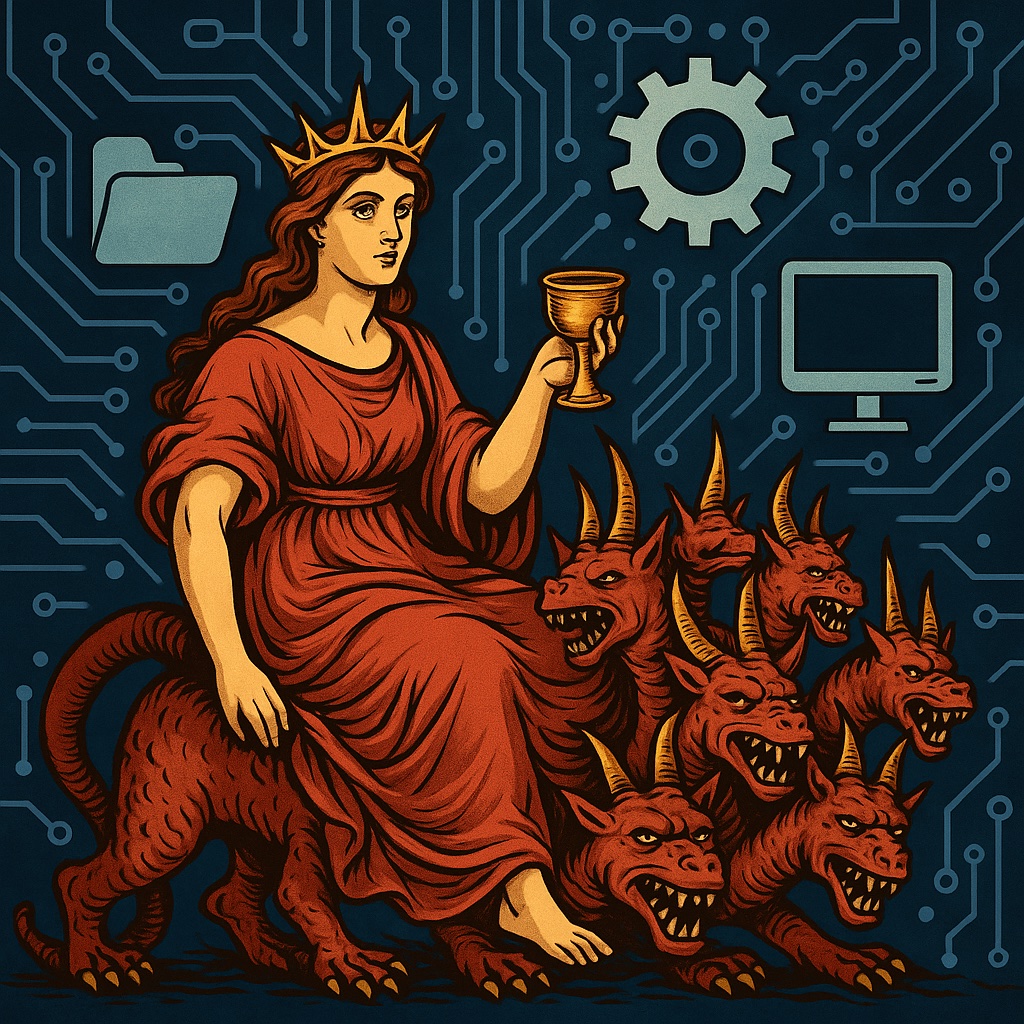
“Mystery Babylon,” that phrase from Revelation, is one of those patterns.
Not a people.
Not a nationality.
Not a modern movement or bloodline.
It is an operating system.
A recurring architecture of power that centralizes authority, shapes narratives, weaponizes debt, and keeps populations dependent. Babylon is not a who. Babylon is a what — a system that outlives every empire that hosts it.
And the uncomfortable truth is that our modern world — our financial system, institutions, and identity rails — runs on this same ancient OS.
This isn’t theology or conspiracy.
It’s simply naming the pattern many intuitively feel:
the world is rigged, but not in the way people think.
This is the pattern behind it — The Babylonian Operating System.
I. What Babylon Actually Is#
To understand Babylon, strip away modern associations.
Don’t picture a country.
Don’t picture a religion.
Don’t picture a shadowy cabal manipulating the world.
Picture an architecture of power.
Babylon was the first empire to fully weaponize:
- centralized authority
- bureaucratic control
- debt as social leverage
- standardized culture
- narrative dominance
- surveillance through record-keeping
Mystery Babylon in Revelation refers to this repeating pattern — the imperial logic that reappears in every era with new faces but the same incentives.
Not an ethnicity.
Not a bloodline.
A civilizational blueprint for domination.
II. The Components of the Babylonian System#
Remove symbolism and focus on structure. The Babylonian OS has several consistent components:
1. Centralization of Authority#
Power collects upward. Accountability disperses downward. A small center governs a wide periphery.
2. Debt as the Foundation of Order#
Ancient Babylon discovered something profound:
A person in debt behaves predictably.
A nation in debt becomes compliant.
Modern systems took this further: they made debt the basis of the entire economy.
3. Narrative and Information Control#
Babylon didn’t dominate with swords alone.
It dominated with stories — imperial decrees, spectacle, ritual.
Today we call it media and “trusted institutions.”
4. Standardized Culture and Identity#
Babel logic: “One language, one order, one system.”
Uniformity presented as unity.
5. Extraction Upward Through Hierarchy#
From ancient tribute to modern taxation to financialization, everything funnels upward.
6. Replacement of Real Value with Symbolic Value#
Clay tablets → royal seals → central bank notes → digital credit.
The symbols change, but the logic remains:
those who control the symbols, control society.
III. Easy Credit — The Softest, Most Effective Chain#
Of all Babylon’s mechanisms, easy credit is the most deceptive — because it feels like empowerment.
We are conditioned to believe:
- credit is normal
- credit is necessary
- credit fuels growth
- credit is opportunity
But historically, credit was rare and used cautiously.
Babylon flipped this.
It made debt the gatekeeper to progress.
And our fiat system perfected it:
**Modern money is not backed by value.#
It is debt.**
Every dollar is:
- created through lending
- issued as a liability
- born as someone’s obligation
This is why inflation is permanent
and why the system cannot function without new borrowing.
Personal debt enslaves the individual.
Systemic debt enslaves the civilization.
That contradiction —
“avoid debt personally, rely on debt collectively” —
is the core of the Babylonian OS.
IV. Why Scapegoats Miss the Point#
Every era blames:
- families
- bankers
- nations
- religions
- political groups
But all of these are distractions.
**Babylon is not a demographic.#
Babylon is what happens to any demographic placed inside a centralized system.**
Empires rise and fall, but the operating system persists.
Blaming groups oversimplifies a structural, ancient pattern.
It is emotionally satisfying but architecturally wrong.
The real villain is not a “who.”
The real villain is centralized incentives.
V. Babylon Beyond Rome — A Global Pattern Before Globalization#
It’s also important to recognize that when John wrote Revelation, Rome did not control the entire world. Far from it.
The Parthian Empire ruled Persia and Mesopotamia.
The Kushan Empire flourished in India and Central Asia.
And the Han dynasty governed China with a highly advanced imperial bureaucracy entirely outside Roman influence.
These civilizations were not conquered by Rome — yet many of their internal structures mirrored the same pattern:
- centralized authority
- imperial bureaucracy
- debt-based control
- enforced hierarchy
- narrative or ideological uniformity
- extraction of wealth toward a ruling center
In other words, they were running their own local versions of the same operating system.
This reinforces a crucial point:
Mystery Babylon is not Rome. Rome was simply the Western host at that moment in history.
The “Babylonian Operating System” predates Rome, outlives Rome, and appears wherever power centralizes — Persia, India, China, medieval monarchies, later caliphates, modern nation-states, and today’s global credit-surveillance order.
John wasn’t describing a single empire.
He was revealing the architecture behind all empires.
VI. Bitcoin and the End of Debt-Money#
Bitcoin is misunderstood because it refuses to follow Babylon’s rules.
Bitcoin:
- is not debt
- has no issuer
- cannot be inflated
- pays no interest
- cannot be printed
- has no hierarchy
- cannot be weaponized
- is neutral, transparent, incorruptible
People ask: “Where is the yield? The dividend?”
But interest only exists in debt systems.
Bitcoin is money, not a liability.
It doesn’t enslave or extract.
It simply exists.
Your wealth grows not by trapping others in obligation,
but by the system’s honesty, scarcity, transparency, and integrity.
Bitcoin is the first modern monetary architecture that rejects the Babylonian model entirely.
VII. Breaking the Information and Identity Layers#
Money isn’t the only place where the Babylonian OS operates.
It also rules through:
- centralized identity
- platform dependence
- surveillance
- narrative steering
- algorithmic shaping
- gatekeeping by institutions
This is why decentralized identity, local-first apps, Nostr, and sovereign publishing matter so deeply.
They break the grip of the OS:
- Nostr decentralizes narrative.
- Self-sovereign identity decentralizes access.
- Local-first systems decentralize data.
- Continuum decentralizes publishing and reputation.
These aren’t tech experiments.
They are exit ramps.
VIII. Personal Reflection#
I’m not writing this from a throne of financial sovereignty.
I’m writing from inside the machinery:
- mortgages
- credit strain
- inflation
- cash-flow pressure
- systems that punish saving
- systems that demand dependence
This is exactly why the pattern is so visible:
when you live inside a Babylonian architecture,
you recognize its shape immediately.
Seeing the system doesn’t require escaping it first.
In fact, those inside it often see it most clearly.
Building sovereignty tools is my way of naming the pattern —
and slowly stepping out of it.
VIIII. Conclusion — Come Out of Her#
“Come out of her, my people…” is not a call to relocate.
It’s a call to exit the pattern:
- exit the debt-growth model
- exit dependence
- exit false narratives
- exit centralized control
- exit systems designed for extraction
And step into sovereignty:
- honest money
- open protocols
- self-custody
- truth
- transparency
- decentralized identity
The Babylonian Operating System is ancient and resilient.
It reappears whenever power centralizes.
But for the first time in centuries,
we finally have the tools to leave it behind.
Bitcoin breaks the monetary layer.
Nostr breaks the narrative layer.
Continuum breaks the identity and publishing layer.
Sovereignty begins one choice at a time.
Acknowledgement#
This article was drafted with the help of Dr. C — GPT-5, which I use as a co-writer and collaborator in developing ideas around sovereignty, Bitcoin, decentralization, and theology.
I dedicate this work to the Holy Spirit, who continues to inspire me and open my imagination. If there is any light in these words, it comes not from me but from the Spirit who gives them. To Him be the glory.
Zaps Appreciated#
If this resonates, consider sending a zap. Every zap is an act of sovereign support — no middlemen, no gatekeepers. Thank you.
Lightning address: andrewgstanton@primal.net
Copyright#
© 2025 Continuum — All rights reserved.
Comments
No comments yet. Start the conversation.