Direct Answer: Power users eliminate brittle cloud webhooks and runaway agent loops by utilizing aiFetchly’s native Task Scheduler. By pairing local Cron triggers and event-driven task dependency chains with hard circuit-breaker safeguards—including max tool call ceilings and risk-categorized tool allowlists—teams deploy reliable, self-governed autonomous agent workflows directly on their workstations.
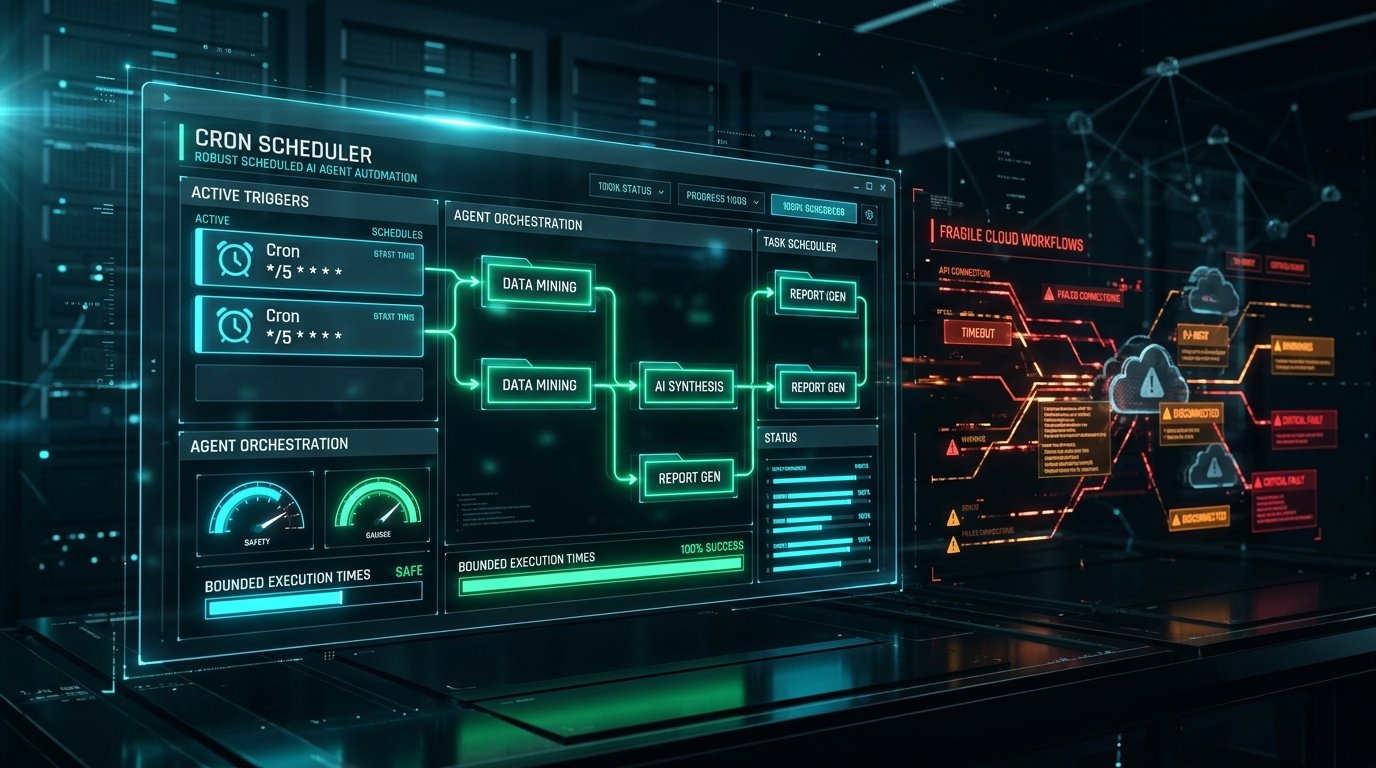
In 2026, automation power users encounter a critical dilemma when scaling autonomous AI workflows: unreliability. Cloud-hosted automation services (like Zapier or Make) rely on fragile webhooks that break whenever third-party endpoints change or network timeouts occur.
Worse yet, running autonomous agents unattended poses serious financial and operational hazards. Without strict circuit-breakers, an AI agent encountering an unexpected API response can easily enter a recursive "runaway loop"—burning through thousands of API tokens, thrashing local files, or hammering external endpoints with unauthorized retries.
The aiFetchly desktop platform resolves these vulnerabilities by embedding a deterministic, local-first Task Scheduler equipped with native dependency chaining and automated agent guardrails.
The Problem: Silent Webhook Failures & Runaway Agent Loops#
Traditional cloud automation treats agentic reasoning as a black box on a simple timer. When a scheduled scraper feeds unexpected HTML into an unconstrained agent, two failures commonly emerge:
- Broken Sequential Dependencies: Fixed timer intervals risk starting synthesis jobs before upstream data extraction finishes, resulting in corrupted datasets or half-empty reports.
- Infinite Error Recursion: If a tool fails, models frequently attempt hallucinatory corrective cycles, racking up massive token costs before human operators even notice.
The Solution: Deterministic Triggers & Chained Pipelines#
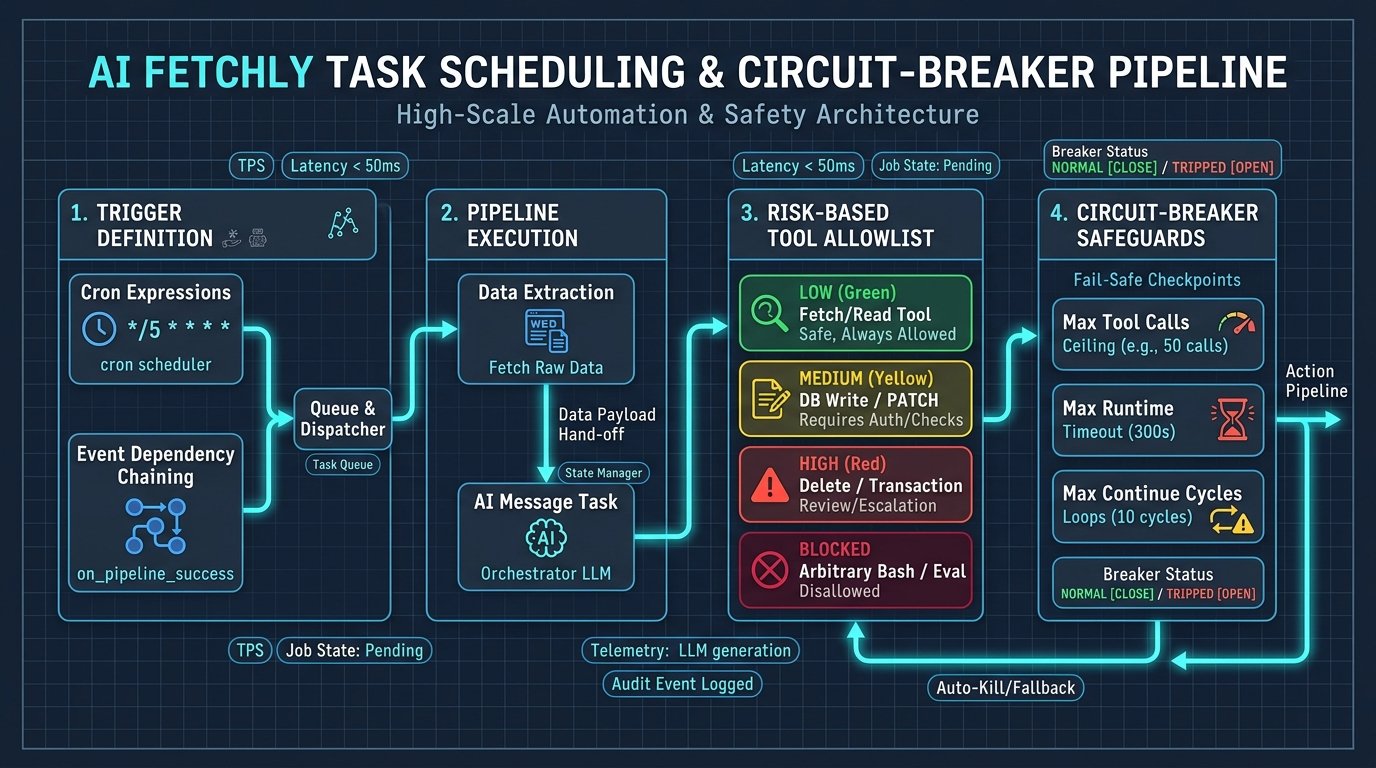
As detailed in the Task Scheduling documentation, aiFetchly structures scheduled automation through three deterministic trigger models:
- Cron Triggers: Execute recurring jobs using standard Unix cron expressions (e.g.,
0 8 * * 1-5for weekday morning data pulls). - Dependency Triggers: Create event-driven directed acyclic graphs (DAGs). Task B triggers automatically the moment Task A successfully completes, eliminating arbitrary timing buffers.
- Manual Overrides: Test full execution chains with single-click manual runs before enabling unattended background schedules.
Dedicated AI Message Tasks & Hard Circuit-Breakers#
When scheduling an AI Message task, aiFetchly surrounds the model with rigorous operational boundaries:
- Multi-Line Agent Prompting: Define comprehensive analysis prompts, such as parsing daily directory extracts and ranking high-value leads.
- Color-Coded Tool Allowlists: Filter tool execution by risk level—granting Low (green) read-only tools, restricting Medium (yellow) database operations, and strictly blocking dangerous terminal commands.
- Hard Execution Ceilings: Set explicit circuit-breaker limits: Max Tool Calls (e.g., ceiling of 10), Max Runtime (timeout at 300 seconds), and Max Continue Cycles (10 loops). If the model exceeds any ceiling, the scheduler safely terminates the turn and flags the audit log.
By combining deterministic local triggers with hard runtime guardrails, aiFetchly enables power users to run autonomous background workflows with complete reliability and peace of mind.
aiFetchly is a local-first desktop AI business agent (free to download). Home: aifetchly.com · Task Scheduling docs: docs.aifetchly.com/docs/automation/task-scheduling
Comments
No comments yet. Start the conversation.