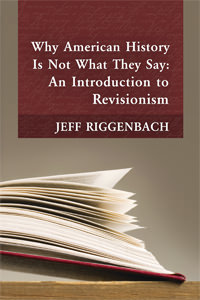

Jeff Riggenbach's 2009 book argues that every account of the American past is a selection. Readers who see how a selection was made, he holds, can judge rival histories by a better test than claimed neutrality. Riggenbach writes from an openly libertarian position. The book guides readers through the revisionist historians and novelists he admires, moving from the theory of historical knowledge through fiction and a family tree of scholars to wars, party labels and school textbooks. The connections it draws between those subjects make it useful. So does the standard of fairness it proposes at the end, which is sharp enough to apply to the book itself.
The opening chapter starts from Peter Novick's That Noble Dream, which won the American Historical Association's 1989 prize for the best book in American history. Novick held that historians pick a small portion of countless true facts, put some at the center, push others to the margins and arrange them all, and that these choices largely decide the picture that emerges. Riggenbach adds an earlier step: the facts have to be established before anyone can select among them. On this view interpretation is unavoidable, and so is the work of establishing evidence. A reader leaves the chapter asking of any history what it centered and what it set aside.
That premise lets Riggenbach narrow the distance between historian and novelist. He reads Kenneth Roberts and John Dos Passos, then gives a full chapter to Gore Vidal's American Chronicle novels, among them Burr and Lincoln. If arrangement shapes every history, a novel built on documents makes historical claims that can be weighed against its sources. The book quotes the revisionist historian James J. Martin saying that Vidal "understands history as well as anybody I've ever known." Whether particular scenes hold up is left for readers to settle against the documents.
Chapter three defines revisionism through its practitioners. Harry Elmer Barnes called it "the readjustment of historical writing to historical facts." William Appleman Williams, writing in 1973, argued that new documents rarely overturn a field, and that the revisionist "sees basic facts in a different way and as interconnected in new relationships." Riggenbach traces three lines: Progressive historians such as Charles Beard and Barnes, the New Left around Williams, and libertarians including Martin and Murray Rothbard. These groups split over domestic policy and joined in opposing American intervention abroad. Chapter four applies their readings to the Civil War, both world wars and the Cold War, and its judgments of responsibility come from Riggenbach and his sources. Chapter five makes the most contestable move. It sorts politics by liberty and authority, places progressivism, New Left thought and libertarianism together "on the Left," and rereads Hoover, Goldwater and Reagan on those terms. A reader can reject the classification and still drop the habit of predicting a historian's method or allies from current party labels.
The final chapter explains why these disputes converge on textbooks. Riggenbach cites a report by Gary Kornblith and Carol Lasser in The Journal of American History: most teachers of college survey courses in United States history assign a textbook as core reading, and many assign nothing else. The campaign against Rugg's textbook series shows that channel under pressure. As the book recounts it from Diane Ravitch and other sources, the Advertising Federation of America, the American Legion, the National Association of Manufacturers and a Hearst columnist attacked the books, and school boards banned or withdrew them. Sales fell from 289,000 copies in 1938 to 21,000 in 1944. These figures describe their own periods, and the preface's claim that textbooks hold all the American history most graduates encounter is Riggenbach's generalization. The mechanism outlasts the dates: whoever shapes adoption decisions shapes the account students inherit.
The conclusion applies that lesson to historical writing. Riggenbach agrees with Novick that history cannot be neutral, then adopts Thomas Haskell's standard of fairness: a strong argument shows "its respectful appreciation of the alternatives it rejects," and takes account of objections that issue from "the rival's position, understood as sensitively and stated as eloquently as the rival could desire." The same standard marks the book's limit. Riggenbach maps a chosen tradition and judges historians by their regard for individual liberty. He portrays Larry Schweikart and Michael Allen's history as resting on a worldview in which any particular individual's freedom carries no weight. He also reports Richard Gamble's 2003 criticism of Thomas DiLorenzo's citations and then rules the cited errors trivial. Readers can ask whether Schweikart, Allen or Gamble would recognize their positions in those pages, and the footnotes lead to the texts needed to decide. Together, Haskell's test and the first chapter's insistence on establishing facts leave room to rank accounts by evidence and fairness after neutrality is given up.
The book suits readers who want an argued route into revisionist historiography and its bibliography, along with a working test for any history they pick up. Some background in American political history helps, and its political references belong to 2009. Read it with the footnotes in hand, starting with Novick and the historians Riggenbach criticizes as well as those he praises. The Mises Institute's PDF of the 2009 edition carries a Creative Commons Attribution 3.0 notice.
The same PDF can also be downloaded from three identical, unmodified copies: Towards Liberty's server, nostr.download and 24242.io. Each file is 3,235,143 bytes with SHA-256 52639ce8b2ac5d78512e1203f3db5801b4217758fba5117d449562e9c169142f. Why American History Is Not What They Say: An Introduction to Revisionism is by Jeff Riggenbach, published by the Ludwig von Mises Institute in 2009 (ISBN 9781933550497), copyright 2009 Jeff Riggenbach, and licensed under Creative Commons Attribution 3.0. The copies reproduce the file without changes, and hosting them implies no endorsement by the author or the publisher.
Comments0
No comments yet. Start the conversation.