Cryptography is built around an asymmetry: you can publish something that proves who you are, without giving away the secret that generates it. Biology does something strikingly similar.
A living cell holds a blueprint (DNA), executes it through a pipeline of transformations, and produces highly specific outputs (proteins) that can be recognized, compared, and validated. The relationship between DNA and protein has the same “easy forward / hard backward” shape that makes public-key cryptography work.
This article builds an analogy:
- The active DNA strand is like a private key.
- The resulting protein is like a public key.
- And a stimulus-driven protein response can be framed as a kind of signature that others can verify without learning the original DNA.
The private key: the active DNA strand#
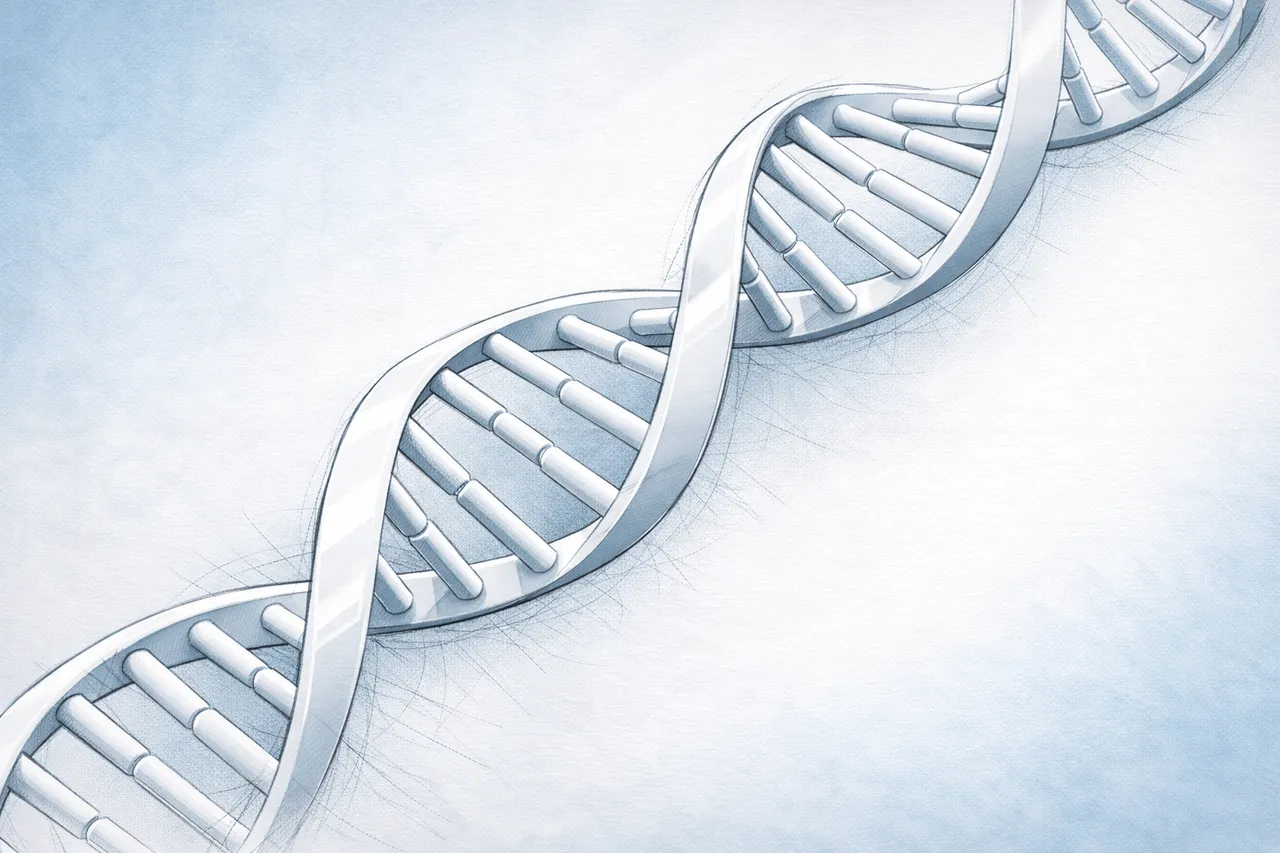
DNA is double-stranded, but when a cell actually “uses” a gene, it doesn’t read both strands. Transcription machinery selects one strand as the template strand and reads it to produce messenger RNA (mRNA), which later gets translated into a protein.
Functionally, that template strand has three key properties:
- It’s the source of truth for what the cell will produce.
- It stays protected and internal (inside the nucleus in eukaryotes).
- It drives a deterministic process: sequence → mRNA → amino acid sequence → protein.
That’s exactly how a private key behaves in cryptography: secret, protected, and the ultimate origin of an output others can validate.
So in the analogy:
Active DNA strand ≈ private key
The public key: the protein#
Proteins are not vague blobs; they’re sharply defined objects. Each is a specific amino-acid sequence that folds into a specific 3D structure. That structure determines what it binds to and what it can do.
Two important consequences follow:
- Proteins are comparable. You can tell whether two instances match (same protein) or differ (mutation, modification, different isoform).
- Small differences matter. A single amino-acid change can alter folding, binding affinity, stability, or function.
That makes a protein a good stand-in for a public key: something derived from a secret source, stable for that source, and usable as a public identifier.
Protein ≈ public key
And, like cryptography:
- Forward is easy: private key → public key; DNA template → protein.
- Backward is hard: public key → private key is infeasible; protein → exact original DNA strand is difficult in practice (️especially when you consider folding, modifications, redundancy in genetic code, and regulation).
The one-way vibe: why “guessing the DNA from the protein” is hard#
In public-key crypto, the public key is designed so you can’t “reverse” it to get the private key. Biology isn’t mathematically one-way in the same strict sense, but the directionality is real in practice:
- DNA is long, combinatorial, and context-dependent.
- Proteins are shaped by folding constraints, chaperones, and post-translational modifications.
- Different DNA sequences can map to the same amino-acid sequence because of codon redundancy.
- The cell doesn’t just “print proteins”; it regulates when and how much.
So while biology doesn’t promise cryptographic hardness, it exhibits the same asymmetry: it’s vastly easier to go from DNA to protein than to infer the exact DNA source from the protein alone.
Now the missing piece: what is signing?#
Here’s the core of digital signatures:
- You have a message.
- You use your private key to produce a signature over that message.
- Anyone can use your public key to verify the signature.
- Verification confirms two things:
- the message hasn’t been altered
- it came from the private key holder
To extend the analogy, we need biological versions of:
- message
- signing
- verification
In biology, a signature is not a separate “token.” It’s a specific response that could only have been produced by the underlying DNA + machinery, and it’s verified by the success of precise molecular interactions.
The message: a molecular event#
In a cell, “messages” are everywhere. A message can be:
- a signaling molecule arriving at a receptor
- a change in nutrient levels
- oxidative stress
- a pathogen fragment
- DNA damage
- a developmental cue
It’s an input condition the cell must respond to.
Cellular stimulus ≈ message
The signature: a stimulus-specific protein response#
When the cell receives a stimulus, it often responds by expressing a particular gene (or set of genes). That expression produces specific proteins—or specific modifications of proteins—that implement the response.
This is the biological analogue of computing a signature from a message:
- The stimulus selects a pathway.
- The pathway causes transcription of specific genes.
- The template DNA is read.
- The cell produces a protein response that is highly specific.
Stimulus-driven expressed protein ≈ signature
This “signature” has a crucial property: if it’s present and functional, it strongly implies the existence and integrity of the DNA template that produced it, just as a valid digital signature implies the signer had the private key.
Verification: binding specificity is signature checking#
Digital signature verification is a deterministic test: given a message, a signature, and a public key, you check whether they match.
Biology does verification through molecular recognition:
- Enzymes recognize substrates and catalyze specific reactions.
- Antibodies recognize antigens.
- Receptors recognize ligands.
- Protein complexes assemble only when shapes and interfaces match.
That selectivity is the physical version of “verification.”
A protein that is slightly wrong—wrong fold, wrong interface, wrong active site geometry—often fails to bind or fails to function. In other words, the signature doesn’t verify.
Specific binding / catalytic success ≈ signature verification
The “public key” role here is played by the protein’s externally testable properties: its structure, its binding profile, its function. You don’t need to see the DNA to validate the outcome. You just need to test whether the protein behaves exactly as expected.
The full mapping#
Here’s the analogy, end-to-end:
- Private key → active DNA template strand (hidden source)
- Public key → resulting protein (publicly testable identity)
- Message → stimulus or molecular event
- Signature → expressed protein response (or a specific protein modification) produced in response to the message
- Verification → binding specificity / catalytic correctness that confirms authenticity
A compact phrasing:
DNA is the private key. Proteins are public keys. A stimulus causes the cell to “sign” by producing a specific protein response. The protein’s ability to bind and function correctly is how the environment “verifies” the signature—without learning the DNA itself.
Where the analogy is strong (and where it isn’t)#
This analogy works well because both systems emphasize:
- one source → one stable public identity
- public verifiability
- tamper detection (mutations break function the way key mismatches break verification)
- asymmetry (forward easy, backward hard)
Where it diverges:
- Biology is not designed for cryptographic hardness; it’s designed for survival and robustness.
- Regulation and context matter; the same DNA may not be expressed at the same time.
- There’s redundancy and noise—biology tolerates some error, crypto generally does not.
Those differences don’t kill the analogy. They just show that biology is a messy, evolved cousin of a clean mathematical concept.
Closing: what this analogy buys you#
Public-key crypto enables maintaining an identity, proving authorship, and verifying integrity without exposing the secret key. Biology, at a different scale, does the same thing: a cell’s hidden template produces stable, verifiable artifacts whose correctness can be tested by interaction.
And that’s a useful lens—especially if you’re building systems (like Nostr) where identity is fundamentally key-based and authorship is fundamentally signature-based.
In that world, it’s natural to say:
- your private key is the strand you never expose
- your public key is the artifact everyone can compare
- your signature is the irreversible proof that you generated the event
- and verification is simply checking: Does it bind? Does it match? Does it work?
In both cases, the idea is to propagate a stable identity through time and space.
Comments
No comments yet. Start the conversation.