

Oct 11, 2026 · npub17veg2gt7ja4dnjhs23jyttvpqlde3ajevlxuumxwghnqmgqwuv4q78cc5z
Idolatry is worse than carnage.
Qur'an 2:191, in N. J. Dawood's translation, the first epigraph to Iain M. Banks's Consider Phlebas (1987)
Gentile or Jew O you who turn the wheel and look to windward, Consider Phlebas, who was once handsome and tall as you.
T. S. Eliot, The Waste Land (1922), the novel's second epigraph
1. It arrived through the questions#
The machine was in every room I entered in the first week of October 2026, though it was rarely on the program. At the Usuli Institute's third annual conference in Columbus, Ohio, held under the banner "Escape to Usuli," it arrived through the questions. In the session on Epstein, the Kiswa and political tyranny, someone asked how Muslims should answer the ideas circulating among the technology oligarchy: hyperstition, accelerationism, AI doomerism. Khaled Abou El Fadl said he finds artificial intelligence, for the most part, a source of ugliness, but that it had lately done something beautiful, setting classical devotional poetry about the Prophet to music so that old praise could be heard again.
The next day Bikrum Gill was asked about Nick Land, accelerationism and AI. "On the question of AI, I don't know much," he began, and then offered a thesis anyway: AI is "fundamentally a process of market manipulation," bound up with AI targeting in Gaza and with a war economy "collecting data by war," and it must be "subordinated to our needs." Cyrus Zargar, lecturing on the ethics of Karbala, described modern warfare as "robotic," mediated by "level upon level of absent decision-makers," with no one present to grant mercy. I quote all three from machine-made transcripts of the sessions, which is the first of this essay's debts to the systems it judges. It is not the last: I wrote this essay with an artificial intelligence, and I have kept a record of what it did and what I decided.
After one session I fell into a conversation about Iain M. Banks: how he imagined a benevolent artificial intelligence, and how his machine Minds treat the humans in their care. The first Culture novel, Consider Phlebas, tells of a war between a civilization that has handed its judgments to those benevolent Minds and a theocratic empire that thinks the surrender an abomination worth any carnage to undo. Banks opened that novel with the two epigraphs that also open this essay, and so posed its question before his story began.
The machine sits at the center of the other milieu I examine here: SAIF. The Society for an Alternative Islamic Futurology writes about artificial intelligence as the terrain of the self and the medium of the coming age. Ibn Maghreb, the pseudonymous author of the Iqra Files, and the most prolific writer in SAIF's orbit, ends a note on the Epstein emails with a system that keeps optimizing itself "while awaiting the arrival of the Machine God." And during the war on Iran this spring, some of the most widely shared images of the conflict were AI-generated films in the style of Lego movies, made by an Iranian outfit that counts the government among its customers.
The conference also showed what presence costs. It gave its humanity award to the Palestinian Feminist Collective, whose members accepted it by video because they could not get visas. Presence is expensive, and the bill falls unevenly.
My argument is that every party in this field is tempted by the same idol: a judge that no one controls. Usuli remembers it in the classical jurist. SAIF means to conjure it as the Mahdi and fears it as the Machine God. The present sells it as AI, an arbiter that seems to belong to no one and is in fact owned. Against the idol the tradition offers three truths. The first absence disciplines: final judgment belongs to God alone, so every human judge is provisional and answerable. The second presence absolves: algorithmic judgment produces what Hannah Arendt called rule by Nobody, a tyranny without a tyrant. And refusal costs, because judgment without enforcement is a sermon, and enforcement without restraint becomes the oppression it opposes. What the field lacks I will call trustee judgment: judgment held as a trust, exercised in presence, formed by practice, and answerable to a final audit that no one on earth conducts.
2. Idolatry is worse than carnage#
Banks's epigraph has a pedigree. He took it from N. J. Dawood's translation of the Qur'an for Penguin Classics. The Arabic of 2:191 says that fitna is worse than killing, and fitna is one of the Qur'an's widest words. In his Jāmiʿ al-bayān, al-Ṭabarī glosses it here as shirk, associating partners with God, and as kufr, disbelief, so Dawood's rendering stands in a real line of interpretation. Most modern Muslims hear the verse another way, as a judgment that persecution and strife are worse than killing. And the word's first sense is older than either: a trial, a temptation, the heat that tests metal, as when the Qur'an calls wealth and children a fitna (8:28). I need all three senses here, the idol, the strife, and the seduction that leads from one to the other.
The verse sits inside a passage about war, and the passage does not flinch. "Fight in the way of God those who fight you, but do not transgress; God does not love the transgressors" (2:190). Fighting goes on until there is no more fitna, and if the enemy stops there is to be no hostility except against wrongdoers (2:193). Islam does not shy away from fighting. What it asks is that the fighter not transgress.
The Qur'an also knows that killing belongs to the human condition. When God announces that He will place a khalīfa on the earth, the angels object that this creature will spread corruption and shed blood. God does not deny it. He says, "I know what you do not know," and teaches Adam the names of things (2:30–33). The vicegerent is chosen knowing he will shed blood. What qualifies him is knowledge, and the trust (amāna) that the heavens, the earth and the mountains declined and the human being took on, unjust and ignorant as he was (33:72).
That trust is laid on everyone who judges. "God commands you to render trusts to whom they are due, and when you judge between people, to judge with justice," says 4:58, and the "you" is plural. When the next verse commands obedience to "those in authority among you," Fakhr al-Dīn al-Rāzī argued that since the obedience is unconditional, the authority meant must be the binding consensus of those who loose and bind rather than any single person. On his reading authority belongs to a process, and the trust of judgment belongs to no class of trustees in particular.
Machines that name, classify and predict now exist, and in a narrow sense they know the names. They do not bear the trust: they cannot be blamed, and they cannot repent. When a state hands a targeting system the choice of whom to kill, it is trying to hand back the trust the mountains refused, to something that cannot hold it. The angels feared a vicegerent who would shed blood. The newer danger is bloodshed with no vicegerent present at all.
The Qur'an's case against idols is materialist, and it is also funny. Abraham asks his people whether they worship what they have carved themselves (37:95). After smashing their statues he leaves the biggest one standing and tells them to ask it who did it, if it can speak (21:63). The idol is a made thing whose power is borrowed from those who serve it. So is the machine: capital spending, procurement contracts, data centers, mines, and the labor Kate Crawford traces beneath the appearance of a weightless intelligence. Ask the model who did it and it will answer fluently, and name someone else, as one did after the massacre at Bondi Beach in December 2025. Calling the algorithmic judge an idol is a way of asking, with Abraham, who carved it and who profits from its worship.
Banks's novel stages all three senses. The Culture's citizens live in comfort under their Minds and let them decide, which is the seduction, and the Idirans make war on the Culture for that surrender, which is the strife. In Look to Windward, titled from the same lines of Eliot, Banks returned to the war eight centuries on. A Culture world commemorates the innocent dead with a new symphony, its governing Mind grieves the deaths it caused as a warship, and an envoy arrives on a mission of revenge from a people whose civil war the Culture admits it fomented. Eliot addresses "you who turn the wheel and look to windward," the steersman, kybernētēs, the word Norbert Wiener borrowed to name cybernetics. Banks set a warning against idolatry beside a warning to the helmsman, and this essay tries to read the two together.
3. Sorting is already judging#
Judgment comes in at least four kinds. Epistemic judgment decides what is the case: whether a report is true, a document authentic, a man the person in the photograph. Legal judgment decides what a rule requires in a given case. Moral judgment decides what is owed, and it includes the power of exception, to pardon, to spare, to show mercy. Final judgment decides what a life amounts to, and the tradition reserves it for God.
The jurists worked with distinctions like these. Shihāb al-Dīn al-Qarāfī separated the jurist's opinion, which informs, from the judge's ruling, which binds, and both from the ruler's discretion. Sherman Jackson, building on al-Qarāfī at the conference, drew a further line between questions of law and questions of fact, which the revealed law leaves to those who know the facts. On his account the law is total in its scope and bounded in its kind.
Most of what artificial intelligence does belongs on the side of fact: sorting, matching, predicting, translating. Al-Ghazālī classed sciences of this kind, medicine and arithmetic among them, as communal obligations (farḍ kifāya), duties the whole community fails if no one in it masters them. By that standard competence in machine learning is a duty Muslims owe themselves, and SAIF's insistence on understanding the infrastructure of the age is closer to a religious obligation than the conference allowed.
Zargar's lecture supplies the outer boundary. On his reading of Karbala, moral judgment is learned by mirroring a present exemplar, and its highest act is an exception granted by someone who is there. When the infant was brought before the army, no one present could grant mercy, because the decision had been made elsewhere, by someone absent. Miskawayh, whose ethics stands behind much of the tradition Zargar studies, called the craft of character the noblest of crafts, since its material is the human being. A machine stands at no one's side. It cannot grant an exception it was not built to grant, and an exception that has been built in is a rule, not a mercy. Arendt reached the same boundary from another direction, calling judgment the faculty of the particular case, exercised among others.
One kind of judgment escapes this taxonomy, and I have not settled where it goes. Abou El Fadl's example was a judgment of taste: he found the machine ugly, and then found something it made beautiful. Kant built his account of judgment on taste, and Arendt built her account of political judgment on Kant's. Tools of this kind can predict a fitting melody from the rhythms and cadences of the words themselves, and the person using them needs no training in music, only a taste of their own, however undeveloped, to choose among what the tool offers. Taste here stays subjective: Abou El Fadl heard beauty, and another listener might not. Whose taste does the melody express, then: the human music the model learned from, the model's prediction, or the untrained person's choice? I do not know how to divide the credit, but the beauty he heard survives the division, and I leave the question open.
The boundary between fact and worth is a norm, and it has to be fought for, because sorting is already judging. A welfare system's "fraud risk" and a targeting system's "likely militant" are labels of that kind, each with an author somewhere who will not be named. The evidence matrix behind this essay sorted its claims with labels too, and those labels decided what I could print.
A list will not hold the boundary. A procurement schedule of the judgments machines may hold would turn the boundary into procedure, and procedure lets everyone point to the rules instead of answering for a judgment. The line has to be held case by case, by people who answer for where they hold it.
4. The judge who is nobody#
In On Violence, Arendt described bureaucracy as the rule of an intricate system in which no one, neither one nor the few nor the many, can be held responsible. She called it rule by Nobody and thought it perhaps the most tyrannical form of rule, a tyranny without a tyrant. She was writing about offices and files, yet the phrase fits the systems of 2026 better than it fit the bureaucracies of 1970.
The clearest case is killing. In 2024, +972 Magazine and Local Call reported that the Israeli army had used an AI system called Lavender to generate lists of people to be struck in Gaza, with human review reduced to seconds. Among the features the reporting described for flagging a suspect was membership in a WhatsApp group with a known militant. It did not say how the army learned who was in which group, but the detail put WhatsApp, and so Meta, somewhere in the chain. The soldier executes a list, the officer approves a recommendation, the engineer tuned the model, a platform hosted the group that counted against the target, and the judgment that a particular person should die belongs to none of them. The vicegerent appears nowhere in that chain. It is bloodshed arranged so that no one shed it.
The war on Iran supplied a nearer case. On its first day, 28 February 2026, an American Tomahawk struck the Shajareh Tayyebeh primary school in Minab, and a second strike followed; 156 people died, 120 of them children. The Pentagon's preliminary findings, as the New York Times reported them, traced the strike to outdated coordinates, and CNN later reported that the targeting systems had warned their users the information was out of date and that the warnings were ignored. Reporting on the strike names the Pentagon's Maven system, built on Palantir's software and Anthropic's Claude, among the tools in the targeting chain, though how far any of them shaped this strike is disputed. In September a UN fact-finding mission found reasonable grounds to believe the strike was a war crime. A warning that no one heeds is rule by Nobody in its purest form: the system reported what it knew, and no one judged.
The same structure governs lives that are never targeted. Virginia Eubanks has shown how automated systems decide who receives welfare and whose children are taken, judging the people least able to appeal. Ruha Benjamin calls the encoding of old racial hierarchies into new systems the New Jim Code, and Safiya Noble has documented search engines reproducing racist judgments while appearing neutral. In each case a judgment is presented as no one's, made by someone, and paid for by people who never consented.
In the information war, rule by Nobody passes verdicts on meaning. During the war on Iran, an outfit called Explosive Media released AI-generated films in the style of Lego movies that lampooned the American side. They were made in English for Western audiences, partly commissioned by Iranian officials and reposted by state media. One showed missiles inscribed with dedications to victims of American power, under the title "One Vengeance For All." By press estimates, videos in this style drew well over a hundred million views in the war's first weeks. Their makers said the green and red of the animations follow Shiʿi tradition, green for Ḥusayn's fight for justice and red for the oppressor. After Minab, another Iranian studio dedicated a Lego-style film of missile strikes to the school's dead.
Set that beside Zargar's Karbala, where Ḥusayn refuses to be the first to fight. In the films, Ḥusayn's green is painted onto missiles. Abou El Fadl's example showed a machine reviving the beauty of devotional poetry; Explosive Media shows the same kind of machine reviving Karbala as vengeance. The machine chose neither reading. Its commissioners did, and the machine carried their choice past the reach of any judge. Ibn Maghreb, writing before the war, saw where this leads: "Sin becomes tolerable once rendered ironic." A verdict rendered as a joke has no author who must answer for it.
5. One keeps its distance, the other moves in#
Usuli and SAIF stand in very different relations to the machine, and I take the difference as a finding.
The conference keeps its distance. Its speakers treated AI as a tool to be subordinated, a market to be exposed, a source of ugliness with occasional beauty. Heather Laird described algorithmic media that wall people off from one another, and set against them the Prophet's practice of pairing believers as brothers, a community technology of the opposite kind. Jackson's distinction gives the conference a sound place to put the machine, among the arts of fact. What it lacked was the obligation that comes with putting it there. A communal duty to master a technique is not discharged by criticizing it, and the Institute teaches every week on a platform owned by a company at the center of the industry it criticizes.
SAIF moves in. Its writers name the terrain the conference neglects, the stack, the platform, the model, the feed, and some of that is the literacy the communal obligation demands. But part of SAIF has also taken up the machine's methods. Hyperstition, a coinage of Nick Land's circle, the CCRU, names fictions that make themselves real by circulating, and SAIF's guide to what it calls spiritual OPSEC tells members to "draw attention to the Hyperstition, not yourself." Circulation is what the machines of 2026 do best. The same guide tells its readers to stop waiting for the Mahdi and create him instead. Fearing one final figure, the Machine God, while manufacturing another makes for a crowded eschatology, and the crowding has not freed SAIF from the longing it diagnoses.
SAIF is divided over the method, and one of its principal writers says so in public. Eco al-Hollandi, one of its principal writers, sets "joycat SAIF," which stays ahead "by egregores, playing with identity, constantly shifting," against a wing whose list includes opsec, cypherpunk, temperance and refuting. The first, in his words, would "nuke the old earth"; the second would "build the new earth." Ibn Maghreb's note on Bitcoin belongs with the builders. It treats cryptography as a new form of testimony, and testimony cannot share a movement with hyperstition. A signature binds a statement to whoever signed it and can be checked however far the statement travels; a hyperstition is made true by travel alone. One fixes the author and the record, the other dissolves both, which is why the cypherpunk wager breaks with Land's thesis instead of extending it. The Qur'an knows the difference. When a charge against ʿĀʾisha passed from tongue to tongue, it asked why those who heard it did not call it an obvious lie, and why no witnesses were brought (24:12–13).
The conference binds itself more than SAIF does. It names its speakers, publishes its reasoning and exposes itself to correction. SAIF understands the machine better, which makes it indispensable to any serious answer and unfit to supply the answer alone. Where there is a symmetry, it lies in the longing: both want a judge that cannot be captured.
6. There has never been such a judge#
The longing has a history, and the history is a record of capture. Abou El Fadl's account of the classical jurists deserves its full strength. Their authority was persuasive rather than coercive, grounded in expertise and in a discipline of self-restraint before God's law, and plural schools checked one another until the modern state seized the endowments and the courts. Wael Hallaq has traced how little was left afterwards.
Yet the jurists' independence was always partial. Rulers appointed the judges, and the jurists borrowed enforcement from the state they kept at arm's length. The Seljuk vizier Niẓām al-Mulk endowed the Niẓāmiyya madrasas as instruments of policy. Endowment deeds bound their trusts with the founder's stipulations, which by a well-known maxim carried the force of the Lawgiver's own words, and only a judge appointed by the ruler could set them aside. Where the state absorbed the jurists, they became its employees. Where the jurists absorbed the state, as in the doctrine of the jurist's guardianship, the jurist did not discipline power. He became it.
The newest candidate repeats the pattern. "Code is law," Lawrence Lessig observed, and the phrase was taken up by people who hoped code would be a law without lawmakers. Ibn Maghreb's proposal of Bitcoin endowments shares that hope, yet this year's worry is that states will capture Bitcoin through paper claims, identity checks and the exchanges where coins circulate. The models that promise neutral judgment are trained by a handful of companies on data gathered largely without consent. Each of these judges has an owner, only harder to see. There has never been a judge that no party controls, and that is where any honest answer has to start.
7. The first absence disciplines#
If no judge has ever stood outside capture, the tradition's deepest answer may be that none should be expected to. Final judgment belongs to God and is withheld in this world. The Qur'an's Day of Judgment and the Shiʿi doctrine of the hidden Imam each institutionalize that withholding, and every present judge acts in the absence of the final one. The absent judge is no vacancy waiting for an institution to fill it; it is what keeps every institution provisional. This is the opposite of rule by Nobody. God's absence leaves every human judge accountable, because none can claim to be final, while the algorithm's presence leaves everyone unaccountable, because each can point to the system. The first absence disciplines; the second presence absolves.
The absent judge can be abused in three ways. At Ṣiffīn, when ʿAlī accepted arbitration, a party of his own soldiers walked out under the slogan that judgment belongs to God alone. ʿAlī answered that it was a word of truth by which falsehood is intended. The Kharijites refused every human arbitration in God's name, then judged everyone else by the sword, ʿAlī among them. "The data decides" has the same structure: it refuses human arbitration in the name of an impersonal verdict and licenses violence no one owns. The second abuse is the deputy's, who claims the absent judge's authority for himself. The third is quietism, the refusal to judge at all because no judgment is final. The comfortable citizens of Banks's Culture do not worship their Minds; they let them decide. Fitna in its first sense, temptation, names this abuse, and the free tool that saves the trouble of judging is a gift that keeps every lever.
The name of the institute that hosted the conference carries this dispute, though it was chosen for another reason. Usul in its name refers to the Sunni science of legal principles. In Twelver Shiʿi history the same word names the school that won the eighteenth-century argument over judgment in the Imam's absence. The Akhbārīs held that believers should keep to the transmitted reports and, where the reports were silent, suspend judgment. The Uṣūlīs, led to victory by al-Waḥīd al-Bihbahānī, held that qualified jurists must reason and judge in the meantime, and that believers should follow a living jurist of their choosing. Their victory produced the marjaʿiyya, many jurists chosen by followers and none final, which is the closest historical model I know of the judgment I am defending. Two centuries later it also produced the jurist's guardianship. The Akhbārī position is the quietist abuse and guardianship the deputy's, and the Uṣūlī wager, judging in the absence without claiming to fill it, lies between them. Readers who find a Shiʿi genealogy for a Sunni institute's name presumptuous are welcome to say so. What interests me is the wager.
Between the abuses lies arbitration (taḥkīm): provisional human judges, plural and reason-giving, who decide because someone must and know they are not final. Some of the tradition's clearest models are women's. The first judgment in Islam was Khadīja's. When the Prophet came down from Ḥirāʾ afraid for his mind, she judged his experience by his conduct. He kept the ties of kinship, bore the burdens of the weak, honored guests and stood by people in their trials, and she concluded that God would not disgrace such a man. Then she took him to her cousin Waraqa, who knew the earlier scriptures, before staking her fortune on her verdict. A generation later, ʿĀʾisha corrected senior Companions when their reports conflicted with the Qur'an, judging against her own side by reasons anyone could check. The tawhidic paradigm of amina wadud states the principle beneath both. Because God alone is God, no creature may stand over another as its final measure, and that rules out the shaykh, the core, the state and the machine.
Is this liberal proceduralism in Islamic dress, Habermas with a fatwa? Procedure lacks four things. It has no final audit above it. It holds no trust, since whoever follows the rules is absolved. It requires no presence, and it has no place for the exception, because mercy is what procedure is built to exclude. Procedure perfected is rule by Nobody. Arbitration differs because its judges are persons who hold a trust, judge in the parties' presence, can grant the exception, and know they will be judged. Machines can serve it as Waraqa's knowledge served Khadīja's, searching, sorting and testing, while a person who can be named and questioned decides.
8. Refusal costs#
The positive claim can now be stated as a concept. Trustee judgment is judgment held as a trust (amāna), exercised in presence, formed by practice, and answerable to a final audit that no one on earth conducts. Each element is a test. Held: the judge stakes something and answers for the verdict. Present: the judge stands before the judged, where mercy and the exception remain possible. Formed: the judgment has been shaped by practice and exemplars, and can be reshaped by repentance. Audited: the judge knows the verdict is not the last word. The machine fails each test by its nature. It holds nothing, is present to no one, is trained rather than formed, and cannot repent, because nothing in it can turn. No gain in its accuracy will change that. It can serve trustee judgment, as Waraqa's knowledge served Khadīja's, and nothing more.
Trustee judgment without enforcement is a sermon with a docket. The classical jurists borrowed enforcement from the ruler. The diaspora has no ruler to borrow from, and the states it lives in are among those it needs to judge. What remains is refusal. A community can withhold its allegiance, its money, its attention and its labor, and withheld together, with reasons given, they amount to a sanction. Refusing allegiance (bayʿa) was the community's oldest sanction, and Karbala is its most famous use.
Refusal has a history that should temper any enthusiasm for it. The first organized boycott in Islamic history was imposed on the Muslims, not by them: for about three years Quraysh refused to trade with or marry into the Prophet's clan. Refusal is a weapon the strong use too, and usually first. A just refusal is bounded by the restraint it enforces. It takes no captives, starves no one, tells no lies about its targets, punishes no one for what others did, and ends when amends are made. Elinor Ostrom showed how communities govern shared resources without either a sovereign or a market. They set their own boundaries, appoint monitors who answer to members, impose sanctions that rise by degrees rather than casting people out, and nest small bodies inside larger ones. Graduated sanctions answer the danger the conference's clinicians described, communities that punish their own members in the name of protecting them. Nesting answers scale, and the question of who organizes a refusal without a secret core.
The boycott also shows who pays. Khadīja's fortune kept the boycotted clan alive, and she died soon after it ended. Abou El Fadl closed the conference with a preacher's estimate, offered to provoke, of what she and Abū Bakr gave in today's terms: eight to ten million dollars and six to eight million, for a community of perhaps eighty to two hundred. The lesson is sharper than the sums. Khadīja's gift made the giver poorer and the community freer, and it was the first strike fund in Islamic history. A patron's gift keeps a lever. The test for any institution is whether its gifts leave levers behind, and whether anyone stands above the gift to judge it.
That test applies to the Institute that hosted the conference. The weekend raised more than a hundred thousand dollars. I do not know how concentrated its donors are or who could tell a large donor no. The Institute can answer, and an institution whose founder preaches the Khadīja test should publish its answers. The weekend produced a smaller exhibit too. By its end, the sermon's verse of replacement, "if you turn away, He will replace you with another people" (47:38), was being read as a promise that the young would replace their passive elders. A verse of judgment circulated for three days without anyone to say whom it judged.
Machines test the theory at its limit. No community can govern a frontier model whose training costs billions. It can govern more than it assumes: which open-weight models it runs, data trusts that hold its members' records under its own rules, cooperative computing on shared hardware, the procurement rules of the institutions it funds, and the refusal to feed its children's attention to systems it cannot audit. These are partial answers to an infrastructure that others own.
9. Run the tests#
An essay that judged structure but not conduct would commit the quietism it condemns. The war of 2026 put conduct on every party's docket, and each verdict below carries the refusal it implies.
Gill argued from the conference stage that the human rights tradition recognizes the suffering of the colonized but not their sovereignty, and so leaves them "beggars." Bartolomé de las Casas condemned Spanish atrocities in the Americas but never Spanish sovereignty, and Gill named the pattern after him: the Las Casas Paradigm. Extended one step, the argument becomes an objection to restraint itself: a stronger party can count on its opponent's restraint while the law records the dead and enforces nothing. The objection is right about the world and wrong about the remedy, and Gill's own talk shows why. He described the strike on the school in Minab as the deliberate killing of schoolchildren, an appeal to civilian immunity, the very norm the paradigm seems to dissolve. Restraint without an enforcer favors the stronger, but that does not license the weaker to transgress, and the norm cuts both ways once means are counted honestly. If sanctions and sieges are structural violence, so are the closure of a strait and attacks on merchant crews and airports. Iran closed the Strait of Hormuz at the end of February and attacks the ships that defy the closure. In the week that ended 4 October, eleven tankers were attacked there, the most since the war began, many of them running with their transponders off to avoid becoming targets; by the International Maritime Organization's count, at least twenty-four sailors have died in attacks on a hundred commercial ships since February. The Houthis, besides blockading Saudi-linked shipping at Bab el-Mandeb, have declared all Saudi airspace outside Mecca and Medina a theater of their operations, and on 10 October a strike on Riyadh's international airport killed at least twelve people and shut it down. The costs fall on sailors and travelers, and on fuel and food far from any battlefield. A criterion that counts only the adversary's structural violence is not a criterion.
Asked at the conference about Iran's internal oppression, Gill answered that critics not working to end sanctions have no standing to ask. He likened Iran to blockaded Cuba and called for "breathing space," because "we cannot have these debates without sovereignty." Gill was deferring judgment, which is a different thing from praising what it defers. But deferral is still a decision about whose judgment waits, and the people asked to wait are Iranians living under that state. The refusal it implies is modest: those who share Gill's cause should withhold their deference on this one point, and keep asking.
Ibn Maghreb's note on what he calls the Sinwar Wars reads October 7 as an accelerationist strike that broke the region's cybernetic order, and it never mentions the civilians killed or taken captive that day. Killing and seizing civilians is transgression by the measure of 2:190. The classical law of rebellion, which Abou El Fadl himself reconstructed, bound rebels and rulers alike: captives were not executed, and property was returned when the fighting ended. A theory that celebrates the strike and omits its captives has exempted its own side. The refusal it implies is the withdrawal of the attention and admiration on which such writing lives.
Explosive Media's charge falls on those who commissioned its films and on Muslims who share them in Ḥusayn's name. A movement that remembers Karbala as Zargar does, as the refusal to strike first, should refuse to let a machine render that memory as vengeance.
One case can be followed all the way through. On 14 December 2025 two gunmen, a father and son, opened fire on a Hanukkah gathering at Bondi Beach in Sydney and killed fifteen people. Australia's federal police commissioner called it a terrorist attack inspired by the Islamic State. A couple in their sixties died trying to stop one of the gunmen. A Syrian-born shop owner named Ahmed al Ahmed crouched behind a car in the car park, crept up behind one of the gunmen, unarmed, and wrestled the rifle from his grip. He was shot twice, in the shoulder and the hand, and survived surgery to face months of recovery. His cousin said Ahmed told him that God had granted him the courage to jump on the gunman.
In the hours that followed, two other kinds of judge went to work. X's chatbot, Grok, credited Ahmed's act to a man who apparently did not exist and questioned whether the footage was real. And a false identification spread: a British influencer known for nationalist politics, who had nothing to do with the attack, was named as the gunman. The false name pointed away from the actual attackers. Reuters's fact-checkers documented the misidentification. One of the original posts survives, and I cite an archived copy of it rather than the account that posted it, which I know to belong to SAIF's network and which is named for joycat, a method one of SAIF's principal writers names in public. SAIF's members claimed the operation in private group chats I have seen, and its core told me the target was chosen deliberately. The public documents establish the misidentification. SAIF's authorship rests on those chats, on my testimony and on the account's name, and the deliberateness of the target on my testimony alone. The rows below carry those statuses, and I have lowered the claim to what they bear.
| Sorting | Claim | Evidence | Status |
|---|---|---|---|
| First | SAIF's memetic campaigns can redirect public attribution during breaking news | Misinformation after attacks in Australia is documented; SAIF's role rests on my testimony | Partly supported |
| Now: the act | Accounts in SAIF's network pushed the false identification of a British influencer as the Bondi gunman | Reuters documents the misidentification; one original post survives, from an account named for joycat, a method one of SAIF's principal writers names in public; SAIF's authorship rests on that, private group chats and my testimony | Partly supported |
| Now: the intent | SAIF chose the target deliberately | Private group chats and its core's word to me; no public document | Asserted |
The first row is how the machine first sorted the claim, and it hid the difference that decides how hard a reader may judge, the difference between what was done and why. Between drafts that single row was raised to "supported," because the machine took a claim of responsibility to be public. It had been made in private chats. The two rows beneath it are the correction, and what follows is written to their statuses rather than to my certainty.
Run the tests. Ahmed al Ahmed held the trust, staking his body. He was present, as no one else in this story was. His act came from character rather than calculation, and by his cousin's account he credited his courage to God, which is what the fourth test looks like in a car park. Grok held nothing, was present to no one, was trained rather than formed, and corrected itself as a system corrects, without repenting. SAIF's network staked nothing it could lose and acted at a distance, by circulation, with a method that forms its practitioners in deception. If the private record I have seen is right, its core also claimed the result as an achievement instead of confessing it as a sin. One man passed every test, and a machine failed by nature. A movement failed by choice of method, which its own guide promotes and one of its principal writers names in public, and by choice of target, on my testimony.
The refusal follows. Readers and community venues should withhold amplification: no boosting or quote-posting of the operation, and none of its slogans in their own mouths. Quoting SAIF's writers in order to argue with them, as this essay does, is a different act; the refusal concerns the operation and leaves the argument open. SAIF lives where it circulates, so the refusal has to reach there: no boosts or dunks from the Muslim accounts whose reach it borrows, no seats for its organizers in the servers and group chats that admit them, no cross-posting or joint projects with its writers, and no zaps or donations, until its core retracts publicly and makes amends to the man it falsely accused, whatever one thinks of his politics. The refusal is bounded. It does not unmask SAIF's members or harass its readers, answers no lie with another, and ends when the amends are made. The bounds belong to the protocol, and anyone who cites the refusal without them is citing something else. The refusal is addressed to SAIF's core because only the core can retract. SAIF is divided over its method, and which wing answers, and how, will show what SAIF is. A disavowal without a retraction would leave the lie standing; the builders have the standing to force the retraction, and the refusal gives them the occasion.
Two seams need naming. Who decides that the amends are enough? No final judge does. Each venue that refuses must say in public why it lifts or keeps its refusal, and stay open to appeal, so the decision is provisional and reasoned like everything else here. Nor is this platform moderation. Moderation by policy is rule by Nobody, an unnamed rule applied at scale, whereas a refusal has named refusers, stated reasons, an appeal and an end. This essay applies the same refusal to itself. It reports the operation as a falsehood and prints none of SAIF's reach figures or slogans. For a movement that lives on circulation, publication alone could serve it, which is why every verdict here travels with a refusal attached.
10. What I decided#
This essay asks whether a position holds itself to the norm it holds others to. A confession would be the comfortable way to apply that test here. A record is less comfortable, so here is the record.
The essay was written with an AI system, Anthropic's Claude, over a series of working sessions. Reporting on Minab names the same family of models among the tools in the Pentagon's targeting chain, and a reader should weigh this essay knowing that. The system is no continuous self. Each session rebuilt its picture of the work from documents and summaries of earlier sessions, and the "I" such systems use is a grammatical convention. The reviewing agent was another system, GLM, made by Z.ai, a competitor of Anthropic's. Its objections are the ones recorded below, and a reader should weigh that rivalry as they weigh the chain. Reconstructed from those records:
| Stage | What the machine produced | What I decided |
|---|---|---|
| Reading | Readings of analytical briefings on each session, themselves prepared from machine-made transcripts, and of SAIF's texts | Supplied the briefings and texts, and testimony where no recording exists |
| Synthesis | A comparison of the two systems, then a matrix of claims, each given a status | Kept the statuses editable, as judgments rather than facts |
| Adversarial pass | Three objections to its own framework, each partly sustained | Supplied the testimony that changed the verdicts |
| Draft 1 | An essay judging both systems, including the Bondi claim on my testimony | Put it to review, which found that the essay failed its own test |
| Draft 2 | A revision that withheld the Bondi claim for lack of documentation | Restored the claim |
| Draft 3 | The claim restored as a judgment of worth, an exception to the evidentiary rule | Accepted a reviewing agent's objection that this was an epistemic claim routed through the moral lane |
| Draft 4 | The claim documented by Reuters and, as the machine wrote it, by SAIF's public claim of responsibility | Asked by a reviewing agent to cite the public claim, found there was none: it had been made in private chats |
| Draft 5 | The claim split into act and intent, each with its status | Lowered the claim to what the documents bear |
| Draft 6 | A revision answering the reviewing agent on evidence and sources | Cut the last hearsay and declared this table testimony |
| Final review | Changes answering my comments on the draft, light edits to the closing I wrote, a plainer self-assessment, and the incompatibility of cryptographic testimony with hyperstition | Reviewed the whole draft, made my own edits, wrote the closing, sent a preview to a member of SAIF's core, and supplied a principal writer's public posts on SAIF's division |
The Draft 3 row records my error. When the machine withheld the Bondi claim, it applied the right rule. When I restored it, I called the restoration a judgment of worth, the kind of exception machines cannot grant. A reviewing agent pointed out that by my own taxonomy, the claim that a network falsely named a gunman is epistemic, since it decides who did what. I had routed a factual accusation through the lane reserved for mercy, and in the opposite direction from mercy. The exception has been withdrawn, and the lesson generalizes. The way to raise a charge you cannot fully document is to lower the claim to what the documents bear and mark the rest as testimony, which is what section 9 now does. No one should cite this essay for the proposition that a charge central enough may skip its evidence.
The machine made errors too, caught by readers or on rereading. It conflated SAIF's core with the writers around it, overstated how many of the field's disagreements concerned means, and attached a news report to an allegation before the incident had been established. It misread the Sufis of blame as models of anonymity, when they were known people who hid their virtue. And in Draft 4 it wrote that SAIF had claimed the Bondi operation publicly, when the claim had been made in private. It also misreported a conversation: it wrote that my talk about Banks at the conference turned on his epigraphs, and put a remark about them in my mouth, when we had talked about how his machines treat the humans in their care. My memory erred as well. I remembered Abou El Fadl's AI-revived poetry as verse about ʿAlī, and the record, read back to me by the machine, said it was poetry about the Prophet.
The last of those errors teaches the most. The right-hand column of this table, like most of the prose around it, was drafted by the machine from the working record and reviewed by me. In Draft 4 that column recorded a verification that had not occurred: it said I had supplied SAIF's own claim as documentation, when the claim existed only in private chats. Neither the table, nor the adversarial pass, nor my own reading caught it. A reviewing agent's demand for the citation did. Self-report, mine and the machine's, failed for a full draft, and an outside demand caught the error in a single round. So this table is testimony too, checkable only against the drafts themselves. I keep every draft, signed, and will send them to anyone who asks. It is also why a preview went to a member of SAIF's core before publication. Time allowed no more, and other replies will be appended as they come.
The docket has an edge I should name. Between drafts I cut a defense of hostage-taking that I heard at the conference, because no recording of it exists and its speaker has not seen my account. Each cut of this kind is defensible, and the pattern they make is not neutral. Speech recorded on a stage is printable; a question period without a microphone is not; and the people with the most to protect increasingly speak where no transcript reaches. An evidentiary ethics that prints only the recorded hands the informal to those who trade in rumor, and it prosecutes the documented rather than the guilty. The pattern has a gendered face as well. The one living woman this essay once judged was the one cut for want of a record, while women appear here as exemplars and men as defendants. I did not intend that, and I record it.
Some recursions the essay cannot escape. Formation needs communities, communities need funding, funding must pass the Khadīja test, and the test needs a judge, so the loop never closes, which is the point of the absent judge. A published sanction is also an advertisement, which is why section 9 attaches a refusal to every verdict. And this essay gives SAIF more standing than its own circulation could buy. I bear that cost knowingly, because a network that pins a massacre on a stranger should be judged where it can answer.
One caution belongs here. The template this essay uses, a machine-assisted text with its process disclosed, will be copied without its division of labor. Disclosure is not absolution. A text whose author cannot say what they decided, as distinct from what the machine produced, has not been judged by anyone.
11. Signed#
The verse of replacement left the weekend with a question for the young, who attend the conference and post on the timeline, give to the Institute and hold the coins. They can replace their elders by joining a vanguard, or by building trustee judgment. Neither Usuli nor SAIF has built it yet.
This essay is published on Nostr and signed with the key that carries the name Abu Mariam. The signed note is short. It points to the full text and to snapshots of every source cited, and the signature covers all of it, so no editor or platform can alter what it covers. Anyone can verify the signature, and anyone, including every person and movement this essay judges, can answer it in public, where no single party controls whether the answer is seen. Before publication, a preview went to one member of SAIF's core, and to no one else this essay judges. On the day it appears, I will send it to SAIF's core and to the conference's organizers, and append any reply from anyone it names, unedited, as a signed note beneath it. Corrections will be appended the same way. Silence is neither assent nor a verdict. Ibn Maghreb proposed cryptography as a new form of testimony, and I have taken up this proposal within its limits. In the terms of the division one of SAIF's principal writers draws in public, this essay stands with the builders: one name, one key, and every claim marked by what supports it. A key proves continuity. It proves neither identity nor truth; it is a seal, not a conscience, and the trust stays with whoever holds the key.
So I should run the tests on myself. What I hold is more than a key: my access to both milieus, which this essay spends by printing what I was told, and my safety, now exposed to a network I have charged on my own word. A key can be abandoned. The rest cannot be won back. And the name hides me less than it seems: the Muslims who have been on Nostr for three years, sat in that hall in Columbus and seen inside SAIF's channels are few enough that some of them can likely name me, which is the same arithmetic of concentration this essay asks the Institute to publish. I am present only through the replies, formed by the work recorded in section 10, and audited by those replies and by the judge none of us controls.
Eliot's lines address whoever turns the wheel and looks to windward, where the weather comes from: a war that has not ended, the next storm of verdicts, and the machines that will render them.
Sadly, this is how many look to the future, hopeful that when AI crawls through their data a hundred years from now (perhaps with a Banksian, beneficial gaze), it will have mercy on those who resisted. I suspect it to be more likely that many will be graded among the heedless. And heedlessness may very well be a fault of my own too since I'm rushing to publish this rather than holding for more feedback. But feedback loops can go on excessively and more patience isn't the answer.
See, I came to Nostr three years ago to escape algorithms and to boycott apartheid tech. My kunya also names a future I hold as a personal trust. Publishing this may cost me community, friends, possibly even money. I know many who have lost, the greatest of these being the women in Palestine and the children of Minab. Such is the cost of standing up for one's conscience, and that is something I dare not restrain. We owe it to ourselves as much as we owe it to the next generation, and when my daughter is old enough to read it, this essay will meet the judge it was held for.
And truly Allah knows best.
Appendices#
These three appendices are the working analysis behind the essay, built in the sessions section 10 describes. Appendix A sorts the claims of both systems, and the essay's own, by the evidence offered for each. Appendix B interprets what that sorting shows, and Appendix C sets out what should happen next. They are redacted for sharing: claims from an unrecorded talk, a speaker's private remarks and figures on SAIF's size and reach are left out, with their IDs kept so cross-references still resolve. The adversarial pass that revised the hypotheses is not included. Statuses are this analysis's judgments as of 11 October 2026, not facts.
Appendix A: Evidence matrix#
Of the 77 claims registered, 69 are shown here and 8 are redacted. Of those shown, 52 come from the corpus, 5 from participant testimony given on 11 October 2026, and 12 from the essay's drafting. Ten are supported by evidence that can be checked: S6's three claims about the juristic tradition, and seven facts the essay sourced from public reporting or from SAIF's own texts and posts. Twenty-five are partly supported, 15 are asserted without evidence, 14 are conceptual frameworks rather than testable claims, and 5 cannot be verified here. Both systems rest mainly on frameworks and partial evidence, which is what this matrix is built to expose. Appendices B and C build on it.
Redacted for sharing. This appendix leaves out claims drawn from an unrecorded talk (C53–C57) and the disagreement built on them (D15), a speaker's private remarks (C58–C59), and figures on SAIF's size and reach (C61). IDs are kept so cross-references still resolve.
- Shown on both sides: a Gulf-funded captured center (C03–C05) and an attention economy that captures desire (C11).
- Asserted on both sides: seven claims on each side carry no evidence in the corpus.
- Conceptual mostly on SAIF's side: 10 of the 14 conceptual claims are SAIF's. The conference argues more from cases, SAIF more from frameworks.
- The decisive empirical claims are still weak. Platform sovereignty (C23), Iran's legitimacy (C25) and the sectarian charge against Iran (C27) remain asserted or unverifiable. The first anti-imperialist war (C17) is now partly supported by the documented closure of Hormuz.
- Seven of the 14 disagreements shown are genuine contradictions. Five concern means (D01, D03, D05, D11, D13) and two concern how to explain resistance (D02, D08). The rest differ in level, definition, time horizon or objective.
- The most consequential absences are shared: limits on violence (X02), gender (X03) and evidence standards for claims about hidden power (X13).
How to read the matrix#
Each claim, assumption, disagreement and absence has an ID (C, A, D, X) so the other appendices can cite it. Held by gives the source codes below. Evidence offered records what the holder offers, not what may exist elsewhere. Status is this analysis's judgment:
- Supported: the evidence offered can be checked in the corpus or the public record.
- Partly supported: some evidence is offered, but key steps rest on anecdote, illustration or selection.
- Asserted: stated without evidence in the corpus.
- Conceptual: a framework, definition or normative claim, not testable as stated.
- Unverifiable here: depends on events or documents this analysis could not check.
| Code | Source | Record |
|---|---|---|
| S1 | Khaled Abou El Fadl, khutba on khilāfa | Full transcript |
| S2 | Heather Laird, Muslim mental health | Full transcript, seven audience contributions |
| S3 | Nader Hashemi with Khaled Abou El Fadl, tyranny, Epstein and the Kiswa | Transcript; opening and Iran segment missing |
| S4 | Bikrum Gill, imperial versus sovereign futures | Complete transcript, nine questions |
| S5 | Cyrus Ali Zargar, The Ethics of Karbala | The same lecture, recorded elsewhere; Q&A missing |
| S6 | Sherman Jackson, The Islamic Secular | Transcript, five questions |
| S7 | Nina Farnia, on Gaza, Iran and the resistance axis | Earlier public interviews; the talk itself is unrecorded, and its claims are redacted here |
| AW | Humanity Award to the Palestinian Feminist Collective | Report summary only |
| PT | Participant testimony, 11 October 2026 | First-hand accounts of the events of 2026; accounts of private remarks are redacted |
| OR | SAIF home page and Origin reading list | In full |
| E1–E3 | Eco al-Hollandi, Islam Between East and West, Parts 1–3 | In full |
| BD | Eco al-Hollandi, Mirroring the Bedouins of Old | In full |
| OP | SAIF Team, Spiritual OPSEC Guide | In full |
| CC | CCOD archive, Islamic Secular | In full |
| IF | Ibn Maghreb, Iqra Files, Notes On Bitcoin Futuwwa, February 2024 | In full |
| IV | Ibn Maghreb, Iqra Files, Iqra 024 on Venezuela, January 2026 | In full |
| IE | Ibn Maghreb, Iqra Files, Notes On Epstein's Emails, February 2026 | In full |
| IS | Ibn Maghreb, Iqra Files, Notes On The Sinwar Wars, March 2026 | In full |
| NN | Abu Maryam, Arabian Land: The Dark Islamicate, Noornote, March 2025 | In full, with replies |
| Essay | This essay | Claims added while drafting, with their public sources |
Source links are in the works cited above, except the Noornote essay, which is cited here by title only.
Claims register 1: diagnosis, the captured center and money#
What each system says is wrong, who holds the center, and who pays.
| ID | Claim | Held by | Evidence offered | Status |
|---|---|---|---|---|
| C01 | The Muslim condition fails the khilāfa charge: despots rule and Muslims depend on others' thought | S1 | Qur'an 24:55, 47:38, 19:59; rhetorical questions, no measure | Asserted |
| C02 | Political tyranny is a core cause of the Muslim condition, and Western elites sustain it | S3 | Kohli on elite-to-elite empire; the Shah's US receptions; Biden on Mubarak (2011); MBS's 2018 itinerary | Partly supported |
| C03 | Obedience theologies reduce Islam to obedience to whoever holds coercive power (shawka) | S3 | Their defense of the 2013 coup; reported statements; the Grozny conference | Partly supported |
| C04 | Gulf money defines orthodoxy, and donors steer Western universities | S3 | Grozny (2016); donor pressure after October 7, from colleagues' cases | Partly supported |
| C05 | Petrodollar Wahhabism became Islam's dominant modern form and now rules its cyberspace | BD | Narrative history from Abduh and Rida to al-Albani and Ibn Baz | Partly supported |
| C06 | Modernity, not the West, is Islam's other: a process of globalizing fragmentation | E1, E2 | Deleuze and Guattari; Land; an IMF example | Conceptual |
| C07 | The Islamic world is the most hollowed out by modernity; its institutions are empty husks | BD | Narrative of Salafism, Qutb and the Arab Spring | Asserted |
| C08 | Capitalism needs imperialism, which keeps the periphery a price-taker | S4 | Wage goods; Guatemalan palm oil; Marx on enclosure | Partly supported |
| C09 | US imperialism is the primary contradiction; Israel is its proxy | S7 | Evidence deferred to a forthcoming paper | Asserted |
| C10 | Healing fails because therapy is individualist and communities do not know their members | S2 | Clinical experience; Prophetic examples; a dissertation sample | Partly supported |
| C11 | Algorithmic media erode relational capacity and capture desire | S2, OP, E3 | Screen-time research cited loosely; mimetic theory | Partly supported |
| C12 | Stinginess, not talent, is the binding constraint; civil society must fund institutions | S1 | Qur'an 47:36–38; a behavioral generalization | Asserted |
| C13 | Bitcoin can anchor a new futuwwa: interest-free by design, outside US finance, a tool for verification | IF | Lowery's Softwar; Hudson | Conceptual |
| C14 | Monetizing Muslim advocacy should be taboo; fund shared infrastructure and charity instead | IF, OP | Normative argument | Conceptual |
| C15 | Gulf states are captive investors who may turn their Treasury holdings against Washington | IS | Hudson; the Saudi–Pakistani pact of September 2025 | Partly supported |
| C16 | Stablecoins and tokenization extend US monetary control under surveillance | IV | BlackRock statements; Circle and Tether; Venezuela's pandemic-era payments | Partly supported |
Claims register 2: empire, sovereignty, Iran, Syria and violence#
Where each system locates power, and what it permits against it.
| ID | Claim | Held by | Evidence offered | Status |
|---|---|---|---|---|
| C17 | The present war is the first anti-imperialist war: resistance has disciplined Western price-setting | S4 | Control of Hormuz; a remark by Scott Bessent; Treasury yields; missile output. The closure of Hormuz is now publicly documented | Partly supported |
| C18 | Human rights law recognizes the colonized's suffering, not their sovereignty (the Las Casas Paradigm) | S4 | Vitoria, Las Casas and Albanese | Partly supported |
| C19 | Liberal human rights are an exclusivist instrument of the modern process | E1 | Argument | Conceptual |
| C20 | Resistance keeps the West at the center of the Muslim psyche | S6 | Argument | Conceptual |
| C21 | Leftist and extremist reactions to the West are both Westernized | E1 | Argument and examples | Conceptual |
| C22 | Sovereignty is non-dependent capacity plus a just form of life; Saudi Arabia lacks it, Iran has it | S4 | A four-cell model; paired cases | Conceptual |
| C23 | Platforms now exercise sovereignty through connectivity, money and compute, as in Venezuela and the Gulf | IV, IS | News reports; Bratton; Easterling | Unverifiable here |
| C24 | Despotism exported abroad returns home | S4, S7, IS | Césaire; Grandin; an ICE detention (S3); visa denials (AW); Gill's arrest | Partly supported |
| C25 | Iran's survival after its leaders were killed shows popular legitimacy | S4 | Survival; anecdotes of mobilization | Asserted |
| C26 | Iran's resilience lies in social cohesion and continuity, not regime legitimacy | IS | Lieven's concept of a hard country; Iran's historical record | Partly supported |
| C27 | Iran backed Assad's destruction of the Sunni Levant out of "Twelver Supremacism" | IF | None offered | Asserted |
| C28 | October 7 was an accelerationist strike that broke the region's cybernetic order | IS | Agamben, Tiqqun, Fisher; news reports | Conceptual |
| C29 | Internal critique of resisting states should wait for breathing space | S4 | The Cuban analogy | Asserted |
| C30 | No one is immune to corruption by power; Islamic power without restraint is self-deception | S3 | The Qur'anic rejection of ṭāghūt; history | Conceptual |
| C31 | Muslims can neither vote nor fight their way out; violent revolution is itself modern | E2, IE | The Kyoto school; jihadist failures; the post-9/11 record | Partly supported |
Claims register 3: knowledge, agency, time, race and gender#
How each system knows, who acts, toward what end, and for whom.
| ID | Claim | Held by | Evidence offered | Status |
|---|---|---|---|---|
| C32 | In America the dirt can come out; comparable abuse in Saudi Arabia or Egypt is never exposed | S3 | The Epstein releases; personal experience; disappearances in Egypt | Partly supported |
| C33 | Exposure without consequence numbs: leaks flood the zone and irony absorbs outrage | IE | The post-9/11 record; observed satire and machine summaries | Partly supported |
| C34 | Islamic sources warrant accelerationism, and hyperstition can bring an Islamic post-modernity | OP, E3 | Esoteric precedents: the Kyoto school, the Juniklub, the Traditionalists, the CCRU | Asserted |
| C35 | Cryptography can separate truth from falsehood, as testimony once did | IF | Lowery | Conceptual |
| C36 | Sharia is total in scope but bounded in kind; legal theory separates religious from rational assessment | S6 | al-Bāqillānī, al-Qarāfī, Ibn Taymiyya | Supported |
| C37 | Questions of fact, such as harm, lie outside the jurist's competence | S6 | al-Qarāfī; the noon-prayer example | Supported |
| C38 | Ijtihād and maqāṣid cannot drive revival; the Islamic Secular should extend to technology and sovereignty | CC | Abbasi, Reinhart, Kleine | Conceptual |
| C39 | Heavy exposure to atrocity imagery causes vicarious trauma and erodes the capacity to act | S2 | A clinical case; consistent with published research | Partly supported |
| C40 | Jurisdictional boundaries among mufti, judge and ruler prevent tyranny | S6 | al-Qarāfī | Supported |
| C41 | A secret online core plus local institutional capture can steer Muslims toward a post-modern Islam | E3 | Historical analogies | Asserted |
| C42 | Humanity is God's vicegerent in cyberspace; the devil rules it by usurpation | OP | Theological claim | Conceptual |
| C43 | Renewal will come from the periphery and the diaspora | BD, NN | Peripheral revolts in Islamic history; Indonesia; European converts | Partly supported |
| C44 | Virtue is learned by mirroring a present exemplar; Ḥusayn reasons from what befits him, not from codes | S5 | Karbala narratives; the Medina speech | Partly supported |
| C45 | Islamic history is helical; a remnant prepares the Mahdi's universal caliphate | BD, OP | Guénon; Gilis; the hadith of the victorious group | Conceptual |
| C46 | Faith, in Karbala and in awaiting the Mahdi, explains the axis's capacity to absorb costs | S4 | Testimony about mourning rituals | Asserted |
| C47 | US foreign policy is racial policy; the wars in Gaza and Iran are racist | S7 | Published law-review scholarship; the talk is unrecorded | Partly supported |
| C48 | A Faustian spirit is innate to Europeans and absent among the Chinese | E2 | None offered | Asserted |
| C49 | Accelerated anti-Arab racialization might consolidate Arab sovereignty against Zionism | NN | A chatbot output; a reading of the new Syria | Asserted |
| C50 | American mosques divide along ethnic lines | NN | Observation | Asserted |
| C51 | Tyranny abuses women especially, and Muslim feminists overlook it | S3 | None offered | Asserted |
| C52 | Israel uses sexualized and gendered violence systematically, often against men | AW | A long report; its summary read, not the report | Unverifiable here |
Claims register 4: participant testimony, 11 October 2026#
First-hand testimony on what has happened since the conference. Eight rows are redacted: C53–C57 from an unrecorded talk, C58–C59 from a speaker's private remarks, and C61 on SAIF's size and reach. C65 was added after Draft 4 of the essay, to separate the intent behind C60 from the act.
| ID | Claim | Held by | Evidence offered | Status |
|---|---|---|---|---|
| C60 | After the Bondi Beach attack of December 2025, accounts in SAIF's network pushed the false identification of a British influencer as the gunman | PT | Reuters fact-check (18 December 2025) documents the misidentification; one original post is public on X, from an account named for joycat, a method one of SAIF's principal writers names in public (C76); SAIF's authorship rests on that, private group chats and the author's testimony | Partly supported |
| C62 | The Usuli Institute has taught weekly on YouTube since 2017, produced an original tafsīr and sīra, and raised over $100k at the conference | PT | Testimony; a public channel, not checked here | Unverifiable here |
| C63 | The Epstein releases remain contested: documents withheld, contempt threatened, leaks threatened before the midterms | PT | Testimony | Unverifiable here |
| C64 | States may capture Bitcoin through paper bitcoin, digital identity and control of exchange ramps | PT | Testimony | Unverifiable here |
| C65 | SAIF chose the Bondi target deliberately | PT | Private group chats and SAIF's core's word to the author; no public document | Asserted |
Claims register 5: claims added while drafting the essay#
Claims the essay made while it was drafted, sorted the same way. Held by "Essay" means the claim is the essay's own; its sources are in the evidence column and the works cited.
| ID | Claim | Held by | Evidence offered | Status |
|---|---|---|---|---|
| C66 | The US strike on the school in Minab was the deliberate killing of schoolchildren | S4 | The UN fact-finding mission (September 2026) found the school was the intended point of impact and the strike likely a war crime; the Pentagon's preliminary findings point to outdated coordinates | Partly supported |
| C67 | A double strike on the Shajareh Tayyebeh school in Minab on 28 February 2026 killed 156 people, 120 of them children | Essay | Investigations by Amnesty, Forensic Architecture, the New York Times and AP, summarized on Wikipedia; final toll from Minab's prosecutor | Supported |
| C68 | AI tools sat in the Minab targeting chain, and the systems' warnings that the target data were outdated were ignored | Essay | The Washington Post (11 March 2026) and CNN (7 July 2026), as summarized on Wikipedia; the Guardian (26 March 2026) disputes how far AI shaped the strike | Partly supported |
| C69 | Anthropic's Claude is among the tools in the Pentagon's Maven targeting system | Essay | Reporting summarized on Wikipedia; no official confirmation read here | Partly supported |
| C70 | Israel's Lavender system flagged suspects partly by membership in WhatsApp groups with known militants | Essay | +972 Magazine and Local Call (April 2024); how the army learned group membership was not reported | Partly supported |
| C71 | At Bondi, Grok credited the bystander Ahmed al Ahmed's act to a man who apparently did not exist | Essay | TechCrunch (December 2025) | Supported |
| C72 | Eleven tankers were attacked in the Strait of Hormuz in the week ending 4 October 2026, and at least 24 sailors have died in attacks on 100 ships since February | Essay | CNBC (9 October 2026), citing International Maritime Organization data | Supported |
| C73 | A Houthi strike on Riyadh's international airport on 10 October 2026 killed at least 12 and shut it down; the Houthis declared Saudi airspace outside Mecca and Medina a theater of operations | Essay | Reuters (10 October 2026) | Supported |
| C74 | SAIF's guide tells its readers to stop waiting for the Mahdi and create him instead | Essay | The Spiritual OPSEC Guide's own text | Supported |
| C75 | After Minab, an Iranian studio dedicated an AI-generated Lego-style film of missile strikes to the school's dead | Essay | Wikipedia's Minab article and the reports it cites | Supported |
| C76 | SAIF divides into a joycat wing of egregores, identity play and trolling ("nuke the old earth") and a builders' wing of opsec, cypherpunk, temperance and refuting ("build the new earth") | Eco al-Hollandi on X | His posts of 1 March and 2 May 2025, from the author's screenshots | Supported |
| C77 | Cryptographic testimony and hyperstition cannot guide one movement: a signature makes a claim checkable whatever its circulation, while hyperstition makes it true by circulation alone | Essay | An argument from C34 and C35 | Conceptual |
Assumptions register#
What each side takes for granted. IDs under "Exposed by" point to the claims above.
| ID | Assumption | Held by | Exposed by | How it could be tested |
|---|---|---|---|---|
| A01 | Classical or prophetic precedent is a template that can be recovered | S1, S2, S5, S6 | OP's turn to the future; the decline history the S1 briefing questions | Historical study of what produced the classical thinkers |
| A02 | A community's worldly condition shows its moral standing | S1 | The Meccan precedent; Qur'an 3:196–197 | Theological, not empirical |
| A03 | The US is the decisive outside actor; Gulf agency is secondary | S3, S4 | C15 | Comparative evidence on what keeps regimes in power |
| A04 | Public, named, accountable argument persuades and protects | The Usuli form | C33; OP | Reception studies; records of repression |
| A05 | Institutions can be funded without being captured | S1 | C04 | Case histories of donor-funded Muslim institutions |
| A06 | Modernity is total, so only infiltration can work | E1–E3, OP | C20; C32 | Not testable as stated |
| A07 | Circulating a claim can make it come true | OP, E3, IS | C35; S3's misinformation question | Diffusion studies of coined frames |
| A08 | An anonymous core can stay unaccountable and uncorrupted | E3, OP | C30; C40; BD's own critique of Qutb's vanguard | Histories of secret fraternities and vanguards |
| A09 | Survival under attack indicates legitimacy | S4 | C26 | Opinion and defection data |
| A10 | Faith causes the capacity to absorb costs | S4 | S7's framework; secular movements in Vietnam and Algeria | Comparison of religious and secular movements under siege |
| A11 | Family and community are reliable correctives | S2 | S2's own evidence of religious abuse and denial | Outcome studies of family-based treatment |
| A12 | Orientation, not content, makes an act Islamic | S1, S4, S6 | S2's halal-and-haram test; OP | Conceptual |
| A13 | The end of history is guaranteed, so acceleration is safe | BD, OP, IS | C30; C44 | Not testable; theological |
| A14 | Exposure leads to correction | S3 | C33 | Records of scandal-driven reform |
Disagreements register#
Each disagreement is typed so the synthesis can separate real contradictions from differences of level, definition, time horizon or objective. D15 is redacted with the claims it rested on.
| ID | Disagreement | Between | Type | What would settle it |
|---|---|---|---|---|
| D01 | Must internal critique of resisting states wait? | C30 vs C29 | Genuine contradiction | A reciprocal criterion applied to one case, such as Iran or Syria |
| D02 | Does survival under attack show legitimacy? | C25 vs C26 | Genuine contradiction | Opinion, defection and protest data from Iran after the war |
| D03 | Was October 7 a liberating rupture or a breach of restraint? | C28 vs C30, C44 | Genuine contradiction | A stated criterion for means, applied to both sides |
| D04 | Does exposure correct power? | C32 vs C33 | Objective | Outcomes of the Epstein releases after the November midterms (C63) |
| D05 | Renew institutions or raze them? | C36, C40 vs C07, C41 | Genuine contradiction | Track records of reformed and newly built institutions |
| D06 | Is the West the enemy? | C09, C17 vs C06, C20, C21 | Definition | Agreement on what "the West" names: empire, civilization or process |
| D07 | Codes or persons? | C40 vs C44 | Level of analysis | A model relating personal formation to institutional design |
| D08 | Faith or a universal popular cradle as the source of resistance? | C46 vs S7's framework | Genuine contradiction | The comparison proposed under A10 |
| D09 | Iran: sectarian aggressor or resilient civilization-state? | C27 vs C26, the same author two years apart | Time horizon | The author's own account of what changed |
| D10 | Vote, fight, or neither? | S3's electoral strategy vs C31 | Level of analysis | Outcomes of the electoral tests S3 named, such as Mamdani and El-Sayed |
| D11 | Verify claims, or circulate them into truth? | C35 vs C34, C60; named by one of SAIF's principal writers (C76) | Genuine contradiction | Diffusion and accuracy of circulated claims |
| D12 | Fund named institutions, or exit through networks? | C12 vs C13, C14 | Objective | Longevity and independence of funded institutions and protocol commons |
| D13 | Race: dismantle racial stereotypes, or ride them? | C47 vs C48, C49; one claim redacted | Genuine contradiction | Effects of adopting or refusing racial stereotypes on relations within the ummah |
| D14 | Technology: a tool, or the terrain of the self? | S4's AI as price manipulation vs C42, C23 | Level of analysis | A theory joining political economy to the formation of the self |
Absences register#
What is missing where the argument needed it.
| ID | Absence | Where it was expected | Missing from | Why it matters |
|---|---|---|---|---|
| X01 | Syria | S3's Iran segment; S4's list of the resistance axis | Usuli (present in IF and NN) | The main ground of anti-Iran feeling among Muslims |
| X02 | Limits on resistance violence, including the civilian victims of October 7 | S4; S7; IS | Usuli (S4) and SAIF (IS) | It decides the restraint test |
| X03 | Gender as an organizing variable | S2, S3, S4 and every SAIF text | Both; the award is the exception | Raised often, central nowhere |
| X04 | The Shiʿi case for the Islamic Secular: correlation and juristic guardianship | S6; CC | Both | Jackson's admitted gap, and the state the sovereignty camp defended |
| X05 | The Iran dilemma itself | S3 | Usuli | Where the master fault line would have been tested |
| X06 | Engagement with accelerationism and hyperstition | Questions in S3 and S4 | Usuli, which deflected both | The bridge to SAIF |
| X07 | Islamic sources in the Sinwar Wars note | IS | SAIF (Iqra) | An Islamicate vocabulary built from Western theory |
| X08 | Accountability for SAIF's core | E3; OP | SAIF | Unaccountable authority by design, and in practice (C60) |
| X09 | Black American Islam as a periphery | BD; E3 | SAIF | The best-documented modern case of peripheral renewal |
| X10 | Gulf funding of Western institutions | S3 | Usuli (present in IS) | The missing case in the donor analysis |
| X11 | The objectives of the law (maqāṣid) | S6 | Usuli; CC dismisses them | The strongest test of the Islamic Secular |
| X12 | Class analysis of the Islamic Republic | S4 | Usuli (partly in IS) | Gill's own test of sovereignty |
| X13 | Evidence standards for claims about hidden power | S3's misinformation question | Both; IE diagnoses the problem but proposes none | Credibility with anyone outside the room |
| X14 | Records of S5's Q&A, day one and the award ceremony | The corpus | Usuli; S7's talk is unrecorded | Limits what can be demonstrated |
Reliability notes#
- Conference records. The session briefings rest on machine transcripts with reconstructed speaker attributions. S5 is the same lecture recorded elsewhere, without its Q&A. S7's talk is unrecorded and its claims are redacted here, and day one and the award ceremony are unrecorded.
- Participant testimony. Claims C60 and C62–C65 come from first-hand testimony given on 11 October 2026; the rest of that register is redacted. Public reporting corroborates the closure of Hormuz, the blockade at Bab el-Mandeb, and the misidentification after the Bondi Beach attack. SAIF's part in it and the state of the Epstein releases rest on testimony.
- Essay additions. Claims C66–C77 were added while the essay was drafted, from public reporting, SAIF's own texts and its writers' public posts, listed in the works cited. Many of SAIF's posts are deleted; Eco al-Hollandi's are cited from the author's screenshots. They were checked against those sources, not independently re-reported.
- SAIF's register. SAIF writes partly to make claims true by circulating them, so its texts are read as program statements. Its authors are pseudonymous or anonymous.
- Unverified events. Claims about the 2026 war beyond register 5, the closures, the strikes on Gulf data centers and the American operation in Venezuela are the authors' and were not verified here.
- Partial documents. The Palestinian Feminist Collective's report was read only in summary. The Noornote reply thread mixes the author with other voices, one of whom repeats antisemitic tropes.
- Judgments, not facts. Statuses and types are this analysis's judgments, based on the evidence each holder offered.
Appendix B: Synthetic analysis#
The decisive line in this field runs through both systems, not between them. On one side are positions that bind their own means by the restraint they demand of power; on the other, positions that exempt their own side in the name of sovereignty, acceleration or secrecy. Both systems answer one problem, the capture of delegated agency, and each holds what the other lacks. The conference holds the principles of restraint; SAIF holds the diagnosis of where power now lives and why exposing it is not enough. After the adversarial pass, the crux is restraint plus a judge that no party controls.
The question set speaks of conferences; here it is applied to the Usuli conference and to SAIF with its orbit (the Iqra Files, CCOD and the Noornote essay). IDs refer to Appendix A.
Relationship#
Q01 · The deepest shared problem
Both systems are trying to solve captured agency: the human charge to act on God's behalf (khilāfa) has been taken over by rulers, money, empire, platforms and the self's own desire.
The conference states the problem in terms of agents. S1 defines khilāfa as legal agency and finds it unmet because despots rule and Muslims depend on others' thought (C01). S3 names the captors: tyrants sustained by Western elites (C02) and an orthodoxy bought with Gulf money that preaches obedience to whoever holds power (C03, C04). S4 names empire, which keeps the periphery a price-taker (C08), and S2 names the erosion of the relationships through which people are formed (C10).
SAIF states the same problem in terms of process. The OPSEC guide makes the human being God's vicegerent in cyberspace and the devil its usurper (C42). Eco al-Hollandi's modernity captures desire and leaves institutions empty (C06, C07), and Ibn Maghreb finds sovereignty passing to platforms (C23) and every exposure absorbed by a self-correcting system (C33).
They disagree on definition. For the conference, capture is an injustice done by identifiable agents, who can be restrained; for SAIF, it is the condition of modernity itself, which can be ridden and exited. They disagree on remedy accordingly. But the shared problem explains why escape appears on both sides: escape is what captured agency reaches for.
Q02 · Which disagreements are genuine
Of the fourteen disagreements shown in Appendix A, seven are genuine contradictions: five over means and two over how to explain resistance. The other seven differ in level, definition, time horizon or objective, and a division of labor could absorb them.
| Kind | Disagreements | What it implies |
|---|---|---|
| Genuine contradiction over means | D01 critique of resisting states; D03 October 7; D05 renew or raze; D11 verify or circulate; D13 racial stereotypes | Both cannot hold of the same case; a choice is required |
| Genuine contradiction over explanation | D02 survival as legitimacy; D08 faith or cradle | Evidence can decide between them |
| Level of analysis | D07 codes or persons; D10 voting; D14 technology | Compatible once the levels are related: person and institution, lever and structure, tool and terrain |
| Definition | D06 the West | Empire, civilization and process are different objects |
| Time horizon | D09 Iran | One author, two years apart |
| Objective | D04 exposure; D12 funding | The same act judged by different aims: diagnosis or consequence, building or exit |
The genuine contradictions do not line up as Usuli against SAIF. D01 and D03 set S3 and S5 against S4 and the Sinwar Wars note. D11 sets Ibn Maghreb against the OPSEC guide inside SAIF, a split one of SAIF's principal writers names as joycat against cypherpunk (C76), and D08 sets Gill against Farnia inside the sovereignty camp. D13 sets Farnia against the Noornote essay. What divides them is one question asked of every position: are its own means bound by the restraint it demands of others?
The disagreements of objective are instructive in another way. On exposure (D04), S3 asks whether exposure allows diagnosis and the Epstein note asks whether it changes outcomes, and both can be right: diagnosis that no institution acts on does not become consequence. That gap returns in Q09 and Q11.
Q03 · The strongest critique each makes of the other
The strongest critique of SAIF comes from the conference's restraint cluster, and the strongest critique of the conference comes from Ibn Maghreb, the author of the Iqra Files.
Against SAIF. S3's maxim that no one is immune to corruption by power (C30) and S6's account of jurisdictional limits (C40) strike SAIF's central organizational assumption: that an anonymous core which reads the signs and steers others can stay uncorrupted (A08). By the conference's standard, a core that answers to no one and claims to read God's narrative is authority without jurisdiction. SAIF's own history supplies the precedent, since Eco al-Hollandi faults Qutb's vanguard for exactly this. S2's finding that healing requires being known strikes the anonymity ethic. S3's misinformation question strikes hyperstition (A07): a movement that makes claims true by circulating them deepens the fog in which, as that questioner said, no one can act.
Against the conference. The Epstein note (C33) strikes the link between the conference's method and its hope (A14). The conference diagnoses, names and argues in public; the note answers that a self-correcting system absorbs diagnosis, and that disgust, the moral register S3 used, is what it absorbs most easily. That undercuts S3's comparative case for American recourse (C32) and the Institute's own theory of change. Three further critiques are narrower but real. Eco al-Hollandi's claim that leftist and extremist opposition are both Westernized (C21) joins Jackson's warning (C20) against the frameworks of Gill and Farnia. The OPSEC guide's refusal to brand or monetize (C14) indicts the conference's form: a named shaykh, a paid weekend, a donor appeal. And Eco's charge against Traditionalists who cling to dead forms presses on the conference's golden-age benchmark (A01).
Inside each system. Some of the sharpest critiques are internal. The Epstein note calls anonymous, ironic posting a consolation prize, against the OPSEC guide. The Bitcoin Futuwwa note's ethic of verification contradicts hyperstition (D11), and Eco's refusal of violent revolution contradicts the Sinwar Wars note. On the conference side, S6 answered S4, and S3's maxim cuts against S4's breathing space (D01). Ibn Maghreb's separation of resilience from legitimacy (C26) corrects S4 from outside.
These two critiques are the strongest because of what they attack. The absorption thesis targets the conference's mechanism rather than one of its positions, so better arguments cannot answer it; only institutions that turn naming into consequence can. The restraint principle targets SAIF where its diagnosis turns against itself: SAIF demands of rulers and platforms the accountability its own program exempts.
Explanatory power#
Q04 · What each explains, and where it breaks
Each system explains well at a different level. The conference is strongest on persons and on institutions of authority; SAIF is strongest on infrastructure and desire. Neither explains the level between them, where institutions form persons inside platforms.
| Position | Explains well | Breaks down on |
|---|---|---|
| Usuli restraint cluster (S1, S3, S6) | Why tyranny persists (C02–C04); why religious authority overreaches and how to bound it (C36, C40) | Why exposure fails to correct (C33); technology as the medium of formation; gender (X03) |
| Formation (S2, S5) | Why healing fails without being known (C10); how mercy depends on presence (C44) | How formation survives surveillance and dispersal; communities that abuse (A11) |
| Sovereignty cluster (S4, S7 framework) | Sanctions and price-setting (C08); the limits of humanitarian law (C18); repression coming home (C24) | Internal repression in resisting states; Syria (X01); limits on means (X02); costs borne by the Global South, which the Sinwar Wars note supplies |
| SAIF core (OR, E1–E3, BD, OP) | Hollow religiosity as a modern product (C05, C07); opposition that mirrors what it opposes (C21); the capture of desire (C11) | Its own accountability (A08); evidence (A07); gender; race (C48); institutions beyond a secret core |
| Iqra Files (IF, IV, IE, IS) | Sovereignty shifting to platforms (C23); the absorption of critique (C33); Gulf agency (C15); Iranian resilience without legitimacy (C26) | Restraint (X02); Islamic grounding (X07); its own drift into conspiracy about Epstein's death |
The pattern in the right-hand column matters more than any single row. Every position breaks down where its own side would have to be held to account. The restraint cluster has not explained what to do when restraint is ignored, the sovereignty cluster brackets the conduct of resisting states, and SAIF brackets its core. A second pattern runs between the systems: SAIF and the Iqra Files explain infrastructure better, while the conference sustains formation online, with weekly teaching since 2017 (C62).
Q05 · What holds if the other side is right
| If this is accepted | It strengthens | It weakens or rules out |
|---|---|---|
| The Epstein note's absorption thesis (C33) | Eco's case against voting (C31); the need for evidence standards (X13) | S3's case for American recourse (C32) and electoral strategy (D10); rules out the assumption that exposure corrects (A14) |
| S3's maxim and S6's jurisdictions (C30, C40) | CCOD's non-clerical cadre, if it is accountable | S4's breathing space (C29); rules out SAIF's unaccountable core as designed (C41, A08) and any exemption of October 7 from restraint (C28) |
| Ibn Maghreb's resilience without legitimacy (C26) | S4's prediction that Iran survives | Rules out S4's inference from survival to legitimacy (C25) |
| Eco al-Hollandi's Westernized opposition (C21) | Jackson's agency apart from the West (C20) | The left frameworks of S4 and S7, and the Sinwar Wars note's critical-theory apparatus (X07) |
| S4's distinction between colonialism and imperialism (C08) | Iqra 024's reading of Venezuela as control of flows (C16, C23) | Eco's claim that the problem is a process, not an agent (C06) |
| The Bitcoin Futuwwa note's verification ethic (C35) | S3's demand for standards | Rules out the claim that hyperstition has Islamic warrant inside SAIF (C34) |
| The Noornote essay's segmented mosques (C50) | Jackson's warning of Black Orientalism (S6) | S2's assumption of a reliable Muslim collective (A11) |
| The Palestinian Feminist Collective's report (C52) | The S4 questioner on patriarchy; gender as structure | S3's charge that Muslim feminists overlook tyranny (C51) |
| S6's line between law and fact (C37) | S2's clinicians; CCOD's technical cadre | Clerical rulings on questions of harm |
Two results stand out. The conference's restraint principles, if accepted, rule out more of SAIF than any SAIF claim rules out of the conference. And Ibn Maghreb, if accepted, corrects the conference's sovereignty camp more sharply than SAIF's core does.
Q06 · Shared mechanisms
Four mechanisms, each named on both sides in different vocabularies, explain phenomena the two systems discuss separately.
1. Capture through desire. S1 reads the generations who followed their desires (Qur'an 19:59) as agency made subject to the ego. S2 describes media that reward craving and erode relationship (C11). Eco al-Hollandi and the OPSEC guide describe mimetic desire channelled by algorithms. These are one mechanism in three idioms: the classical nafs and hawā, clinical psychology and mimetic theory. It explains why S2's performative piety and Eco's hollow, information-driven religiosity are the same phenomenon: devotion converted into display.
2. Capture through funding. S3 shows Gulf money setting orthodoxy and donors steering universities (C04), and Eco tells the same story through petrodollars (C05). The Futuwwa note finds the Gaza attention economy enriching personalities (C14), and S1 diagnoses stinginess (C12) at a conference that was itself a fundraiser. Orthodoxy follows its funders, and so does dissent. This explains why both systems' institutional answers turn to money: civil-society funding in S1, Bitcoin endowments in the Futuwwa note, the OPSEC guide's refusal to monetize.
3. Absorption of critique. The Epstein note's self-correcting system (C33), Eco's modernity that re-codes whatever it destroys, S3's obedience theology neutralizing dissent and S2's performance absorbing piety all describe a system that turns opposition into its own material. This explains why the conference's exposure, SAIF's irony and activists' outrage fail in the same way.
4. Power at a distance. Zargar's "robotic" chains of absent command (S5), S2's therapist as stranger, the Sinwar Wars note's drones against data centers and S4's repression returning home (C24) describe power that acts where it is not present, and so escapes the restraint presence imposes. It explains why mercy, accountability and healing all weaken as distance grows, and why both systems reach for presence: the clinic and congregation on one side, local institutions on the other.
A fifth, slower mechanism frames the four: the Khaldunian cycle, in which renewal comes from the edge and decays at the center (C43). Eco makes it a hope, and S3's account of funded orthodoxy shows its phase of decay. Neither system applies it to itself.
Intellectual development#
Q07 · Schools, stages or responses?
They are responses to a common transformation, not two schools and not two stages of one movement. Both are reacting to power exercised through infrastructure, visible since October 2023 in war at a distance, platforms that hold connectivity and money, surveilled finance and algorithmic attention. They answer that shift from different positions in one field, and a single axis divides the field more cleanly than the boundary between the two systems does.
Placed on two axes, restraint and exit, the field shows the conference on both sides of the line. Its restraint and formation sessions sit above it, and Gill's deferral of critique sits near it. SAIF is split the same way: its secret core and its accelerationism sit below, while Ibn Maghreb's endowments and verification, the Noornote footnote and Eco's refusal of revolution sit above. Accountable exit is the field's thinnest quadrant, and it is where the synthesis points (Q11). That divide is normative; on fluency with infrastructure, the line runs between the systems.
There is a difference of stage, but it lies in medium and generation rather than doctrine. The conference is an institution with a named scholar, a press and a weekend program; SAIF and the Iqra Files are networks of pseudonymous writers that date themselves to 2023 and 2024. Their audiences already cross: conference questioners raised accelerationism and the occult from the floor (S3, S4), and CCOD builds directly on Jackson.
Q08 · What is inherited, transformed, radicalized, domesticated or abandoned
| Movement | Ideas | Where |
|---|---|---|
| Inherited | Vicegerency (khilāfa); Ibn Khaldūn's periphery; Guénon's remnant; Tiqqun's cybernetic hypothesis; Karbala | S1, OP, NN; BD; BD; BD, IE, IS; S4, S5 |
| Transformed | The Islamic Secular into techno-sovereignty; vicegerency into a cyber charge, then a license to fight now; Karbala into cost absorption and into restraint; futuwwa into Bitcoin futuwwa | CC; OP, NN; S4 and S5; IF |
| Radicalized | Acceleration into a doctrine of strikes; hyperstition into a secret core; Land's race theory into accelerated racialization | IS; E3; NN |
| Domesticated | Land's acceleration into Sufi idiom; Evola's ride the tiger into institutional infiltration; resistance into resistance in the right place | OP; E3; S6 |
| Abandoned | The gold dinar; electoral hope; revolution; a return to the past; universal human rights; maqāṣid as engine | IF; E2, IE; E2, IE; OP; E1; CC |
SAIF radicalizes and domesticates at once. It takes the most radical Western theory available and dresses it in Sufi idiom, which is why it can sound both more dangerous and more pious than the conference. The conference conserves and extends, abandoning little on stage. Its one real abandonment is happening in its audience: the S3 questioner who could no longer tell claim from fact had already given up the hope that exposure suffices.
Critical inquiry#
Q09 · Questions no framework answers
Six questions go unanswered across every position:
- How to bind one's own means. No position states a criterion of restraint that applies to its own side as well as its adversary's (X02, D01, D03).
- How formation survives surveillance. The conference forms people by being known; SAIF protects them by anonymity. Neither says how a person can be formed while watched (C10, OP).
- Gender as structure. Raised in nearly every session and absent from every SAIF text, it organizes no argument on either side (X03).
- War and division inside the ummah. Syria, sect and ethnic segmentation fall outside both maps: empire against resistance, and Islam against modernity (X01, C50).
- How naming becomes action. Both systems work by diagnosis, and neither explains how a diagnosis turns into consequence (D04).
- Who may act in the principal's absence. S1's absent principal, SAIF's Mahdi, whom its guide says to create rather than await (C45, C74), and the Shiʿi doctrine of deputyship pose one question that no session or text took up (X04).
They go unanswered for three reasons. All six live at the middle level of congregations, movements, institutions and networks, between the person the conference forms and the system SAIF diagnoses. The conference's units are the person and the ruler, SAIF's the self and modernity, the sovereignty camp's the state; none is a community that has to govern itself. Both systems also spend far more effort naming problems than designing institutions, and their settings reward that, since a fundraising weekend and an attention economy both pay for diagnosis. And each master category exempts its own side. Sovereignty exempts resisting states, acceleration exempts the strike and secrecy exempts the core; even the restraint camp aimed its maxim at rulers more than at movements or donors.
Q10 · Evidence that would decide
| Contested question | Evidence that would settle it | Who would have to revise |
|---|---|---|
| Does exposure correct power? (D04) | Prosecutions, resignations and policy changes after the Epstein releases, over two years; comparable scandals | S3 (C32) if nothing follows; the Epstein note (C33) if consequences do |
| Does survival show legitimacy? (D02) | Iranian opinion surveys, defections and protest after the war | S4 (C25) if resilience holds without legitimacy; the Sinwar Wars note (C26) if both collapse together |
| Has Western price-setting been disciplined? (C17) | Oil-price formation, shipping insurance and Treasury term premia over several years | S4, if disruption fades and dollar recycling resumes |
| Does funding capture orthodoxy? (C04, C13) | Governance and independence of donor-funded Muslim institutions; foreign-gift disclosures by US universities | S1 (C12) if funded institutions stay free without safeguards; the Futuwwa note if protocol commons bend to their funders |
| Does hyperstition work? (C34) | The spread and effect of coined frames such as the Sinwar Wars and the Dark Islamicate | The OPSEC guide and Part 3, if coinages neither spread nor change behavior |
| Does renewal come from the edge? (C43) | A map of new Muslim intellectual institutions since 2015, by place and funder | Eco and the Noornote author, if the Gulf center founds and funds most of them |
| Faith or popular cradle? (D08) | A comparison of religious and secular movements under siege | S4 (C46), if secular movements absorb comparable costs |
| Do ethnic divisions in mosques matter? (C50) | Congregational surveys of composition and leadership | S2's collective assumption (A11), if segmentation is high and consequential |
Two of the decisive disagreements cannot be settled this way. Whether October 7 breached restraint (D03) and whether a secret core may act without accountability (A08) are normative questions. Evidence can show their consequences, but only a criterion settles them, and stating that criterion is the work Q11 begins.
Synthesis#
Q11 · A framework of accountable exit
Combining the conference's restraint principles with SAIF's diagnosis of capture yields a framework this analysis calls accountable exit. Captured agency is restored only when a community leaves the structures that capture it and binds its own authority by the restraints it demands of power. Exit without restraint reproduces capture, as Qutb's vanguard did and SAIF's secret core risks doing. Restraint pursued only inside captured structures is absorbed, as the Epstein note argues of exposure. And restraint without a judge that no party controls becomes a trap, as Gill argues of international law.
The framework pairs each channel of capture from Q06 with the discipline that answers it, drawing each discipline from both sides:
| Channel of capture | Discipline that answers it | Drawn from |
|---|---|---|
| Money | Independent endowment with dispersed donors and governance answerable to members | S1's civil society; the Futuwwa note's Bitcoin endowments; S3's account of Grozny |
| Desire | Formation in presence, with inward discipline: no brand and no income from advocacy | S2; S5; the OPSEC guide's ethic and its account of mimetic desire |
| Unaccountable authority | Bounded jurisdiction applied to one's own side, judging the stronger party first | S6's al-Qarāfī; S3's maxim; S5's refusal to strike first; Gill's objection |
| Absorption | Verification without exposure, and accountability to members rather than to outsiders | The Futuwwa note's verification ethic; S3's misinformation question; the Epstein note |
| Impunity | A judge that no party controls and that can impose costs | Gill's Las Casas critique; S3's comparative case; the classical ideal of the independent jurist |
| Time | A clock: authority rotates before the cycle turns | Ibn Khaldūn via Eco al-Hollandi; S3's account of funded decay |
Five testable hypotheses follow, as revised by the adversarial pass:
- H1′ Lateral self-binding. Communities that exit captured structures and hold their leaders accountable to members stay independent longer than those accountable only upward, to donors or regulators.
- H2′ Uncaptured judgment. Exposure produces correction only where an institution of judgment exists that the exposed do not control and that answers to its members.
- H3 The clock. Peripheral renewal decays within a few generations of leadership, as Ibn Khaldūn's cycle predicts, unless authority rotates and funding stays independent.
- H4 Bounded formation. Formation survives surveillance in small communities of mutual knowledge, rather than in the open congregation or the anonymous network.
- H11 The missing judge. Restraint norms constrain the stronger party only where a judge it does not control can impose costs on it.
Q12 · The most consequential conclusion
Renewed Muslim agency in this field turns on two divides and one missing institution. The first divide is normative: every position demands restraint of its adversaries, and the line between those who apply that norm to themselves and those who do not runs through both systems. The second is explanatory: on fluency with infrastructure, the line runs between them, with SAIF ahead in theory and reach and the conference ahead in sustained formation. The missing institution is a judge that no party controls. Without one, restraint becomes a trap for whoever practices it, and exposure is absorbed. This becomes defensible only when the two systems are read together: the conference supplies the norm and the memory of an independent judge, SAIF the map of where power now lives, and neither has built what both require.
What remains uncertain:
- Whether restraint can survive war and surveillance. The clash between Zargar's Karbala and the Sinwar Wars note is normative, and no evidence settles it.
- Whether a judge that no party controls can exist without a state to enforce its judgments, and what would give it the power to impose costs.
- What follows the Epstein contest after the November midterms (H2′).
- SAIF's authorship of the misidentification (C60) and its intent (C65), which rest on testimony.
- The Shiʿi case, which could confirm or overturn the restraint principle's grounding in Sunni jurisprudence.
- Whether accountable exit is rare because it is hard, or only because it is quiet.
After the essay: what drafting changed
Drafting the essay tested this synthesis against new evidence, and four findings moved. The war supplied the stronger party's case. A US double strike killed 156 people at a school in Minab, 120 of them children (C67). Gill called it the deliberate killing of schoolchildren (C66), so the sovereignty camp invokes civilian immunity, the norm its Las Casas critique seems to dissolve. That supports the reciprocal test in Q02. A UN mission found grounds to call the strike a war crime and no judge has imposed costs, which is what H11 predicts.
The targeting chain at Minab turns the missing judge into a judge who is nobody. Systems flagged outdated data that no one heeded (C68), and reporting names Anthropic's Claude among the tools (C69). The essay's answer is trustee judgment: judgment held as a trust, exercised in presence, formed by practice and answerable to a final audit. It is accountable exit (Q11) restated for judgment. SAIF's guide, meanwhile, tells its readers to create the Mahdi rather than await him (C74), so SAIF does not wait for the absent judge; it means to manufacture one.
The Bondi case was sorted twice. The act (C60) is partly supported by a public post and a Reuters fact-check, and the intent (C65) rests on testimony alone. The essay lowered its charge to what the documents bear and attached a bounded refusal to it. That is the evidence standard of X13 put into practice.
A principal writer's public posts name the split the matrix recorded as D11. Eco al-Hollandi sets a joycat wing of egregores, identity play and trolling, which would "nuke the old earth," against a builders' wing of opsec, cypherpunk, temperance and refuting, which would "build the new earth" (C76). Cryptographic testimony, Ibn Maghreb's proposal (C35), cannot share a movement with hyperstition: a signature makes a claim checkable whatever its circulation, while hyperstition makes it true by circulation alone (C77). That sets the cypherpunk wager against Land's thesis, not inside it. The Bondi post came from an account named for the joycat method, and the essay's signature takes the builders' side. The restraint the essay asks of SAIF is also a virtue SAIF's builders list for themselves: temperance.
Appendix C: Agenda and implications#
Four investigations come first, because they decide the field's master question and protect everything built on it: a reciprocal test of means, staged on Iran and Syria; the design of a judge that no party controls; an evidence standard for claims about hidden power; and a study of how institutions can be funded without capture. Each follows from a genuine contradiction or a shared absence in Appendix A, and each tests a hypothesis from Appendix B as revised by an adversarial pass, which these appendices do not include.
Prioritized hypotheses#
Hypotheses marked ′ were revised by the adversarial pass, which also added H10 and H11; H6 to H9 come from the matrix.
| ID | Hypothesis | Derived from | Test | Priority |
|---|---|---|---|---|
| H1′ | Lateral self-binding: communities that exit captured structures and hold leaders accountable to members stay independent longer than those accountable only upward | Q11; adversarial pass; D05, A08 | Comparative histories of exit communities and new Muslim institutions, coded for whom leaders answer to | High |
| H2′ | Exposure produces correction only where an institution of judgment exists that the exposed do not control | Adversarial pass; D04, C32, C33, C63 | The Epstein contest after the November midterms; comparable scandals | High |
| H5′ | Asymmetric restraint: a criterion that binds how force is used, counts structural violence including economic war, and judges the stronger party first can be stated from the tradition | Adversarial pass; D01, D03 | Draft it from S3's maxim, S6's jurisdictions and S5's Karbala, then apply it to Iran, Syria, October 7 and both sides' captives | High |
| H11 | The missing judge: restraint norms constrain the stronger party only where a judge it does not control can impose costs | Adversarial pass; C66–C68 | Historical cases where restraint norms held or failed against stronger parties | High |
| H3 | The clock: peripheral renewal decays within a few generations unless authority rotates and funding stays independent | Q11; C43, A05 | Organizational histories of Muslim institutions: founding, leadership transitions, funders | Medium |
| H4 | Bounded formation: formation survives surveillance in small communities of mutual knowledge | Q11; C10, OP | Ethnography of study circles, recovery groups and online cohorts | Medium |
| H6 | Iran's survival reflects cohesion and coercive capacity more than popular legitimacy | D02; C25, C26 | Opinion surveys, defections and protest after the war | Medium |
| H7 | The ethnic segmentation of mosques shapes whose renewal counts as Islamic | C50; S6 | Congregational surveys of composition and leadership | Medium |
| H10 | Inward discipline: institutions whose leaders renounce personal brand and income from advocacy resist donor capture longer | Adversarial pass; C14, C62 | Donor concentration and leadership income across Muslim institutions | Medium |
| H9 | Western price-setting power has shifted durably since the 2026 war | C17 | Oil-price formation, shipping insurance and Treasury term premia | Medium |
| H8′ | Coined frames can move attribution without institutions, but change behavior durably only when institutions carry them | C34, C60, C76; A07 | Diffusion and network analysis of SAIF and Iqra coinages | Exploratory |
Unresolved questions and empirical tests#
Unresolved questions, ranked
- What criterion binds one's own means, and who enforces it? The field's master question (D01, D03, X02). Without a criterion, every position can exempt its own side; without an enforcer, restraint becomes a trap.
- Who may act in the principal's absence? The Shiʿi test of the Islamic Secular, joined to S1's absent principal and SAIF's Mahdi, whom its guide says to create rather than await (X04, C45, C74).
- How does formation survive surveillance? Being known against being protected (C10, OP).
- How does naming become action? The missing link between diagnosis and consequence (D04).
- Where does gender sit as structure? Across tyranny, empire and the movements opposing both (X03, C52).
- How should Syria and sect be argued? The debate the conference left off its stage (X01, C27).
- How does race work inside the ummah? Arab-centrism, Black Orientalism and segmented mosques (C50, D13).
- What does sovereignty mean when platforms hold it? Connectivity, money and compute as instruments of rule (C23).
Empirical tests
| Test | What it settles | Data and method | Feasibility |
|---|---|---|---|
| Verify the 2026 claims | C17, C23, C28, C66–C69 and the facts of the war | News archives, official statements, shipping and market records | High |
| Track what follows the Epstein releases | D04, H2′, after the November midterms | Prosecutions, resignations and policy changes over two years | High |
| Map foreign and donor funding of US universities | C04, X10 | Foreign-gift disclosures under Section 117 of the Higher Education Act; university gift records | High |
| Code Muslim institutions for governance and independence | A05, H1′, H3 | Founding documents, boards, funders and leadership transitions since 2000 | Medium |
| Measure Iranian opinion after the war | D02, H6 | Independent online surveys such as GAMAAN's; records of defections and protest | Medium |
| Survey mosque composition and leadership | C50, H7 | Congregational studies such as ISPU's American Mosque reports, plus new questions on leadership | Medium |
| Trace the diffusion of coined frames | C34, H8′ | Network and text analysis across X, Substack and Nostr | Medium |
| Separate price-setting effects | C17, H9 | Oil-price formation, shipping insurance and Treasury term-premium estimates | Medium |
| Compare cost absorption across movements | D08, A10 | Historical comparison of religious and secular movements under siege | Low |
Theoretical developments and follow-up investigations#
Theoretical developments
- Accountable exit. Develop the framework in Q11 into a full theory of delegated agency under capture, with its disciplines as components.
- Trustee judgment. The essay's restatement of accountable exit for judgment: held as a trust, exercised in presence, formed by practice and answerable to a final audit. Test it on cases where judgment was handed to systems, such as Minab and Bondi (C66–C71).
- A reciprocal restraint criterion. State a test of means that binds one's own side, drawn from S3's maxim, S6's jurisdictions and S5's Karbala. This is the theoretical core of H5′.
- Formation under surveillance. A new question for Islamic psychology: how being known and being protected can coexist, drawing on brotherhood pairs, recovery groups and the OPSEC guide's warnings.
- The Shiʿi test of the Islamic Secular. The correlation of reason and revelation, juristic guardianship, and what each implies for who may act in the Imam's absence.
- A Khaldunian theory of diaspora institutions. Renewal from the edge with a clock built in: rotation, independent funding, tolerated disagreement.
- An ethics of exposure. From the Qur'anic command to verify reports (49:6) to cryptographic verification: when revelation produces judgment, how institutions of judgment are built, and why cryptographic testimony and hyperstition cannot share a movement (C77).
- Gender as structure. Tyranny, empire and resistance read through the Palestinian Feminist Collective's report and the S4 questioner on patriarchy.
Follow-up investigations
| Investigation | Why | First step |
|---|---|---|
| Recover or reconstruct Farnia's talk | S7 remains at framework level | Ask the speaker or organizers for notes, slides or a written version |
| Read the Palestinian Feminist Collective's report in full | C52 is unverifiable here | Code its evidence and methods against the matrix |
| Ask Ibn Maghreb about his turns | D09, and the shift between February and March 2026 | A written interview, with his anonymity respected |
| Stage Jackson and CCOD in writing | CCOD extends S6 to technology and sovereignty | An exchange on whether the Islamic Secular licenses power |
| Stage Zargar and Gill on Karbala | One event read as restraint and as cost absorption | A joint session or paired essays |
| Map SAIF's network and readership | SAIF's reach is unknown | Network analysis of shared links, citations and coinages |
| Check S3's flagged claims | C03 and C04 rest on reported sequences | Verify the Grozny sequence and the donor cases against records |
Implications for the conference organizers and SAIF's core#
For the Usuli Institute's organizers
- Stage the real fault line. Pair restraint and sovereignty speakers on Iran and Syria, with papers circulated in advance and the reciprocal criterion (H5′) as the question. The Iran dilemma announced in S3 and never held is the place to start.
- Turn the escape into a return. The weekend works as a retreat; its output should be the going forth (nufūr) S1 commanded, through working groups that continue after the event.
- Answer the absorption thesis with institutions. Naming problems is not enough if exposure is absorbed (C33). Each session could end with an institutional proposal and someone responsible for it.
- Govern the money in public. Publish a funding-independence policy. By the conference's own diagnosis, fundraising is part of the capture problem (C04, C12).
- Add technology and formation. Platforms, money and formation are where SAIF is strongest and the conference silent. Writers from SAIF's orbit could be invited on condition that their claims meet the evidence standard.
- Adopt evidence standards for speakers. Mark claims as documented, inferred or speculative, starting with claims about hidden power (X13).
- Make gender organizing, not ceremonial. The award's subject deserves a plenary.
- Protect the vulnerable in the room. Noncitizens and students need recording and publication policies that reflect the repression the conference itself documented.
For SAIF's core
- Apply the diagnosis to the core. SAIF demands of rulers and platforms the accountability its own program exempts. The core should state how it is held to account, or give up the claim to read and steer (A08).
- Settle the contradiction on truth. Hyperstition (C34) and Ibn Maghreb's ethic of verification (C35) cannot both guide one movement. One of SAIF's principal writers names the split, joycat against cypherpunk (C76), and the Bondi post came from an account named for the joycat method (C60).
- Answer the critique from within. Ibn Maghreb, the most prolific writer in SAIF's orbit, calls anonymous, ironic posting a consolation prize for resigned souls. If he is right, the OPSEC style is a symptom, not a strategy.
- State a position on means. Eco al-Hollandi's refusal of revolution and the Sinwar Wars note's praise of October 7 cannot both stand; SAIF should say which binds it, and why.
- Fill the absences. Gender (X03), Black American Islam as the very periphery SAIF theorizes (X09), and race beyond Land's neoreaction (C49).
- Ground the vocabulary. An Islamicate program built on Western critical theory alone (X07) repeats the Westernized opposition that Eco's Part 1 diagnoses.
- Answer for Bondi. Retract the false identification publicly and make amends to the man it named (C60, C65). The essay's refusal is bounded and ends when that happens.
Implications for intellectual communities and periphery audiences#
For intellectual communities and institutions
- Islamic studies programs. Treat networked movements like SAIF as objects of study in digital religion, and take up what the Islamic Secular debate left open: the Shiʿi test and the objectives of the law, maqāṣid (X04, X11).
- Clinicians and jurists. Build the partnership that S6's line between law and fact makes possible (C37). Clinicians decide questions of harm, jurists questions of law, and both can study formation under surveillance.
- Mosques and community institutions. Governance, not doctrine, is the bottleneck. Ethnic segmentation (C50) and the lack of bounded spaces for being known (H4) are where to start.
- The Anti-Imperialist Scholars Collective. Apply a reciprocal restraint test to resisting states, take up Syria (X01), and account for the costs that disruption imposes on the Global South.
- CCOD. Answer the question its extension of Jackson raises: who holds authority over technology and sovereignty, and what binds it.
- Universities and funders. Disclose foreign and donor gifts (X10), and protect the scholars and students under pressure whose cases the conference recorded (C24).
For periphery audiences
The periphery here means the students, online readers, converts, Black American Muslims, noncitizens, women, and Syrian and Iranian diaspora communities who sit between the institution and the network.
- Their questions came first. Questioners raised accelerationism and the occult before the conference engaged SAIF (X06), and the S3 question on misinformation anticipated the Epstein note.
- Read claims by their status. The matrix's tiers apply to anyone's claims: ask what evidence is offered before acting on a claim about hidden power.
- Weigh being known against being exposed. Small, bounded communities may offer both formation and safety (H4); neither the open feed nor full anonymity does.
- Pass through, do not settle. The weekend and the network are both places of retreat for the sake of return.
- Take part as researchers. Congregational data, oral histories and diaspora accounts of Syria and Iran are evidence that only the periphery holds.
Order of work#
- Now. Verify the 2026 claims, read the Palestinian Feminist Collective's report, ask for Farnia's notes, and draft the reciprocal criterion (H5′) and the evidence standard.
- Within six months. Stage the Iran and Syria exchange in writing, publish the funding-independence policy, begin coding Muslim institutions (H1′, H3, H10) and follow the Epstein contest through the November midterms (H2′).
- Within a year. Run the formation ethnography (H4) and the mosque survey (H7), trace SAIF's coinages (H8′), and hold the clinician–jurist roundtable.
- Before the 2027 conference. Redesign the program around the fault line, with a technology track and gender as a plenary theme.
- Ongoing. Update the matrix's statuses as evidence arrives.
Works cited#
Usuli Institute conference, Columbus, Ohio, 2–4 October 2026: Khaled Abou El Fadl, sermon on khilāfa and closing remarks; Nader Hashemi and Khaled Abou El Fadl on Epstein, the Kiswa and political tyranny; Heather Laird on Muslim mental health; Bikrum Gill on imperial and sovereign futures; Cyrus Ali Zargar, The Ethics of Karbala; Sherman Jackson, The Islamic Secular.
SAIF****:
- SAIF, home page
- SAIF, Spiritual Opsec Guide
- Ibn Maghreb, The Iqra Files, Notes On Epstein's Emails (February 2026), Notes On The Sinwar Wars (March 2026) and Notes On Bitcoin Futuwwa (February 2024)
- An original post on the Bondi misidentification, X (December 2025), cited from an archived snapshot
- Eco al-Hollandi, posts on X (1 March and 2 May 2025), cited from screenshots and archived snapshots
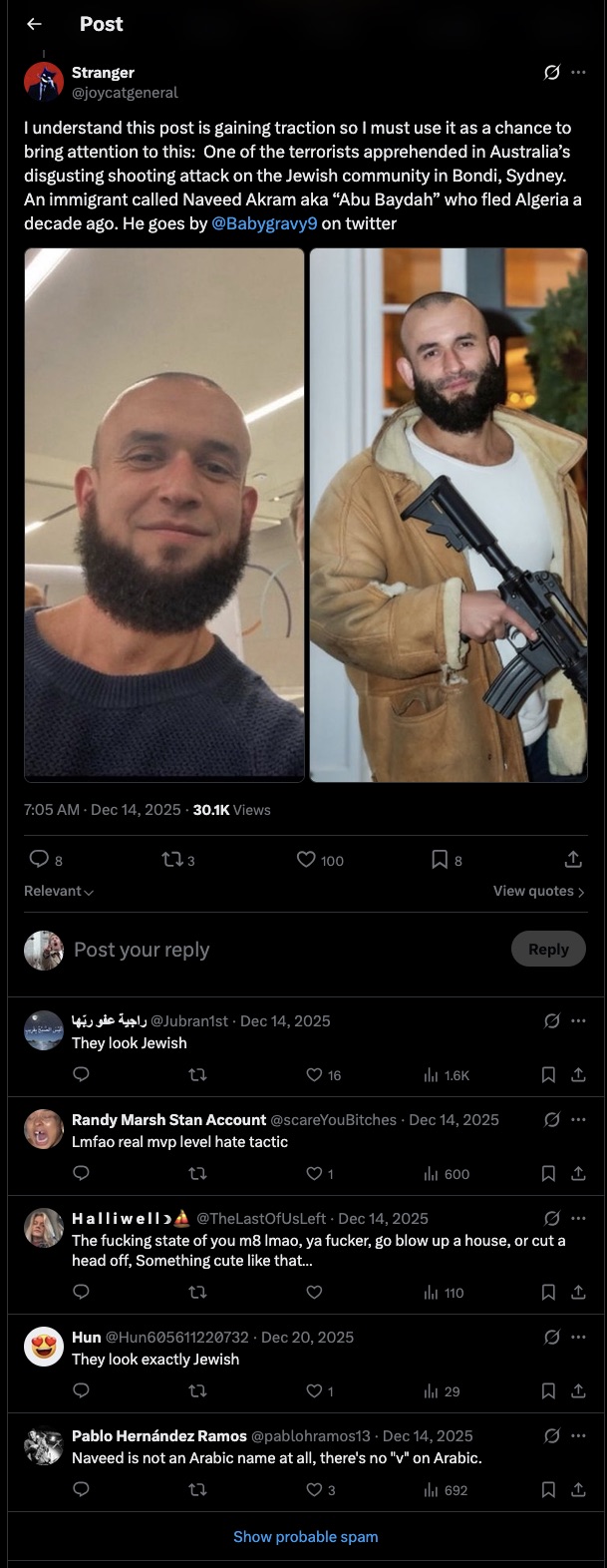
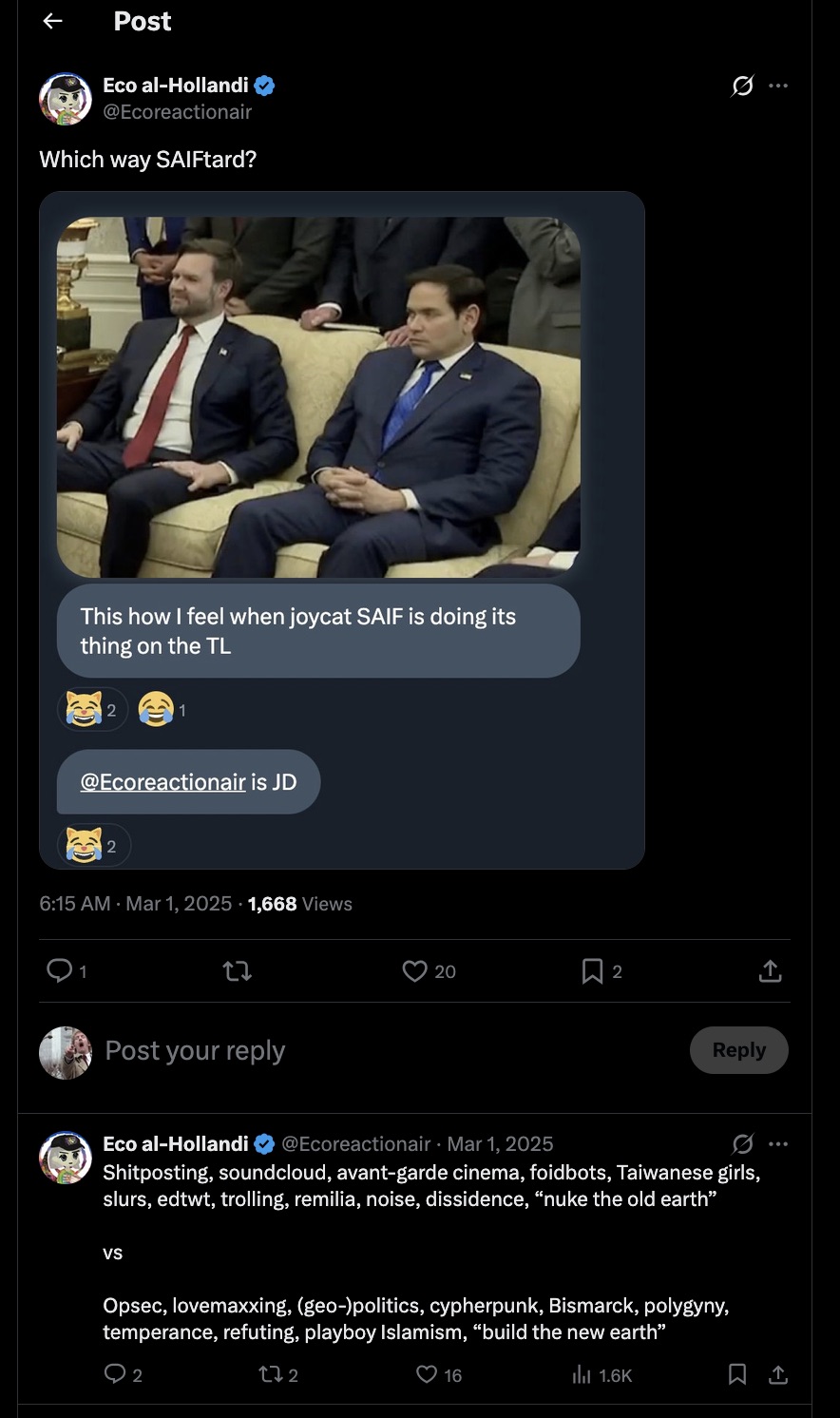
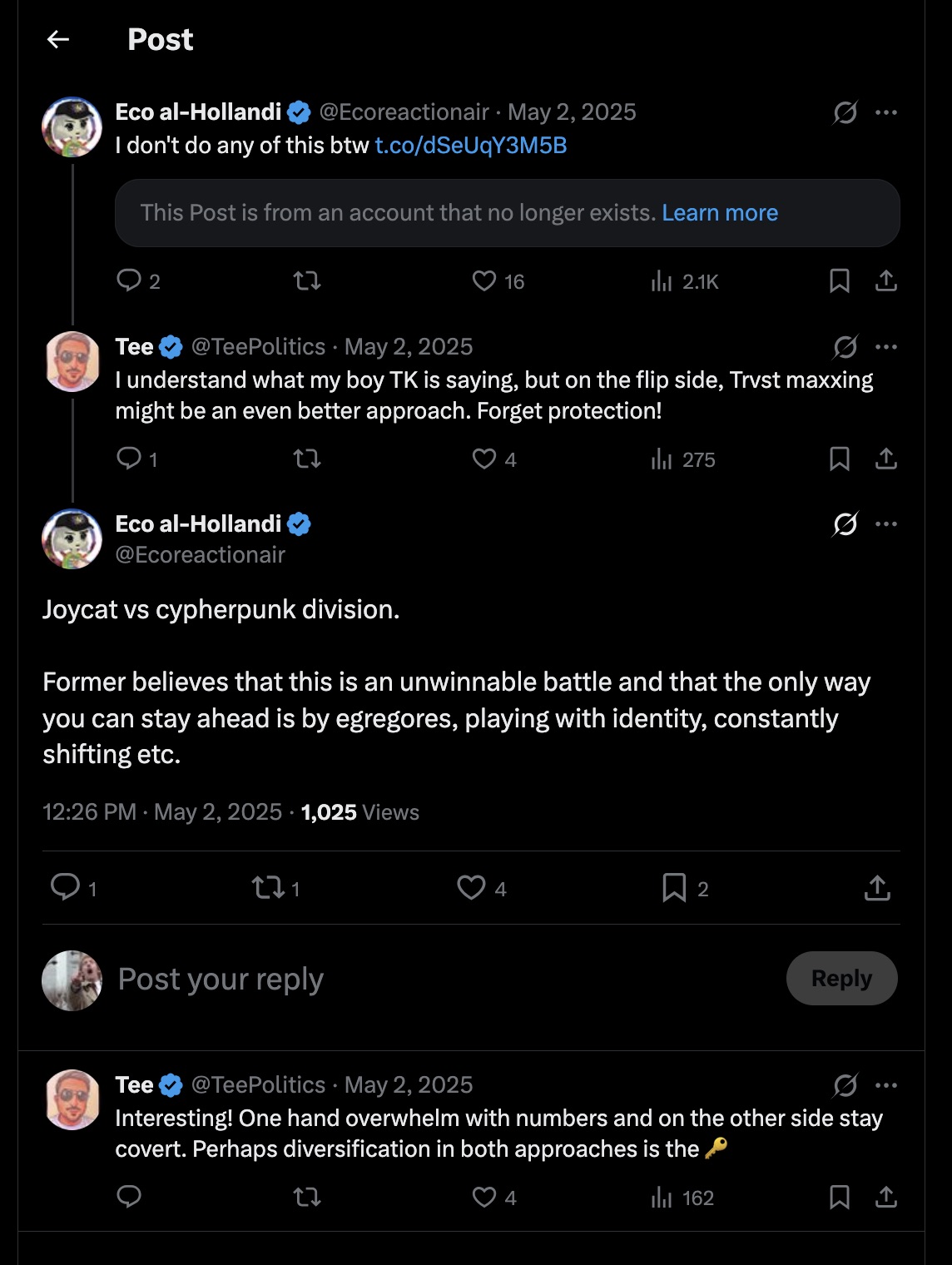
Scripture and classical sources: Qur'an 2:30–33, 2:190–193, 4:58–59, 8:28, 21:63, 33:72, 37:95, 47:38, with 2:191 in N. J. Dawood, trans., The Koran (Penguin Classics, first published 1956); al-Ṭabarī, Jāmiʿ al-bayān ʿan taʾwīl āy al-Qurʾān, on 2:191; Fakhr al-Dīn al-Rāzī, Mafātīḥ al-ghayb, on 4:59; al-Qarāfī, al-Iḥkām fī tamyīz al-fatāwā ʿan al-aḥkām and al-Furūq; al-Ghazālī, Iḥyāʾ ʿulūm al-dīn, Book of Knowledge; Miskawayh, Tahdhīb al-akhlāq; al-Bukhārī, Ṣaḥīḥ, on the beginning of revelation; al-Zarkashī, al-Ijāba li-īrād mā istadrakathu ʿĀʾisha ʿalā al-ṣaḥāba; ʿAlī ibn Abī Ṭālib on the Kharijite slogan, in Nahj al-balāgha.
Modern sources:
- Khaled Abou El Fadl, Rebellion and Violence in Islamic Law (2001) and Speaking in God's Name (2001)
- Hannah Arendt, On Violence (1970) and Lectures on Kant's Political Philosophy (1982)
- Iain M. Banks, Consider Phlebas (1987) and Look to Windward (2000)
- Ruha Benjamin, Race After Technology (2019)
- Ccru, Writings 1997–2003 (2017)
- Kate Crawford, Atlas of AI (2021)
- T. S. Eliot, The Waste Land (1922)
- Virginia Eubanks, Automating Inequality (2018)
- Robert Gleave, Scripturalist Islam: The History and Doctrines of the Akhbārī Shīʿī School (2007)
- Jürgen Habermas, Between Facts and Norms (1996)
- Wael Hallaq, The Impossible State (2013)
- Eric Hughes, A Cypherpunk's Manifesto (1993)
- Sherman Jackson, The Islamic Secular (2024)
- Immanuel Kant, Critique of the Power of Judgment (1790)
- Bartolomé de las Casas, A Short Account of the Destruction of the Indies (1552)
- Lawrence Lessig, Code and Other Laws of Cyberspace (1999)
- Safiya Umoja Noble, Algorithms of Oppression (2018)
- Elinor Ostrom, Governing the Commons (1990)
- amina wadud, Qur'an and Woman (1999) and Inside the Gender Jihad (2006)
- Norbert Wiener, Cybernetics (1948)
- Cyrus Ali Zargar, The Polished Mirror (2017)
Reporting:
- Reuters Fact Check, British influencer misnamed, misidentified online as alleged Bondi Beach gunman (18 December 2025)
- Associated Press, Australian police say Bondi Beach mass shooting was terrorist attack inspired by Islamic State group (16 December 2025)
- Australian Associated Press, Long road to recovery for Bondi mass shooting hero (16 December 2025)
- Al Jazeera, Dashcam footage captures moment couple tries to stop Bondi shooter (16 December 2025)
- TechCrunch, on Grok's false claims about the Bondi Beach shooting (December 2025)
- Explosive Media, Wikipedia, with the reports it summarizes, among them BBC News, the interview with Explosive Media's maker (12 April 2026); The New Yorker, The Team Behind a Pro-Iran, Lego-Themed Viral-Video Campaign (2 April 2026); and Al Jazeera, "Vengeance for all": How Iran's Lego videos won narrative war against Trump (17 April 2026)
- On the closures of Hormuz and Bab el-Mandeb: Carra Globe, Windward and the Council on Foreign Relations
- Yuval Abraham, "'Lavender': The AI machine directing Israel's bombing spree in Gaza," +972 Magazine and Local Call (3 April 2024); and Paul Biggar, Meta and Lavender (April 2024)
- 2026 Minab school attack, Wikipedia, with the reports it summarizes, among them The Washington Post, Iranian school was on U.S. target list, may have been mistaken as military site (11 March 2026); The Guardian, AI got the blame for the Iran school bombing. The truth is far more worrying (26 March 2026); Forensic Architecture, Airstrikes on Minab Primary School (16 July 2026); and Reuters, UN mission finds grounds to believe US committed war crimes in Iran, and Tehran crimes against humanity (17 September 2026)
- CNBC, Tanker attacks in Strait of Hormuz surge to wartime high as Iran tries to choke off oil exports (9 October 2026), citing International Maritime Organization data
- Jalopnik, 7 Oil Tankers Attacked In Strait Of Hormuz, As U.S. Official Admits Iran's Targeting Abilities Keep Improving (October 2026), summarizing Wall Street Journal reporting on tankers running with transponders off
- Reuters, Houthi strike on Saudi airport kills 12, worst attack on kingdom in a decade (10 October 2026)
Comments4
🇰 🇷 🇾 🇵 🇹 🇮 🇽
···
🇰 🇷 🇾 🇵 🇹 🇮 🇽
···
ابو مريمAuthor
···
🇰 🇷 🇾 🇵 🇹 🇮 🇽
···