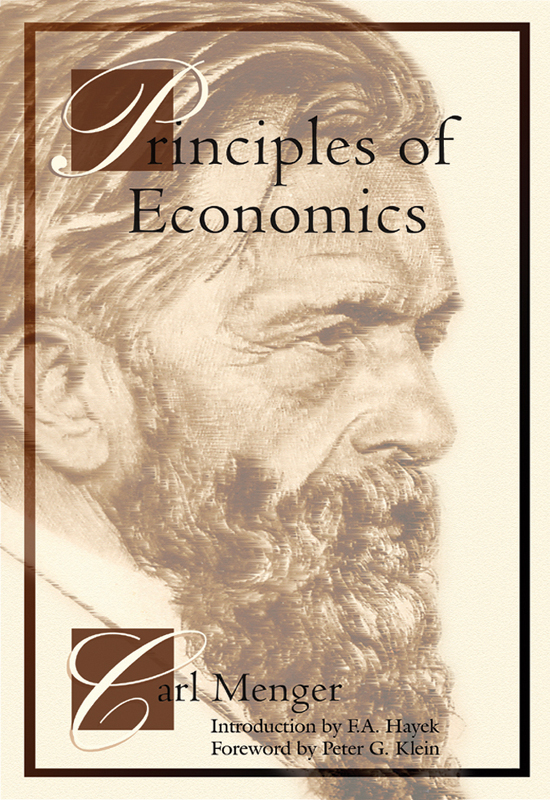

Carl Menger's Principles of Economics, first published in Vienna in 1871, explains value, prices, capital and money from one starting point: a person whose requirements exceed the quantity of goods available to satisfy them. The 2007 Mises Institute reprint carries James Dingwall and Bert F. Hoselitz's complete translation of that first edition, with a foreword by Peter Klein and a historical introduction by F. A. Hayek. The book's eight chapters move from goods to money in a deliberate order. Each institution Menger reaches follows from the valuations set out in the chapters before it.
A thing becomes a good, in Menger's account, when four things coincide: a need, a causal capacity to meet it, knowledge of that capacity and command over the thing. It becomes an economic good when requirements over a planning period exceed the available quantity. Scarcity is therefore a relation between requirements and quantities. A plentiful stream stays outside economizing until drought, poorer quality or a change of location alters that relation. Menger traces property to the same disparity, so redistributing goods leaves their scarcity in place. He also separates wealth from welfare, since abundant water can remove an item from a household's wealth while improving its life.
Value follows from that relation. A farmer holding wheat assigns bushels to keeping his family alive, seeding next year's fields, feeding animals and brewing. If he loses a bushel, he reallocates the rest to protect the most important uses and gives up the least important satisfaction he had been securing. The value of a unit is that forgone satisfaction, and labor already spent producing it has no bearing on the judgment. Menger's comparison of water with diamonds turns on available quantities and circumstances, and water gains value wherever it becomes scarce.
Production extends the argument through time. Bread, flour, grain and the field that grows it stand in a causal order toward consumption. Complementary inputs must be present together, so a loss of cotton leaves specialized labor idle. Inputs take their value from the output expected when production ends, which is why ingredients for artificial ice can be valuable in winter. A single input is worth the output that would be lost after the producer substitutes or redeploys what remains. Menger applies this rule to wages and interest while keeping economic explanation distinct from moral justification.
Exchange becomes possible when two people value each other's goods in reverse order, and it happens once both recognize the fact and have the power to transfer the goods. Grain and wine show the gain, and horses and cows show it shrinking until trade stops, with transport, time, storage and intermediaries absorbing part of it. Prices then form within bounds set by those valuations. Competing buyers narrow the bounds through the rivals they exclude. A monopolist can fix price or quantity, and buyers' valuations then determine the other, so withholding output can raise his profit. Competition changes that incentive because withheld output now benefits rivals, though Menger also examines collusion. These chapters identify the bounds within which prices form. Applying them to a contemporary price requires evidence about the particular people, quantities, knowledge and competitive conditions involved.
Marketability connects prices to money. A commodity is a good its owner holds for sale at prices that fit the general economic situation, a temporary relation between good and owner. A jeweller could clear his watches at one Thaler each and still have reason to call his sales slow. Saleability varies with the number of buyers, geographic reach, quantity and time, and grain sells more readily than furs. Menger's smith, who needs fuel and food among other things, finds armor hard to trade for them. Accepting more marketable cattle improves his chances even before anyone treats cattle as universal money, and others who observe his success spread the practice through custom. Legislation is unnecessary for this origin, although Menger holds that state sanction improves a money by making it legally binding in payment. He accepts government guarantees of coin weight and fineness while condemning their abuse. Money owes its role to saleability, and Menger denies that it must measure objective value or preserve value through time. His closing pages accept suitably limited, redeemable copper coins alongside full-weight precious metal.
Comments0
No comments yet. Start the conversation.