
Bloom’s Taxonomy is a hierarchical model used to classify educational learning objectives into levels of complexity and specificity. It was first introduced by Benjamin Bloom in 1956 and has since become a foundational framework in education. The taxonomy is often depicted as a pyramid, with each level representing a stage in cognitive development, from basic knowledge recall to complex evaluation and creation. Understanding Bloom’s Taxonomy is crucial for educators and learners alike, as it provides a structured approach to developing deeper and more effective learning strategies.
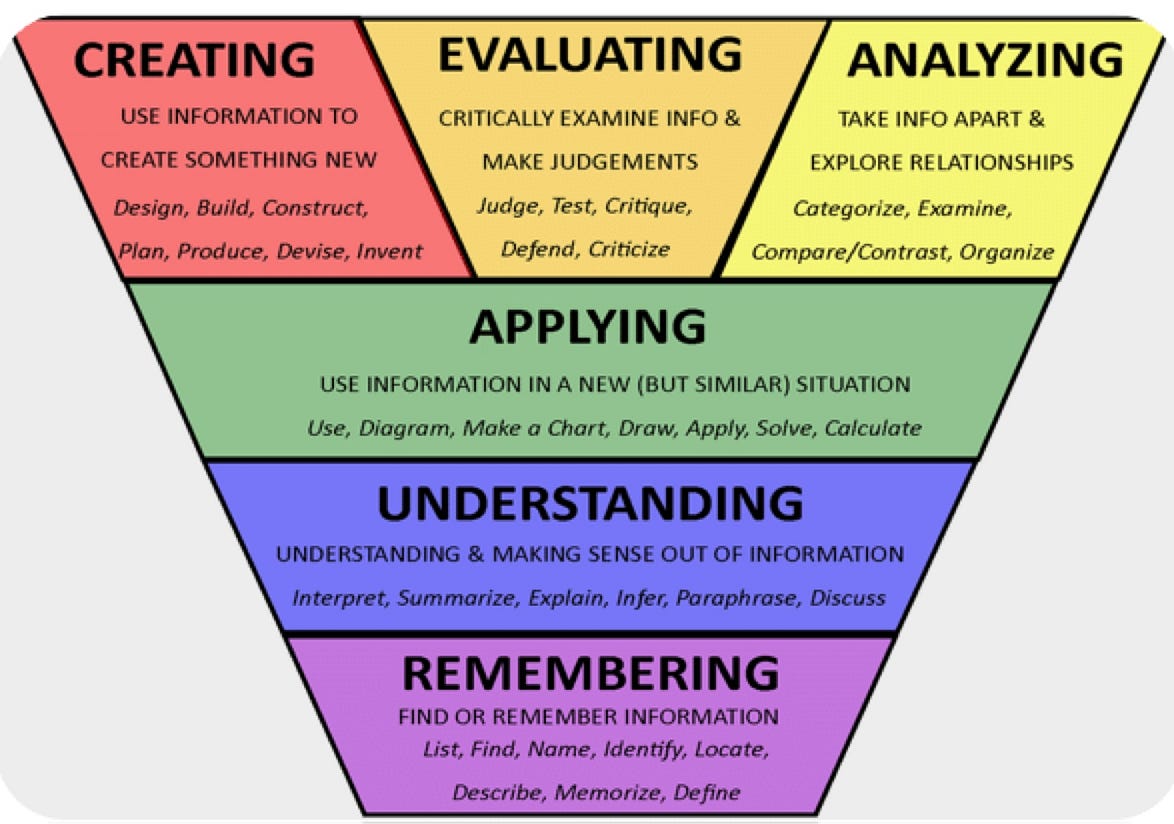
The Levels of Bloom’s Taxonomy
- Remembering: The first and most basic level involves recalling facts and basic concepts. This is where students learn to recognize and remember key information.
2. Understanding: At this stage, learners grasp the meaning of information by interpreting, exemplifying, classifying, summarizing, inferring, comparing, and explaining ideas.
3. Applying: Here, learners use the information in new situations. This involves executing or implementing a concept in different scenarios.
4. Analyzing: This level requires learners to break down information into parts to understand its structure. It involves differentiating, organizing, and attributing, as well as being able to examine relationships.
5. Evaluating: At this stage, learners make judgments based on criteria and standards through checking and critiquing.
6. Creating: The highest level of Bloom’s Taxonomy involves generating new ideas, products, or ways of viewing things. This includes designing, constructing, planning, producing, and inventing.
How Blogging and YouTube Enhance Learning Through Bloom’s Taxonomy
Blogging and creating YouTube content can significantly enhance learning experiences by engaging various levels of Bloom’s Taxonomy. Here’s how these platforms contribute to deeper learning:
Remembering and Understanding
- Blogging: When learners write blog posts, they often need to research and recall information. This process helps reinforce knowledge and understanding as they articulate what they have learned.
- YouTube: Creating videos requires learners to explain concepts visually and verbally, which can help solidify their understanding. The process of teaching others is a powerful way to reinforce knowledge.
2. Applying and Analyzing
- Blogging: Writing blogs allows learners to apply their knowledge by discussing how theoretical concepts can be used in real-life situations. It also encourages them to analyze different perspectives and synthesize information from various sources.
- YouTube: Video creation involves the practical application of skills, such as scripting, editing, and storytelling. Analyzing audience feedback and comments can provide insights into how well the content was understood and what can be improved.
3. Evaluating
- Blogging: As bloggers reflect on their posts and reader interactions, they engage in self-evaluation and critical thinking. Evaluating the success of their content helps them refine their arguments and presentation styles.
- YouTube: Creators often assess the impact of their videos through metrics like views, likes, and comments. This evaluation process allows them to critique their work and make informed decisions about future content.
Creating
- Blogging: The act of writing blogs is a creative process that involves synthesizing ideas and presenting them uniquely. Bloggers often develop a distinctive voice and style that reflects their understanding and creativity.
- YouTube: Video creation is inherently creative, involving everything from conceptualizing ideas to producing visual content. This level of creation requires synthesizing information, problem-solving, and innovative thinking.
Benefits of Blogging and YouTube in Learning
- Active Engagement: Both blogging and video creation require active participation, which can lead to better retention and understanding compared to passive learning methods.
2. Critical Thinking: Creating content involves analyzing and evaluating information, which strengthens critical thinking skills.
3. Communication Skills: Articulating ideas in writing or through video helps improve communication skills, which are essential in both academic and professional settings.
4. Feedback and Improvement: Interacting with audiences provides valuable feedback, enabling learners to refine their understanding and presentation of topics.
5. Creativity and Innovation: The creative process involved in content creation fosters innovation and encourages learners to explore new ideas and approaches.
Conclusion
Bloom’s Taxonomy offers a comprehensive framework for understanding and enhancing learning processes. By incorporating blogging and YouTube into educational practices, learners can engage with material at multiple levels of the taxonomy, from basic knowledge recall to complex creation and evaluation. These platforms not only make learning more engaging but also equip learners with essential skills for the modern world. As technology continues to evolve, integrating digital content creation into education will become increasingly important, offering dynamic and interactive ways to foster deep, meaningful learning.
Comments
No comments yet. Start the conversation.