
Stablecoins represent the biggest use case with a product-market fit beyond Bitcoin. As Bitcoin enthusiasts advocate for stacking satoshis via Lightning, the actual accumulation occurs through Tether on Tron Blockchain. The total market capitalization of stablecoins, within the context of crypto markets, is approximately $200 billion. Of this, Tether, the most widely used stablecoin, boasts a market capitalization of around $111 billion at the time of writing. Users in developing countries show a preference for Tether over Bitcoin, primarily due to its stability. This stability is imperative for daily transactions and savings, especially in areas with volatile local currencies.
However, there are several reasons why we need to replace Tether with a resilient, private medium of exchange.
Let’s ask the difficult question first. Why do we need to replace Tether? If there is already a product market fit and Tether is the leader in this, why bother to replace it?
Here’s why?
Honey pot for Regulatory Scrutiny and Compliance - Tether has faced increased regulatory scrutiny, raising questions about its compliance with financial regulations, particularly regarding transparency of its reserves and redemption obligations.
Risk to Tether employees: Smaller countries like Nigeria arrest Binance execs and ask for $10B+ in damages. Wait until they start to capture one of the 50 Tether employees or wait until a bigger country like India uses the same tactics.
Market Dominance and Systemic Risk Tether's significant market dominance, with over $110 billion in circulation, introduces systemic risk to the cryptocurrency markets. Its pivotal role in trading and liquidity means that any issue with Tether could have widespread repercussions, potentially affecting the stability of other cryptocurrencies and the broader financial system and the price of Bitcoin
Backing and Redemption Mechanisms- The actual composition of Tether's reserves and its redemption mechanisms have been points of contention. Concerns about the liquidity of its reserves, particularly during periods of market stress, could lead to a scenario where Tether is unable to meet redemption requests promptly. A significant deviation from its peg or a failure to honor redemptions could trigger a crisis of confidence.
Tether is neither private or decentralized - Let’s make it clear. Tether is controlled by one company with around 50+ employees. They can lock your tokens anytime by simply creating a transaction with your address and also track the entire transaction history of where the tokens get transferred.
I will give at most another two years by the time a viable alternative arrives or it is curtailed by the Government and regulators to the point where it is not usable anymore.
USDC is another stablecoin provided by the company Circle. Even their way of providing proof of reserves is a joke. We are now in the middle of May. They just posted their proof of reserves statement for March 2024 and it is mostly a Trust me Brostatement.
Given what we have today,
The idea is to reimagine a new stable mechanism that is fully automated, auditable and backed by Bitcoin that has no external dependencies to the legacy fiat world.
To succeed Tether, what properties does Cashu mint require?
Stable - For day to day use, everyone prefers the value to remain the same. So using Bitcoin SATS is not ideal.
Non custodial - Tether on Tron or Ethereum can be bought and sold without KYC, can hold it on your wallet with your own keys and cannot be rug pulled except for 2 reasons (1. Tether goes down or 2. Ethereum or Tron blockchain goes down)
Faster settlement time - Ethereum block settlement time is 12 seconds and Tron block settlement time is 3 seconds.
Cheaper transaction fee - The transaction fee on TRON is less than $1 and equates to transferring an unlimited amount of Tether token transfers.
Programmable: Ability to use cryptography to impose conditions to be met for spending or transferring.
Let’s look at the key ingredients that require you to mint your own stablecoin backed by Bitcoin.
1. Cashu Mints
Cashu Mint represents a significant advancement in the realm of digital currency, especially within the Bitcoin ecosystem. It functions as a Chaumian eCash system that integrates seamlessly with Bitcoin's Lightning Network, offering a modern interpretation of David Chaum's original digital cash concept. This innovative protocol enables the creation of mints that can issue eCash tokens denominated in any unit of account, which can be transacted over the Lightning Network. Token units can also be defined at the mint level, allowing for the denomination of tokens in any currency type. Additionally, each mint can have multiple units, paving the way for numerous innovative solutions.
Minting, swapping, and melting tokens are the processes through which tokens are created, transferred between wallets, and eventually safely melted (burned or deleted) based on specific conditions.
Tokens are created within a mint through a process called "minting." The mint establishes the unit and rules for token minting. Users can then utilize any wallet to mint, swap, or melt tokens.
Key Features of Cashu Mints
Privacy: One of the hallmark features of Cashu is its emphasis on user privacy. By leveraging Chaumian blind signatures, Cashu ensures that transactions remain anonymous. The mint, or issuer of ecash tokens, cannot track who is spending the ecash or where it is being spent. This feature addresses a significant concern in the digital currency space, where privacy is often compromised.
Ease of Use: Cashu is designed to be user-friendly, requiring no sign-up process. It simplifies the setup for users and mints alike, making it accessible to a broader audience. This ease of use is crucial for fostering adoption among those who may not be technically inclined.
Integration with Lightning Network: Cashu's operation on the Lightning Network ensures fast and low-cost transactions. This integration is vital for scalability, allowing Cashu to handle a high volume of transactions efficiently, which is a significant advantage over traditional on-chain transactions.
Proof of Liabilities (PoL): A credible way to check the solvency of the mint is to check the mint’s PoL at any given time. As described here Cashu mint can provide the proof of mint and burn reports to prove their solvency. Combine this with lightning channels and on-chain to reduce the rug-pull risk
Open-Source and Community-Driven: The Cashu protocol is open-source, inviting developers and enthusiasts to contribute to its development and improvement. This community-driven approach ensures that Cashu remains adaptable and innovative, addressing the needs and concerns of its users.
2. Stable Channels
Stable channels are simple lightning channels between two non custodial lightning nodes with an external agreement to keep the channel balance on side pegged to agreed dollar value. They are envisioned by @tonklaus and wrote a detailed article here. https://delvingbitcoin.org/t/stable-channels-peer-to-peer-dollar-balances-on-lightning/875
There are two types of users in a Stable Channel: Stable Receivers and Stable Providers. Each of these two types of users run the Stable Channels software, which runs alongside their Lightning node or else can securely interact with it.
Stable Receivers. Stable Receivers want less Bitcoin price exposure versus a reference asset, like the dollar. Example: Alice has 1 BTC and wants less BTC price volatility / exposure versus the dollar. Alice wants to use her 1 BTC to lock in $62,000 stable USD exposure (let’s assume the current price is $62,000). Stable Providers. Stable Providers want more Bitcoin price exposure versus a reference asset, like the dollar. Example: Bob has 1 BTC but wants even more BTC price exposure against the dollar. Bob wants to use his 1 BTC as margin to leverage up his bitcoin exposure. We match up these users over a Lightning Channel. Alice and Bob each put in 1 BTC and we open a dual-funded channel. That’s 2 BTC total capacity in a balanced channel.
Now we are ready to go to the regularly scheduled programming of the Stable Channels software. Every one minute, the program queries the same five different price feeds: BitStamp, CoinGecko, Coindesk, Coinbase, and Blockchain. We take the median price to protect against one or two of them being way off or compromised.
After we get the latest price, one of three things happens:
The BTC price went down. Then it takes more BTC for $62,000 stability. The Stable Provider pays the Stable Receiver over the channel. The BTC price went up. Then it takes less BTC for $62,000 stability. The Stable Receiver pays Stable Provider over the channel. The price didn’t move. No payment is required. This settlement process goes on continuously. Assuming the actors are basically cooperative, then on the Stable Receiver side of the channel we have created a synthetic dollar balance. Each side gets what they want: the Stable Receiver gets stability and the Stable Provider leverages their bitcoin. Of course, each side can lose bitcoin if the price goes against them. And each side can win bitcoin if the price goes their way. Nice.
Note that these are vanilla Lightning channels. For better or worse, this process involves no DLCs, no oracle digital signatures (besides HTTPS to fetch prices from exchanges), no tokens, no modifications to the Lightning contracts / scripts, no fiat, and no banks. Each side remains self-custodial and can leave at any time. As this is an ongoing and voluntary process.
3. uMint.cash
Idea for umint.cash is to combine stable channels with cashu mints. Mint is the stable receiver and pegs to the dollar balance. All cashu mints run lightning nodes to be able to mint/melt sats. The same lightning node can be used for creating the stable channel. Since the stable channel is balanced every five mins, why not show this info on the mint website for anyone to track and confirm that the stable channel is active and provides stability to the mint. This is the idea for proof of reserves. In real time, the mint can show stable balance and manage the cashu tokens minted so that it can manage its risk of being solvent effectively.
Proof of Reserves:
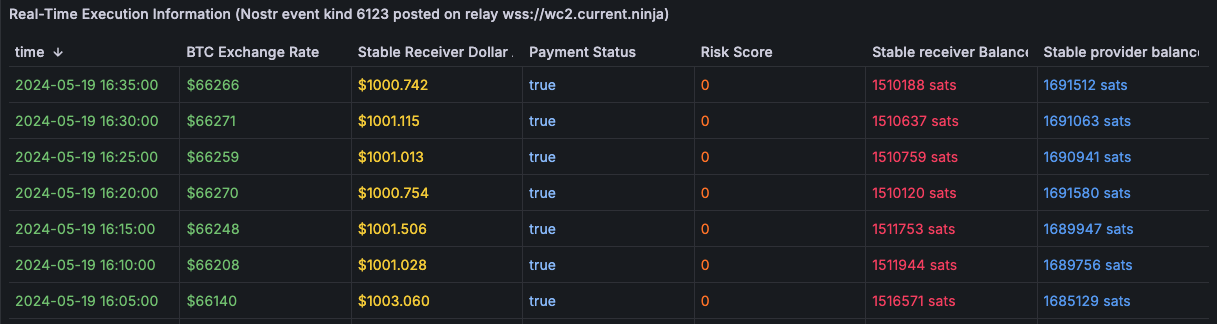
Both the stable provider and stable receiver (Mint) executes a service that checks for BTC exchange price and calculates if it needs to pay or expects to be paid by the other side. The output is then published as a Nostr event that can be monitored by anyone and also shown on the mint website.
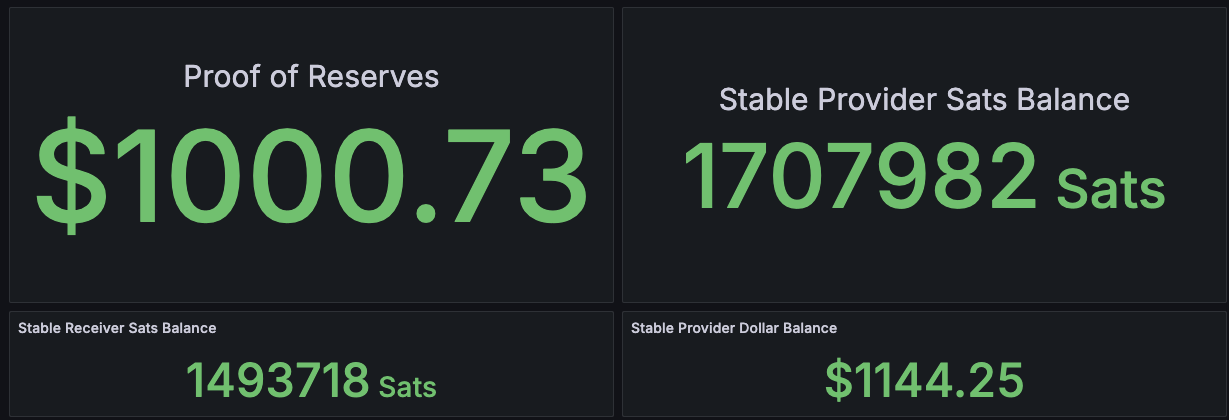
With the proof of reserves (The stable dollar amount) the mint is solvent and can payback all the minted tokens up to the stable dollar amount. In this case it is $1000. While this amount is small to start, there can be multiple stable channels open at the same time and the balance in each can easily go beyond say 10 BTC.
Also note the stable provider side the $ value is $1144.25 which means they are up 14% in 3 days...
The table below shows the Nostr event published by the mint every 5 mins. The two important fields to track here are payment status and risk score. The payment status indicates that there was some sats movement between stable receiver and stable provider. The risk score is a number that increments everyone when a payment does not happen. So if for some reason, the stable provider stops sending sats, the risk score will start to go up. Users and admins, can setup alerts to notify when the risk score goes above say 5 and quickly take corrective action.
This can also be automated to close channels, send messages and flip to a new stable providers so that the mint is able to manage the stable balance most of the time without any manual intervention.
Users can and should also check for themselves and validate if the information shown on the website is correct.
Proof of Liabilities:
A credible way to check the solvency of the mint is to check the mint’s PoL at any given time. As described here Cashu mint can provide the proof of mint and burn reports to prove their solvency.
Cashu tokens are bearer assets and the mint keeps track of all the minted and melted tokens. When a token is minted by the user by paying a lightning invoice, the proofs are created on the user’s wallet with a matching signature by the mint. The user can independently verify this information by going to the proof of liabilities page on the mint to query with their proof. If you find the proof, then you know the mint is counting your token. The dleq proofs can be validated only by the user who holds the cashu token.

Same as minting, when the user melts a token by issuing a lightning invoice then the melted tokens are displayed in the melt tokens table.

We are also working on forcing the mint to create a new keyset every month, forcing it to issue new tokens only from the new keyset. As Calle puts it, “You force an artificial bank run on the mint every month to keep them in check”. This will eliminate if the mint is artificially including any forged tokens into count.
If you want to try checking yourself, the easiest way to do is use https://nostrapps.github.io/cashu/ to copy/paste your melted cashu token and you will get proofs with secret and C. Copy secret, go to https://umint.cash/pol#pol and in the melted tokens table, search/filter for your secret. You should see your secret listed and the amount should match.
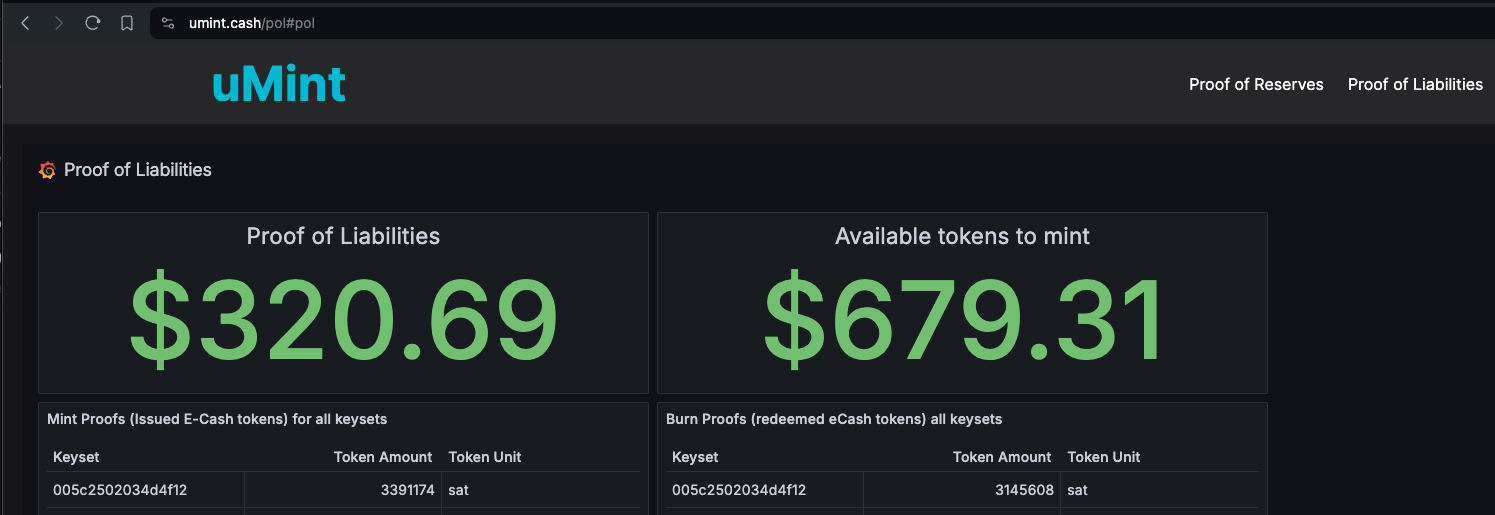
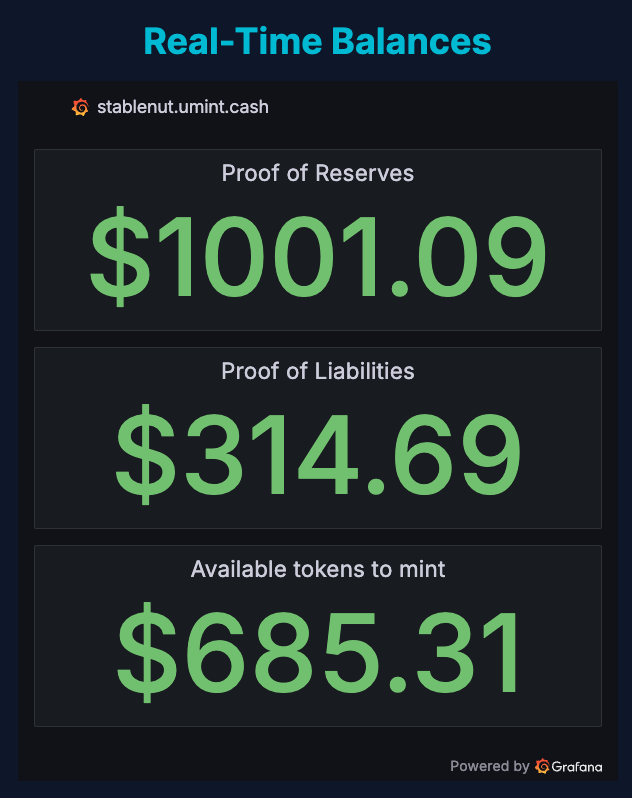
To summarize, when combining with stable channels, mints can be solvent and provide Dollar stability by eliminating bitcoin volatility. Users also get to view the proof of reserves and liabilities in real-time to judge the solvency of the mint and call out slow rung pulls.
All these are operational today with mint https://stablenut.umint.cash The mint homepage displays a quick summary of proof of reserves and proof of liabilities. So at a glance, you know if the mint is solvent, and how much more mintable tokens exist. The mint can be used by many Cashu wallet that supports “usd” unit tokens such as cashu.me, minibits and boardwalkcash.com
For a quick guide on how to mint these tokens, go to [https://umint.cash/how#faq](URL Here) which has a step by step process. For now there is no KYC or identification required. Simply open the wallet and mint the token. Keep the token in USD for a few days and try to melt them when the BTC price goes low to make some extra sats..!
References:
Cashu Protocol: Master of Cashu @calleBTC Github: https://github.com/cashubtc Telegram: @CashuBTC Proof of Liabilities: https://gist.github.com/callebtc/ed5228d1d8cbaade0104db5d1cf63939
Stable Channels Master of Stable Channel: @tonklaus Github: https://github.com/toneloc/stable-channels Twitter thread: https://x.com/tonklaus/status/1729567459579945017 Detailed write up: https://delvingbitcoin.org/t/stable-channels-peer-to-peer-dollar-balances-on-lightning/875
Supported cashu Wallets: https://wallet.cashu.me https://minibits.cash (Android App) https://boardwalkcash.com
For any additional questions, let me know @arunned on twitter or @starbuilder on Nostr.
Comments
No comments yet. Start the conversation.