

I love it when seemingly unconnected things connect. This happened to me recently...one thing leapfrogged to another, then to another, and then to yet another altogether, crossing oceans and centuries, connecting these things seemingly unrelated things. What started as a short hike led to a glockenspiel, a fairy tale, a novella, and bitcoin.
There must be a word for when things like this thread together, where everything is linked, somehow, in life. I want to know that word. But, I'm reminded of the quote: "Eventually, all things merge into one, and a river runs through it."
There are four parts to this article. I realize this is a bit long and that you may be familiar with some or much of it, but I think you might learn a thing or two new. I did.
Glockenspiel...#
Recently, after an afternoon hike, my wife and I walked the main street of the nearby town and stumbled on this glockenspiel clock. Each hour it tells the Pied Piper story. If I lived or worked nearby, it might get a bit annoying hearing this story every hour, but it was very enjoyable as visitors. It's nostalgic and a bit mesmerizing...people love a storytelling glockenspiel.
 Photo by me, crrdlx
Admittedly, my knowledge of the Pied Piper was very basic. I knew that it's something about a fellow playing the flute, things followed behind, just a fairy tale story. My wife looked it up on her phone and she commented out loud, "That's a terrible story," (not terrible in that it was poor story telling, but terrible in that it was a horrific tale). My curiosity was piqued.
You can view and listen to the glockenspiel story that we heard at:
Fairy tale...#
Well, after listening to the glockenspiel story and doing some research, I've learned quite a bit more. Surprising to me, this fairy tale is actually true, at least in some fashion. Here's the upshot of the Pied Piper story:
- The 13th century town of Hamelin, Germany had a rat problem. A piper in colorful (pied) clothing arrives in town and promises to rid the rats, for a fee, and the mayor agrees.
- The pied piper plays, he marches through town, the rats are mesmerized and follow him, the rats march right into the river, drown, and rat problem is no more.
- However, the mayor and townsfolk go back on their promise and do not pay the piper. Why not? That's unclear, but one thought is that the townsfolk decided the piper was in league with the devil and was employing witchcraft and the black arts to do his magical deeds.
- The piper is angry, he vows revenge, and leaves town.
- Then, on June 26, 1284, he returns while the adults are all attending church. He plays the pipe and lures the children into the streets, out of town, into the mountains, and they are forever gone. The end.
- In the glockenspiel version that we saw and heard, there was an added "modern version" to the end. In this modern version ending, the townsfolk change their minds, the piper gets paid, he returns the children, and "they all lived happily ever after." You can hear the modern version addendum at the 4:50 mark in the video. Personally, I found this as weak. Notice that the voice or audio is different? My guess is that some soft-hearted history revisionists pushed to change the story, to Disneyfy it, so that, now, listeners don't know the truth of what happened, but we all just feel good about it. :/
It's unclear to me how much is true regarding the rats following the piper, that's a bit of a stretch. But, apparently, the town of Hamelin did in fact lose 130 children into thin air. The Wikipedia article outlines the early "documentation" of this event, starting with 1384, to commemorate the 100 year mark since it happened. Henceforth, the town marked its chronology based on the date of losing their children, like B.C. or A.D. And, interestingly, the last street the children were seen marching down, Bungelosenstrasse or "street without drums", still forbids music or dancing.
There are a lot of theories on what happened to the children: they went into a cave and (magically?) popped out 1100 miles away in Transylvania (the "cross-woods"), they were consumed by fire, or landslide, or sinkhole, they emigrated to eastern Europe where more children were desired, they engaged in "dancing mania" (which evidently was a thing in the 1200s) and simply danced away into neverland. And there are more.
To me, the specific date of June 26, 1284 is the curious part of the story (actually, the whole endeavor is very curious). The emigration theory has some evidence: place names in the theorized new lands have a high occurrence of German names. But, this specific date would make the emigration story less likely. A one-day emigration to another country? With a 130 children? On foot? That's a lot of mouths to feed and tired children to coddle along. It's not like they walked out of town and loaded onto an awaiting plane. They would have had to walk those hundreds of miles. The logistics alone...
Another angle is that this is very near the summer solstice. Evidently some people would "celebrate" the solstice with pagan rituals in the hills. This fits, a bit, in that the early recordings point to the children going to the Koppen, the hill out of town. It also meshes well with the idea that the piper was employed witchcraft or the occult. In this theory, the children were atop the Koppen, and then were encircled by a ring of fire that consumed them. Of course, a major flaw in this theory is that an all-consuming fire would have left obvious evidence of what happened...which is not recorded.
Anyway, stumbling on the glockenspiel led me to the Pied Piper and this quite interesting story and town. I watched this fairly good "welcome to Hamelin" video by American tourists which I enjoyed. Note, you can stop watching at the "learn German" advertisement, there's nothing new afterward:
And, the glockenspiel, the story, and my research, reminded me of other things...
A novella...#
The Pied Piper tale reminded me of the story "The Man That Corrupted Hadlyburg" by Mark Twain. Maybe you read it back in school, and I doubt that students still read it in school today (Twain is on the modern-day naughty list because of political incorrectness). But, it's a very, very clever story.
If you're unfamiliar, I'll outline the plot below. (Spoiler alert: it's a good story. Twain is such a humorous writer and he had a real, earthy understanding of people. You might want to read the story before I spoil it, or at least watch the movie version, it's less than an hour.)
The Hadleyburg plot:
- Hadleyburg is a perfect little town where the townsfolk take great pride in their uncompromising integrity. Its motto: Lead us not into temptation. The town is led by 19 upstanding couples, the Nineteeners.
- A stranger comes to town. He'd been there years before, was insulted, and left. Now, upon his return, he is a wealthy man (and seeking revenge).
- He stops at one of the 19 couples' homes, the home of Edward and Mary, and drops off a sack of about 160 pounds of gold (Grok says that's about $5.7 million today). He said that, back then, he was ruined by gambling, and was a penniless beggar. But, a certain person gave him $20 to get back on his feet (Google says this is about $775 today, wow, the inflation!). He took the gift and subsequently grew it into a huge fortune. The sack of gold is now a gift for that kind benefactor to say, "Thank you."
- Unfortunately, the stranger does not know the benefactor's name. To find out who the benefactor was/is, a secret has been sealed inside the sack. Along with the $20, the benefactor had given the poor stranger some verbal advice. That advice is written down and placed securely inside the sack. The stranger tells Edward and Mary to advertise this story in the local paper. The rightful owner will hear of this, and will recall the advice that was given. He or she should write it down, seal it, and give it to the local parson, Burgess. At the next town meeting, Burgess will compare the advice submitted by the townsfolk with the sealed secret advice inside the sack.
- The local paper puts the word out, not only locally, but nationally via telegraph. The Hadleyburg story goes viral, as it were, and is nationally famous overnight. Everyone in town is enthralled by the fame and chance to claim the gold. Each of the Nineteeners wan the money. But, how could they figure out the secret advice hidden inside the sack?
- Then, a letter arrives to each of the 19 couples. It is actually the same letter to all 19 and it says the benefactor wanted you, yes you, to be the rightful heir. It reveals the advice: "YOU ARE FAR FROM BEING A BAD MAN: GO, AND REFORM." So, each of the 19 couples turns in a letter to Burgess with this same inscription, all claiming to be the rightful recipient of the gold.
- A town meeting is held, presided by Burgess. The first two letters are read, they are identical, of course, and an argument ensues. All of the other couples immediately begin to worry because they know their letter says the same thing. One by one, as the claim-letters are read, and the couples' integrity is shamed. The out-of-towners and press at the meeting find this shaming of the once-holy Nineteeners as hilarious.
- Edward and Mary are last, but their letter is surprisingly never read. To repay Edward for a favor he once did for Burgess, Burgess spares them the shame and does not read their letter. (If you watched the movie, it essentially stops here for some reason, but the story goes actually on.)
- Burgess digs out another letter from the sack. This letter explains that the situation truthfully: the entire story was made up in revenge for being ill-treated years back. He scolded them for their vain pride in their purity. He said purity that is never tested by temptation is easily broken. So, he devised a plan to break it. By offering temptation, they quickly fell into impurity. Also, the gold is fake: it is merely lead, gilded over.
- The townsfolk decide to auction the fake "gold" coins and give the money to Edward and Mary, the only true upstanding citizens. The stranger who set up the whole thing is present and buys the coins. He wants further shame on the Hadleyburg residents, so he makes up a new story....
- He says he trades in rare coins and that he can find a way to trade the coins so that their value will wind up as though they actually were gold. That is, he can make them worth the $40,000 that they would have been worth, had they actually been gold coins. He would give $10,000 to Edward and Mary as the only honest couple. The stipulation is that he will stamp the names of the 18 dishonest couples onto the coins to forever shame them. The meeting-goers are very enthusiastic about this proposal. Except for one...
- Dr. Harkness is one of two wealthy men in town, Pinkerton, the banker, is the other. They are both running for Legislator in a tight race. Further, the railroad was to be laying track through the area soon. He and Pinkerton had both bought large tracts of land and hoped the Legislature would route the train through their property, thus reaping great money in the process. With these coins, Harkness saw an angle, and quietly makes a deal with the stranger to buy the coins for the full price of $40,000.
- The next day, the stranger returned to Edward and Mary. He left a note that said he'd anticipated that all 19 couples would fall into temptation, but since they didn't, they should get the money. Along with the note were checks adding up to almost the whole lump sum of the money to Edward and Mary. (He kept $1500, for expenses?, and gave $38,500 to the couple.) The coins, purchased by Harkness, had been stamped with the name "Pinkerton". This way, as they were traded around, the shame would certainly lose Pinkerton the election and thus Harkness would win.
- Another message from Burgess arrives to Edward and Mary. It explains that he withheld reading the letter to repay for a favor Edward had done for him.
- Edward and Mary are very troubled with the $38,500 in checks. The town thinks they are the only non-corrupted couple. Yet, they're now in a double lie: first for their false letter that went unread, and secondly for accepting the congratulations and money for being pure. They struggle wondering if they should speak up or remain hidden and accept the rewards.
- The stress goes psychosomatic, they grow physically ill, eventually confess, and die; the checks never having been cashed. The town changes its name from Hadleyburg to ____ (town unnamed) and changes its motto to: Lead us into temptation.
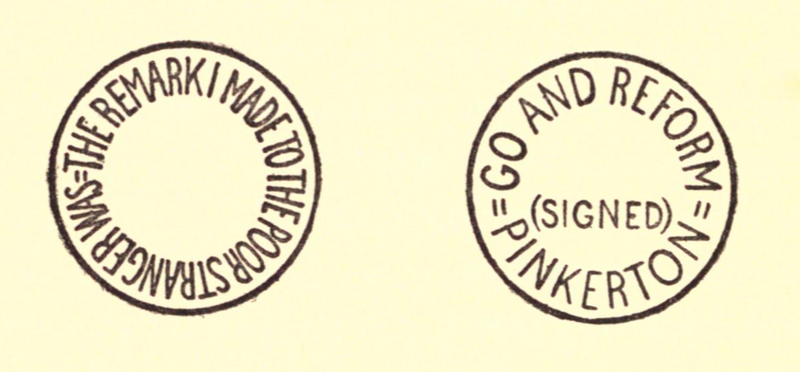
Image from Wikipedia
What's the Hadleyburg story mean?
Literary types love to interpret this type of thing. They say that the prototypical American town of Hadleyburg is a allegory for America at large: pious and self-praising, but money-hungry, corrupt, and run by the powerful for themselves and their greed.
Or, in an even larger sense, Hadleyburg can be interpreted as an allegory for humanity in general and the flaws of humanity. Not to pick on Americans alone, money and power, and the love of each, corrupts all indiscriminately.
Or, religiously, Hadleyburg can be seen as Eden. The fall of Edward and Mary is the fall of Adam and Eve. Eve, when tempted by Satan in the garden, gave the fruit to Adam, just as the stranger beguiled Mary who presented the gold to Edward. Just as Adam and Eve fell into sin and were cast out of Eden, the once "pure" Hadleyburg fell from purity to depravity and it, too, became a lost Eden.
Personally, I doubt Twain had these things in mind. This was later in his life and, as the story goes, he'd become a rather bitter and cynical old man. He wanted revenge on something.
Twains Hadleyburg?
In researching the Hadleyburg story, one theory is that he wanted revenge on the town of Oberlin, Ohio. He'd given some lectures there and they, or he, were not well-received. Oberlin may have been something of a high-browed town, religiously and academically. It was started by Presbyterians to be something of a model town for morality. It later became most well-known as one of the leading abolitionist (anti-slavery) towns in the U.S. This is all fine, but, together with the other thing the town is most known for, the liberal arts Oberlin College, this holier-than-thou-ism and academic intellectualism might have poisoned the minds of the residents. In other words, they might have begun to think their poop don't stank, as Twain might say.
Enter Twain. He and George W. Cable, another writer, came to town in February of 1885 on what was essentially a book tour. They read from their works in the local church (as in Hadleyburg). The other writer was apparently well-received. Twain read about "King Sollermun" from Huckleberry Finn. The King Sollermun tale is very politically incorrect by today's standards, but to be fair, this was 1885, not today. Still, the church-going Obies seemed nonplussed with Twain's Earthy and colorful rhetoric and style.
Then, he made fun of the German language. He read a translated version of "The Tale of the Fishwife" from his "The Awful German Language". He describes his frustrations with the gender of German words and how there is no logic or sense to it. One must simply remember which gender belongs to which word. Personally, I don't see anything offensive about it all, so I'm not sure why this would be a problem with the Oberlin crowd. But, perhaps King Sollermun had been read first and the Oberlin crowd had been primed to be ill-receptive.
To my English-only ears, Fishwife Tale translation from German is actually pretty funny: a turnip is a "she" and a woman is an "it." And there are many more examples like this. Even the title that I wrote here, "Das glockenspiel...", I had to look up. Is it das, die, or der glockenspiel? Evidently, a glockenspiel is neuter, genderless, so it is das glockenspiel.
I've got to agree with Twain on his main point here. Examining the word "glockenspiel," Glocke, bells, in German is genderized as below according to Google Gemini:
In German, the word for "bell" can be either "Glocke" (feminine, die Glocke), "Glöckchen" (neuter, das Glöckchen), or "Schelle" (feminine, die Schelle), depending on the context. "Glocke" generally refers to a bell in a more general sense, while "Glöckchen" is a diminutive, referring to a small bell. "Schelle" can refer to a bell, especially a small bell or a jingle bell.
So, bells are generally feminine, Glocke. But smaller bells are genderless, Glöckchen, unless it is a small Schelle bell, then it is a feminine small bell. Makes sense, right?
As a bit of wider context, this Oberlin reading was part of a traveling book tour hype show. "The Adventures of Huckleberry Finn" had come out a year prior, in 1884, and Twain was selling books. He was well-known for sure, but not the literary legend he is today. This likely adds to how some of the townsfolk that heard the lecture were rather "meh" on his performance and talent.
Of course, Huck Finn, went on to be hugely successful. Ernest Hemingway famously wrote in "Green Hills of Africa" (1935), "All modern American literature comes from one book by Mark Twain called Huckleberry Finn." That's high praise.
Still, Twain felt ill-treated or ill-received in Oberlin by the townsfolk. He couldn't let it go, it brewed. In the end, Twain likely got the last laugh. Aside from eventual fame and literary respect like Hemingway's quote, the Hadleyburg novella was his acidic bite back at the town of Oberlin. So, now, Oberlin is forever scarred as the real-life Hadleyburg.
I have to wonder, though, do modern Obies wear Hadleyburg as something of a badge-of-honor? Although Hadleyburg was a jab, has it become a laurel? Do they follow a line of thinking something like this?: "By 1885, Oberlin had already moved beyond Twain's ribald and juvenile linguistics. And, the fact that Huck Finn is now one of the banned books in schools, and that it is regarded as culturally inappropriate, simply proves that Oberlin was right all along. The town had progressed far ahead of its time and folks like Twain just couldn't keep up."
Full discretion: I've met a few Obies, I'm not a big fan. They subtly and politely let me know that they're better than me. And, better than you too.
Connection to the Pied Piper
Since we're making connections, the Mark Twain/Hadleyburg/Oberlin situation and the Pied Piper connection are rather clear. In both cases, a stranger comes to town, feels disrespected, then later returns to exact revenge. Each man uses the tools of his trade: the piper with the pipe and Twain with his pen. And revenge is exacted.
Bitcoin...#
The Hadleyburg story, which I hadn't thought of in years, reminded me of bitcoin. There's something about bitcoin that goes like this:
The more you learn about bitcoin, the more you realize you really don't know anything and want to learn more. Bitcoin is pervasive. When you begin to understand bitcoin (emphasis on "begin", I'm convinced that you never really understand it all), you start to see bitcoin everywhere.
Bitcoin is seen in money, of course, and computer science, of course. But, it's also in mathematics, and physics, and energy. It's in economics, for sure, and in philosophy, and game theory. Bitcoin is in psychology, for sure, and in sociology and social relationships; you might even say bitcoin IS a social relationship. And I'm sure there are many more places where bitcoin lives and works that I don't recall at the moment or fail to see altogether.
My point is, when you begin to learn about bitcoin, it appears in unexpected places. I saw it in Hadleyburg. Let's do a bitcoin/Hadleyburg comparison.
- The Hadleyburg stranger left a sack of gold. Similarly, Satoshi left a treasure of digital gold. That is, his coins (and everyone's, actually) are sitting there, waiting to be opened, you just need to know the secret key. (I'm not saying this would be right to do, but if you had the private key, it could be done.) To get the Hadleyburg gold, you needed to know the secret message...that was the key to the gold. With bitcoin, if you come up with Satoshi's private keys, you get his digital gold.
- In Hadleyburg, people falsely stepped forward claiming to be the rightful owner, claiming to have the secret key. In bitcoin, we've certainly seen people step forward claiming to be the rightful owner of Satoshi's keys.
- With conflicting claims to the Hadleyburg gold, there was no consensus. The Hadleyburg townhall in the church broke down into a shouting match. Satoshi fixed this. Satoshi divorced people from consensus-making. People have inherent flaws in human nature, as Hadleyburg showed. Instead, consensus is achieved programmatically and mathematically.
- With consensus broken in Hadleyburg as to who should get the gold coins, forks in the plan emerged. Townsfolk came up with new ideas for what to do: give it to Wilson, became give it to Edward, then became, give it to charity. In bitcoin, well, there have been forks too.
- Twain understood human nature. He knew that incentives drive people. The incentives the stranger injected into Hadleyburg fueled the plot. Competing incentives caused trust in a civilized society to break down. Satoshi understood human nature. Satoshi knew incentives fuel behavior too. But, Satoshi built bitcoin where incentives compete with one another to actually secure the system, not to break it down. Satoshi knew that human greed, competitive selfishness, and bad-actors are limitless. So, he built a system that used this fuel to secure the system against it. (If that's not revolutionary, I don't know what is.)
- The stamping of "Pinkerton" on the coins shows that money is actually its own social media. Money is actually social relationships, conceptual debt and value and trust. It might be paper, or gold coins, or gilded coins, or bitcoin, but it is relational between people and across time. The transfer of a gilded Pinkerton coin transferred both value and a message. Today, when someone zaps a tip of a few satoshis to someone else, there is both value and a message. The value is the sats, the message is a "Nice job!" that is communicated as well, even without words. Money is social media.
- In both Hadleyburg and bitcoin, psychology abounds. There is pride and selfishness, FOMO, hype, and FUD. And "social media", like the telegraph, plays a part in fueling the mentality, emotions, and decisions.
- Hadleyburg's gilded lead shows one reason bitcoin is superior to gold. Gold, real, pure gold, is terrific and terrific money. However, proving that your gold coin is really pure gold requires time and expensive assaying. With bitcoin, you do not need to assay a sat. This is to say nothing of physically moving gold from place to place - the effort and danger involved in that. Gold is great. Bitcoin is better.
- The political and business scandals in Hadleyburg illustrates how fiat money is used as a tool by the powerful and corrupt. The rich in Hadleyburg used the coins in attempt to wrangle up more riches and more political power. Bitcoin gives a big "forget you" to the rich and powerful. Too-big-to-fail banks had long shunned bitcoin as snake oil, fighting tooth and nail. Only recently have they begun to warm up to bitcoin, obviously because they see that they must. The bitcoin train has left the station, they already missed it, and are trying to catch up. And, regarding politicians and bitcoin, well, they're trying to figure out how to work a truly revolutionary economic system into an old and broken fiat money system. What they likely don't know is: bitcoin doesn't care, it just...does bitcoin.
- Hadleyburg's new motto: "Lead us into temptation" is analogous to bitcoin's "Don't trust, verify." After biting the apple in Eden, Hadleyburg now wants the temptation so they can see the difference between good and evil (and not be fooled again). With bitcoin, coiners don't need to blindly trust, the Bitcoin system verifies.
- The final note in Hadleyburg boasts that they won't be fooled again: "...the man will have to rise early that catches it napping again." The people will be watching vigilantly for any and all infiltrators henceforth. This is analogous to bitcoin's resilience to hacking. Everything bitcoin is publicly visible on chain, on explorers. Bitcoin, like Hadleyburg, is vigilant. The criticism that "only criminals use bitcoin" is silly. It seems to me that bitcoin is really a terrible place to do illegal business - everything is open, everything is recorded, everything is traceable.
- In one final unexpected connection while writing this, I stumbled across William John Howey. After advertising the gold coins in Hadleyburg, Twain wrote that the story was on the lips of everyone from "...from the glaciers of Alaska to the orange-groves of Florida..." I recalled the Howey Test...the U.S. Supreme Court's model to define a security. (This is the test to see if anything, in this case, bitcoin or any altcoins, are securities and should be regulated by the SEC.) And, in yet another strange networking connection here, Howey once owned a home in Lake Wales, Florida. That site became Bok Tower Gardens, which houses today a carillon, which is...a glockenspiel! The Bok Tower carillon does not have animatronics or tell stories, but it is indeed a carillon, a glockenspiel.
And with that, this long, winding story has come full circle.
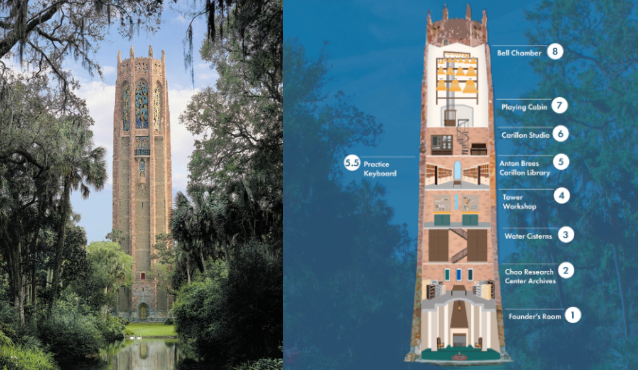
Image sources:
Comments
No comments yet. Start the conversation.