
Bitcoin & Scaling#
Finding A Geometric Approach for Optimal Channel Rebalancing: A Payment Channel Liquidity Management Framework#
Rene Pickhardt shares his latest research note A Geometric Approach for Optimal Channel Rebalancing. This theory builds upon the mathematical theory of payment channel networks and provides a framework to improve liquidity management in payment channel networks.
- Motivation: While off-chain rebalancing does not affect the expected rate of payment feasibility in theory, in practice, unbalanced channels lead to frequent routing failures even if the payment was feasible. This notebook investigates whether structured, globally optimal replenishment can mitigate this issue—even when starting from a severely depleted network.
- Method: Formulates liquidity balancing as a constrained optimization problem
- Objective: Find the closest feasible liquidity state to a target (e.g., balanced channels)
- Solution:
- Continuous relaxation via Quadratic Programming for fractional flows;
- Integer Linear Programming via Integer Linear Programming to enforce satoshi constraints and make sure nodes do not lose money.
Breaking OP_RETURN Limits with Hop-Return: An Innovative Approach for Non-Standard Tokens (NST)#
The OP_RETURN output in Bitcoin has long been seen as a simple data carrier — ironically, its strict size limits make pushing these boundaries especially attractive. The Hop-Return protocol embraces this unconventional power by using very large, non-standard OP_RETURN payloads to achieve standardized, secure on-chain transfers. Unlike Ordinals, Hop-Return operates on an account-based model and completes token transfers via OP_RETURN outputs. As a meta-protocol, Hop-Return embeds UTF-8 encoded JSON messages into non-standard OP_RETURN outputs, serving as the transmission layer for NSTs (Non-Standard Tokens). Because each Hop-Return-based NST must contain at least 100 bytes of OP_RETURN payload, under current node relay policies these are classified as "non-standard transactions." NSTs are optimized for large OP_RETURN transactions and implement a structured, protocol-driven issuance mechanism.
The article discusses how the seemingly arbitrary OP_RETURN size limit is actually the core appeal of this protocol. It explains the NST issuance mechanism and highlights the unique cryptopunk-style innovation arising from "bending" Bitcoin’s standard transaction rules.
Block Number-Based Address Clustering for Bitcoin Taproot Upgrade#
Bitcoin address clustering is a technique used for Bitcoin deanonymization to determine address ownership. It serves as a valuable method for assessing the level of anonymity within the system and detecting addresses associated with illicit activities. The Taproot soft fork in Bitcoin has introduced significant privacy enhancements, making deanonymization more challenging.
This paper proposes a novel on-chain heuristic approach, block number-based address clustering, which leverages the fundamental principle of 6 block confirmations for double-spending prevention. By relying on the trust relationships between transacting parties, our method enables the generation of clusters even upon the soft fork, where existing methods encounter challenges.
To evaluate our heuristics, researchers analyze the approach using the address reduction ratio and pure contribution as key metrics. The results show the effectiveness of our method both before and after the soft fork, which implies that our approach remains unaffected by the usage of Taproot transactions. Furthermore, they provide real-world empirical cases that validate the practicality of our heuristics. As shown in the investigation cases conducted by the Korean National Police Agency, our method can generate new clusters and improve address ownership identification compared to the previous approaches.
Find more details in the paper: Block Number-Based Address Clustering for Bitcoin Taproot Upgrade
Round-Efficient, Adaptive Secure Threshold Signature Scheme with Rewinding#
A threshold signature scheme allows distributing a signing key to n users, such that any t of them can jointly sign, but any t − 1 cannot. It is desirable to prove adaptive security of threshold signature schemes, which considers adversaries that can adaptively corrupt honest users even after interacting with them. For a class of signatures that relies on security proofs with rewinding, such as Schnorr signatures, proving adaptive security entails significant challenges. This work proposes two threshold signature schemes that are provably adaptively secure with rewinding proofs. Our proofs are solely in the random oracle model (ROM), without relying on the algebraic group model (AGM).
Find more details in the paper: Round-Efficient Adaptively Secure Threshold Signatures with Rewinding
MnemonicMaker: Gamify Mnemonics Memorization#
MnemonicMaker is a serious game applying the Method of Loci technique via interactive gameplay to improve users’ memorization of BIP 39 mnemonics.
A user study with 38 participants over two months evaluated its advantage over traditional memorization. Results showed MnemonicMaker users maintained significantly higher recovery success rates after 60 days. Most users needed minimal practice to learn the routes, indicating a gentle learning curve.
The study demonstrates that gamified spatial memory techniques can effectively address mnemonic memorization difficulties while maintaining high user engagement.
Nostr-Based Global Bitcoin P2P Exchange Aggregator#
P2P.BAND is an exchange aggregator that collects P2P Bitcoin offers published on the Nostr protocol, helping users worldwide find trading counterparts. Users can filter offers based on trusted contacts and sign confirmations.
BitVM Latest Improvements: Off-Chain SNARK Verification with Garbled Circuits and Optimistic Computation#
Robin Linus introduced BitVM3, a protocol balancing implementation complexity, communication overhead, and verification cost.
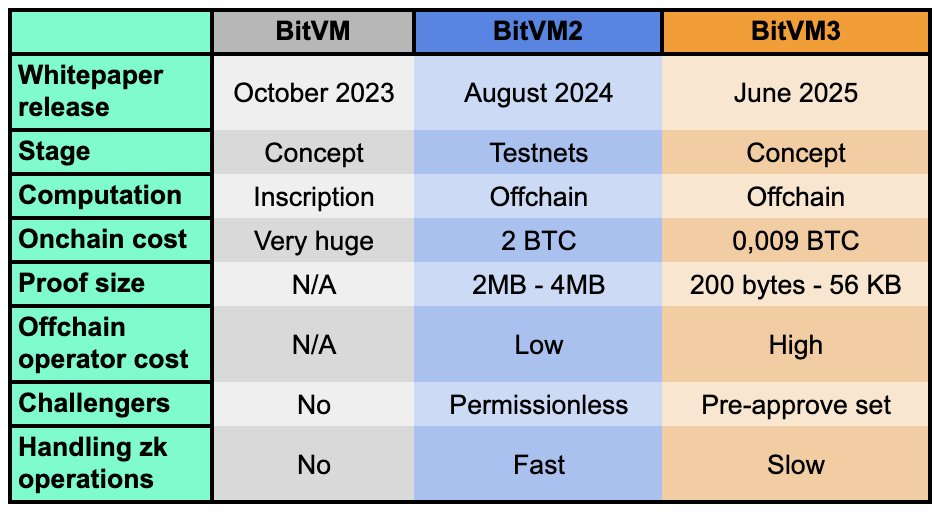
BitVM3 verifies SNARK proofs on Bitcoin while significantly reducing on-chain cost compared to BitVM2. It combines optimistic computation with RSA-based garbled circuits to perform SNARK verification off-chain. In case of disputes, validators generate compact fraud proofs. On-chain transactions are very efficient: assertion transactions (assertTx) are about 56KB, while dispute transactions (disproveTx) are only 200 bytes, reducing on-chain dispute costs by over 1000 times compared to previous designs.
Inspired by Jeremy Rubin’s Delbrag scheme, BitVM3’s key innovation is performing verification in plaintext before reblinding, solving Delbrag’s main drawback—dependency on either costly circuit correctness proofs or 200KB disprove scripts.
However, the paper notes limitations — it requires terabytes of off-chain setup data. The example SNARK verifier circuit has ~5 billion gates and demands 5TB off-chain setup, 56KB on-chain assertion transaction, and minimal (~200B) dispute transaction.
Find more details in the paper BitVM3: Efficient Computation on Bitcoin.
Additionally, Eugene Bulltime also highlighted BitVM3’s shift to using garbled circuits enables fully off-chain zk-proof generation and compares BitVM, BitVM2, and BitVM3.
Introduction to the Transfer of Ownership Protocol (TOOP)#
This article introduces TOOP — a BitVMX-based system enabling trustless cross-chain transfer of Bitcoin-native assets without centralized custodians or pre-registered receivers.
Find more details in the TOOP paper.
GOAT Network Launches zkRollup Economic Model to Solve BitVM’s Major Challenge: Incentives#
GOAT Network announced a Bitcoin-native zkRollup economic model ensuring fairness, security, and sustainability. Key features:
- Universal Operator Rotation: Multiple roles involved in Rollup unified under a "Universal Operator" role that rotates among participants over time;
- Multi-Round Challenge Model: Each round randomly assigns a challenger; if fraud is detected, the previous round’s challenger who did not act is penalized; finality reduced from 14 days to 24 hours; maintains 1-of-n honest assumption and high coverage;
- Aligned Incentives: Role assignment and cross-subsidies encourage consistent honest participation; challengers are rewarded for honesty; dishonest operators or false challengers are penalized.
StarkWare Funds Research on OP_CAT’s Impact on Bitcoin#
StarkWare announced funding Post Capone to research the potential impact of OP_CAT on Bitcoin, especially regarding enhanced scripting capabilities and their effects on user experience, MEV dynamics, and block production incentives.
How Americans Came to Own 40% of All Bitcoin#
River Finance released a report titled America’s Bitcoin Advantage: How Americans Came to Own 40% of All Bitcoin which aims to help U.S. individuals, business leaders, and policymakers better understand Bitcoin’s development in the U.S.
The report attributes the U.S.’s sustained success largely to its embrace of emerging technologies. Today, the U.S. again leads at the forefront of technology — one that aligns deeply with American values: individual rights, free markets, and innovation. Although Bitcoin belongs to all humanity, the U.S. occupies a unique leadership position. By leveraging this advantage, Americans have the opportunity to further consolidate economic strength and global leadership.
Broader Perspectives#
6 Practical Use Cases for DePIN#
An article by a16zcrypto points out that DePIN (Decentralized Physical Infrastructure Networks) protocols offer an alternative to today’s monopolized, opaque, and outdated infrastructure systems by reimagining them as user-owned, permissionless, open networks. This lowers entry barriers, incentivizes innovation, distributes ownership, and shares economic returns across almost all categories relying on large physical infrastructure systems. The six categories where DePIN has made progress are: energy, telecom, transportation, AI, robotics, and healthcare.
Comments
No comments yet. Start the conversation.