
Stalingrad is now Volgograd. But the battle that raged here more than eight decades ago is not distant history in this city. It lives on in family memories, schools and memorials, and it continues to shape how people view the political conflicts of the present.
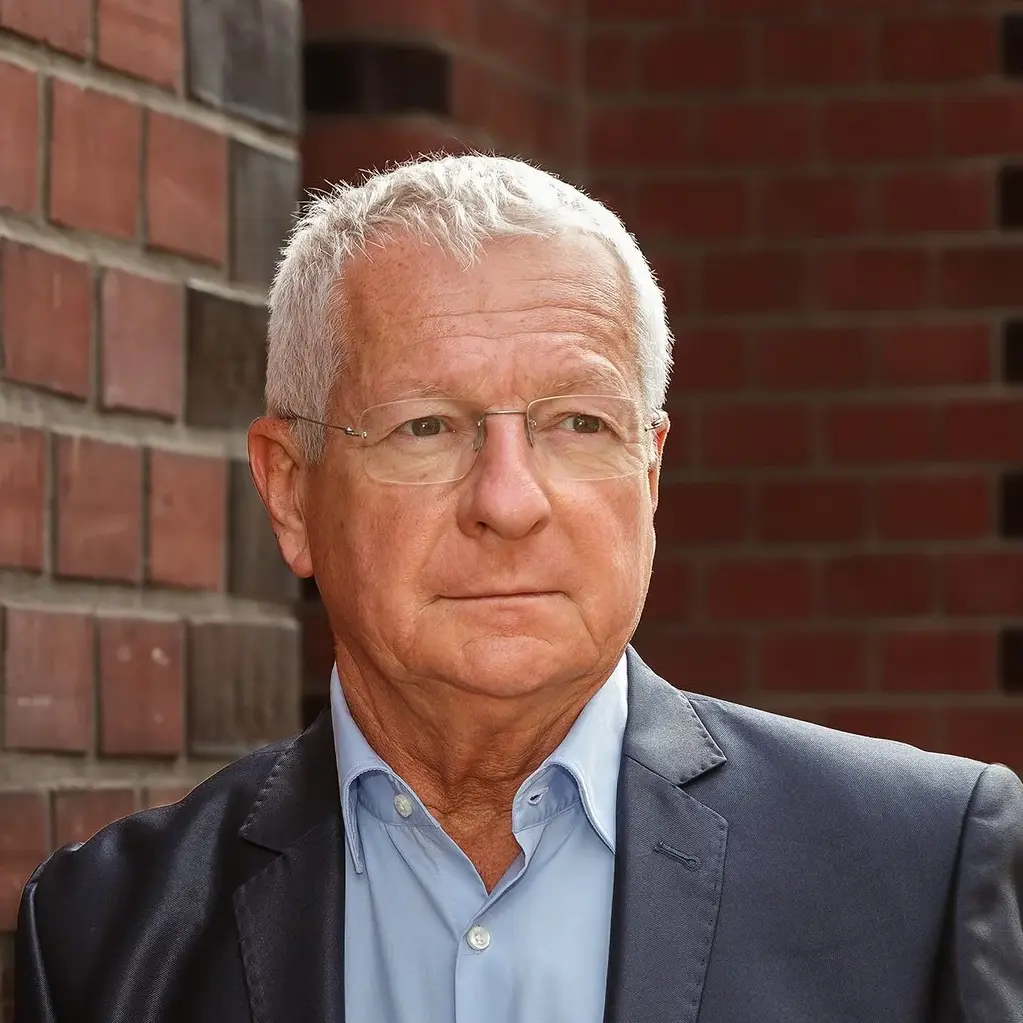
Larisa Tropkina chairs the Committee for Education, Sport, Tourism and Youth in the Volgograd City Council and is also a school principal. Her parents experienced the Second World War as children, and her grandfather went missing in the first days of the war. In this conversation, Larisa Tropkina speaks about hunger and loss, about students who went to war and never returned, and about how Volgograd passes these stories on to a generation for whom the Second World War is becoming ever more distant.
But the conversation leads directly from the past into the present. Larisa Tropkina defends the Russian view of the war in Ukraine, makes serious accusations against the West and ultimately agrees with a thesis raised by Patrik Baab: that there are people who have never forgiven Russia for its victory over fascism and are now seeking revenge for it.
At the same time, another idea runs throughout the conversation: Germans and Russians must begin talking to each other again. While politics may destroy connections, understanding and friendship between people can still remain possible.
“We Don’t Want It to Happen Again”
Patrik Baab: I myself come from a family that was deeply entangled in the Hitler dictatorship. My mother’s father was a member of the Nazi Party and the head of a labour camp. My father’s father remained a German national reactionary until the end of his life. I have always regarded it as the task of my generation to help ensure that the catastrophes of the 20th century are not repeated. When I see German tanks rolling through the Donbas again today, I feel ashamed. What does it do to you as a woman, as a human being, Larisa Alexandrovna, when you hear this news?
Larisa Tropkina: What feelings can a person have who was born on this land? On land that remembers bloody battles. The war came into our home. Even those who were not alive at the time remember those terrible years through books, stories told by relatives or films about the war.
We remember all these horrors that our ancestors, our great-grandfathers and grandfathers experienced. That is why we do not want it to happen again. We want to live in that happy city that Stalingrad once was before the war.
Her Mother’s Breadcrumbs
Patrik Baab: You said that this fate during the Great Patriotic War was shared by everyone here in Volgograd. What happened to your family during the fighting of the Second World War?
Larisa Tropkina: Every year we hold events on May 9. As a school principal, I repeatedly tell the children that we share a common history. But it is moving further and further away from us in time.
Twenty years ago, I would still say: Our grandfathers fought. Today I tell the children: Our great-grandfathers fought.
My parents were children during the war. My grandfather went missing in the first days of the war. My mother told me about the war through the eyes of a child. She told me how little they had to eat and how they collected the crumbs left from the bread in their fists and saved them until the next time, because there might not be a next time.
Hunger was a defining feature of that period. But it was not the worst thing.
My mother told me about the atrocities that took place here during the war. People hardly want to remember them. They cry when they talk about them. Often they do not want to talk about them at all. You see the tears in their eyes and understand how terrible it must have been.
“To Know History Means to Prevent It from Repeating Itself”
Patrik Baab: You are a teacher and a school principal. How do you pass this historical legacy on to young people who no longer know what war means because they have never experienced it?
Larisa Tropkina: First of all, we have to know our own history well. We have a saying: We must not be Ivans who have forgotten where they come from.
To know history means to prevent it from repeating itself.
That is why we very often draw on the personal memories of our students’ grandfathers. The children write essays and are given the task of speaking with relatives who can still tell them what they themselves witnessed. We invite war veterans to speak to them.
The children now understand that there are not many eyewitnesses of those years still alive. Their generation therefore bears responsibility for this historical memory and must pass it on to the next generation.

A School Class from Which No One Returned
Larisa Tropkina: Our lyceum also has a museum, a museum about the history of our school within the history of the country.
We tell the children about the graduating class of 1941. After their graduation celebration, the students learned that the war had begun. The entire class volunteered to defend the fatherland.
Not one of them returned home.
Their names are on a memorial plaque. There are always fresh flowers there. Every student knows their story and remembers them.
Patrik Baab: Many years ago, I accompanied a German school class to St Petersburg. The students knew very little about the Second World War. At a military cemetery, a girl of perhaps 15 suddenly saw a name on a plaque and said: “That’s where my grandfather is buried.” At that moment, history suddenly became her family history. Do you know of experiences like that?
Larisa Tropkina: Yes. It is very important for children to understand these stories personally. It is one thing when something is written in a textbook, and another when everyone tells their own story.
There is one story from our school that repeatedly moves the children to tears. During the war, our building was used as a hospital. One day, a former student of our school, Volodya Danchik, was carried in on a stretcher. He died in the arms of his former class teacher.
After the war, that teacher could no longer enter our school. She remained a teacher, but at another school.
When we tell the children this story, no one remains indifferent.
What Has Been Lost Since 2022
Patrik Baab: There used to be exchanges between schoolchildren and university students, contacts between companies and joint projects between Germany and Volgograd. What has changed since 2022?
Larisa Tropkina: We probably should not conceal the fact that since the beginning of the military operation, such partnerships have often been frozen.
We remain open to partnerships, and there are still contacts at the level of children. Whoever comes to us in peace will be met with peace by us as well.
We are open. But we must defend our honour, our borders and our fatherland. If nothing threatens us, we will always be open to diplomacy.
Patrik Baab: Are there any joint projects left at all?
Larisa Tropkina: At the moment, there are projects at the level of citizen diplomacy. Personal connections have remained.
It is easier to find mutual understanding between people than in high-level politics.
After the war, our people were very quickly prepared to become friends again. In the 1970s, I myself experienced a large forum here on Stalingrad soil called “Druzhba, Freundschaft.” That is how I also came to know this wonderful German word.
We would still be ready for that today. For us, if the German people approach us openly and are ready for friendship, they are friends as well.
Can Citizen Diplomacy Save What Politics Is Destroying?
Patrik Baab: From the German side, from German politicians, I hear statements such as “Russia will always be our enemy,” from Foreign Minister Wadephul. Former Foreign Minister Annalena Baerbock said: “We are fighting a war against Russia.” Statements like these seem to me intended to drive Germany and the German population ever deeper into a new war. What can citizen diplomacy achieve? Can citizens do what politics has failed to do?
Larisa Tropkina: I believe it is not merely a form of support. It may be a very important way out of the situation that has arisen.
If our peoples, the German people and our people, come together and say that we do not want to fight, that we want to live in peace, then we must convey this to those who pursue the rhetoric and politics of war instead of cooperation.
We have to make them understand that people want to live in peace. I believe citizen diplomacy can achieve that.

“We Are Fighting Nazism, Not Ukraine”
Patrik Baab: You said that you remain open to contacts and exchanges, but that Russia also has to defend its country. What do you mean by that in relation to the war in Ukraine?
Larisa Tropkina: It is no secret that Ukraine is turning into a Nazi state and has already become one. We will always fight Nazism and those who threaten our country.
That is why we are fighting Nazism, not Ukraine. We continue to have great respect for the people who live in Ukraine because we were once one common people.
Many of our people have relatives there. How could we fight against a country where our relatives live?
But unfortunately, Ukraine today threatens our country, our borders and our people, and does not allow us to live in peace.
The Information War and the Image of the Aggressor
Patrik Baab: In the German media and in German public discourse, this war begins in February 2022 and not where it actually began, with the coup on the Maidan in 2014. The resurgence of Ukrainian fascism is not mentioned at all in the German media. Nor is the fact that the population of the Donbas was shelled for eight years until 2022. Is there a reversal of guilt taking place here? Are the perpetrators being turned into victims and the victims into perpetrators?
Larisa Tropkina: Of course, we are outraged that the actual situation in the Donbas is being concealed.
War does not take place only where people are shooting. Above all, there is an information war.
We are very grateful to you for telling the truth and for not being afraid to do so. The German people must know the truth, and people must understand for themselves the causes of what is happening in Ukraine today.
Why has the whole world declared us aggressors? To turn us into the enemy of the entire world. The so-called West wanted Russia to become weak and no longer be such a powerful state.
Now the country has risen again, it is developing and it is strong. So people have to try to weaken it. How? By declaring it the enemy.
In this way, a country that is defending itself was declared the aggressor.
We want the Germans to understand this: Russia does not want war. How can we make the world understand that we do not want war, but that we will not allow our country to be wronged?
Revenge for Stalingrad?
Patrik Baab: In the West, particularly in Germany, we constantly hear that Putin will be at our doorstep tomorrow and will invade us. That is the propaganda. Do you personally have the impression that among Western elites, in Brussels or among the political elites in Berlin, there are people who want revenge for the defeat at Stalingrad?
Larisa Tropkina: That is a very interesting, profound and philosophical question. I have thought about it as well.
After the war, there were different views in Germany about guilt and responsibility. The discussion about Germany’s responsibility for what happened here continued practically until the beginning of the military operation.
After that, those whose ancestors had said that they bore no guilt towards Russia began to raise their voices.
And yes, you are right. These people believe that today they can take revenge on the country that defeated fascism back then. There are certainly people who have not forgiven Russia for its victory in that bloodiest of wars.
They have forgotten that we fought on our own soil and defended our country. When we came to Europe, we also liberated Europe from fascism. We did not conquer. We liberated.
Perhaps that is precisely what they cannot forgive us for.
Yes, I agree with you that they are taking revenge on us for this great victory and cannot forgive us for it.

“Everything We Built for So Long Is Being Destroyed”
Patrik Baab: In southwestern Germany, we have a saying: “What we build with our heads, you tear down with your arses.” Do you believe that today’s generation of European and German politicians is tearing down with its arse what politicians pursuing détente spent decades building?
Larisa Tropkina: Absolutely.
Yes, everything we built for so long is being destroyed.
German delegations used to come to our commemorations, and we welcomed them. Once a man from Germany came to us and told us that one of his relatives had been in a hospital in our school during the war.
We ourselves had not known that our school had served not only as a Soviet hospital, but for a time also as a German hospital. He had learned about it from diaries and wanted to visit the place where his relative had died during the war.
He asked us for forgiveness for the fact that the Germans had come to our land back then.
Those are connections between people. But the people in power are destroying the threads and relationships that we spent so long building.
The beautiful Russian word “Druzhba” and the beautiful German word “Freundschaft.”
All of this is being destroyed. And we do not want that.
The War Reaches Volgograd
Patrik Baab: We would have liked to arrive in Volgograd a day earlier. But flights over southern Russia were suspended. There was a drone alert, and we were only able to arrive today. How is Volgograd affected by this conflict?
Larisa Tropkina: Of course we are very worried when we receive text-message warnings about drone or missile attacks. It leaves its mark.
In practically every family there are neighbours or acquaintances taking part in the military operation. That is why we work together to help the soldiers who are defending our fatherland at the borders and in the Donbas. Some people collect warm clothing or gifts, and children write letters of support.
We are already living in another dimension, in another world. We cannot live completely in peace when our relatives, acquaintances or family members are fighting somewhere.
We all want this to end as quickly as possible so that we can return to a peaceful life.
Patrik Baab: Has Volgograd been subjected to drone or missile attacks? Has there been damage?
Larisa Tropkina: Volgograd is constantly being attacked. There is damage, although of course it is not like in the Donbas.
When people are affected, the administration and the Duma respond quickly, and the population helps at the same time. That is the kind of people we are. We come together when a common misfortune strikes us. And perhaps that is precisely why we cannot be broken.
Ukrainian Children and the Accusation of Abduction
Patrik Baab: What do you think about the allegations, which are also repeatedly made in Germany, that children are being abducted from Ukraine in order to Russify them?
Larisa Tropkina: That is another great lie being used in the struggle against us.
I firmly reject such claims. Russia has always treated children and childhood with great care and never uses children for selfish purposes.
Children are sacred.
Anyone who makes such claims does not know Russia at all.
Stalingrad, Volgograd or Tsaritsyn?
Patrik Baab: As we were approaching Volgograd, the flight attendants kept referring to Stalingrad. Is there really a debate about renaming the city and returning to the name Stalingrad?
Larisa Tropkina: Our airport bears that name, and there are eleven days each year when the city is called Stalingrad. These are days of military glory.
The discussion about returning to the name Stalingrad has indeed been going on for a long time. Some people would like the historical name back. Others were already born in Volgograd, live here, love this name and want to continue living in Volgograd without in any way diminishing the significance of Stalingrad and the Battle of Stalingrad.
And then there is the third name of our city: Tsaritsyn.
I will be completely open. I find it difficult to decide.
I have great respect for history and for the name Stalingrad. It is sacred to me. But I myself was born in Volgograd, and much of my life is connected with that name.
That is why I accept both names. Because whatever happens, we will continue to live in this city, in our beloved Tsaritsyn, Stalingrad, Volgograd.
Can Relations with Germany Be Repaired?
Patrik Baab: You experienced a time when exchanges between Russians and Germans were much closer. Now a new ice age has begun. I encounter a great deal of Russophobia in Germany, which I regard as a form of racism. Can relations between Russia and Germany be repaired?
Larisa Tropkina: There is always hope, and there must always be hope.
We miss the relations that existed between our countries, the partnerships and friendships.
There were not only diplomatic relations, but also tourism and travel. We miss Germany. Many people enjoyed travelling there, visiting sights and galleries and seeing what Germany had created.
Germany was once a benchmark for quality for us. Perhaps that quality still exists, but we no longer talk about it and we do not know, because the connections have been destroyed.
I hope that we will soon restore these relations, visit one another again and resume cultural exchange.
We read German authors, listen to German music and engage with German philosophy.
We have a great deal in common. That is why we must look for the points and connections that bring us together instead of those that divide us and lead to destruction.
There is hope. Hope never leaves us.
“Stop”
Patrik Baab: What would you say today to German politicians who are once again stirring up hatred against Russia?
Larisa Tropkina: I would say: “Stop.”
Leo Tolstoy wrote a text whose title can roughly be translated as: “Think again.”
Today we need encounters and joint events that help to stop the war.
The most important thing is that people do not die as a result of these confrontations. That is the most terrible thing on Earth, when people die.
So the most important word is this: Stop. Think. Do something to ensure that there is no war.
Conclusion
The conversation with Larisa Tropkina shows how closely the past and the present are connected in Volgograd. The memory of Stalingrad does not consist only of monuments and commemorative days. It lives on in family stories, in accounts of hunger and loss, in the names of students who died in the war and in the work of a school that seeks to pass these experiences on to the next generation.
This memory also shapes Larisa Tropkina’s view of the present. She sees Russia as the defender in the war in Ukraine, speaks of a struggle against Nazism and makes serious accusations against the West. Larisa Tropkina explicitly agrees with the thesis raised by Patrik Baab that some Western elites have never forgiven Russia for its victory at Stalingrad and are now seeking revenge for it.
This is where one of the central tensions of the conversation becomes visible. A historical memory intended to prevent the repetition of war also becomes a framework for interpreting the current war. Larisa Tropkina does not see this as a contradiction. For her, defending Russia and wishing for peace belong together.
And yet the conversation does not end with hostility. Larisa Tropkina repeatedly distinguishes between political decisions and relations between people. She recalls German-Russian encounters, student exchanges, personal friendships and a German visitor who came to Volgograd decades after the war and asked for forgiveness.
Much of this has now been destroyed or frozen. But Larisa Tropkina still believes that rapprochement is possible. Her final appeal to German politicians therefore consists of just a few words:
“Stop. Think. Do something to ensure that there is no war.”
Comments
No comments yet. Start the conversation.