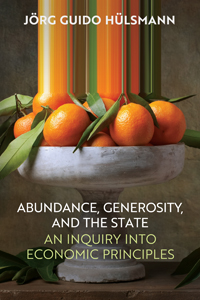

Jörg Guido Hülsmann's Abundance, Generosity, and the State builds an economic theory of gratuitous goods on a property-based definition. A good is gratuitous when someone provides or receives it beyond legitimate claims and obligations, so a zero cash price proves insufficient: a robber pays nothing for his loot, and his haul remains plunder. The same good can cost its provider dearly and still be gratuitous for its recipient, and a freshly painted house in one of his hypotheticals gives passersby a free view, although a deliberate trip to admire it costs time. His later classifications, above all of the state, depend on that property premise. The Mises Institute offers a free PDF of the 2024 English edition.
A donation, in his restrictive sense, is devoted to a person or cause beyond the donor, is unconditional, stays voluntary within property rights, and costs the donor personal time or savings. A grant expects some return or reciprocity, and spontaneous benefits arise as side effects of action aimed elsewhere. Other gift theorists draw these lines differently, and Hülsmann concedes that pure gifts may be rare while holding that their donor still pursues an end and weighs means. The frame is openly Christian, beginning with Benedict XVI's 2009 encyclical Caritas in Veritate and Josef Pieper, yet the economics is argued on its own terms, and Hülsmann disputes some of the encyclical's conclusions.
The economics turns on saving. As savings accumulate, the expected return on further capital tends to fall, and with it the income a saver forgoes by giving money away. Donations therefore tend to grow faster than for-profit activity during savings-driven growth. Hülsmann limits the claim: new resources and better organization or technology raise returns and counteract the fall, so growth from those sources gives no systematic push to giving's share of wealth. A slump that weakens demand for capital also lowers its return and thereby the opportunity cost of giving, while falling incomes work against donations. Either force may dominate, so in that case the effect on giving's share is indeterminate. His conclusion nonetheless holds that gratuitous goods in a free economy tend to shrink faster than the market in downturns. Virtue stays a personal choice, since lower opportunity costs make generosity cheaper while each owner decides whether to give.
Market exchange supplies a second source of gratuitous goods. In the book's trade between Brown and Smith, each party values what he receives above what he gives, so each gains more, by his own subjective estimate, than the price that discharges his obligation. Each trader anticipates his own gain, and his partner's gain arises as a side effect, whatever either intends. The argument assumes legitimately owned goods and free, informed consent, and fraud or force places a transaction outside it. Competition and pricing thus spread gratuitous side effects through ordinary commerce.
The same property baseline governs his treatment of the state. Within his rights framework, tax-funded services fall outside the gratuitous category because taxpayers are compelled to finance them, though he grants that recipients benefit and administrators work sincerely for their pay. Monetary intervention, he contends, enables debt-financed investment, and borrowing can raise the return on owners' equity even while the return on total capital falls. Where borrowing lifts the return on equity above what the owner's capital would earn on its own, it can raise the opportunity cost of giving and reverse the saving mechanism, while constrained incomes leave others with less to give. His worked illustration assumes the indebted business performs as planned.
Chapter 11 states the limits of its evidence. Its long-run American series counts monetary gifts to charitable intermediaries and excludes bequests and direct gifts along with all donated time, so it measures one channel of giving. The separate time-use series he consults begins in 2003, a span he judges too short for tracing long-run policy effects. Hidden motives add a second limit, since outsiders would need to see into the giver's intentions to tell a gift from a reciprocal grant. Two hypotheses close the chapter: that decades of intervention, monetary policy above all, likely reduced time and money donations relative to income and wealth, and that the decline is probably mildest in monetary giving to charities.
The book's conclusion insists that a free economy and one inflated by monetary intervention obey different laws, and Hülsmann faults Aristotle, Belloc, Polanyi and Marx for attributing to free markets disorders he traces to inflationary money.
Comments0
No comments yet. Start the conversation.