
Read on Substack: https://bitkarrot.substack.com/p/the-circular-zap-o-conomy
Here’s a sentence that stops most people cold: “Bitcoin fails as a currency if it’s not used as payments.”
Not stores it. Not trades it. Uses it — in exchange for things, between people, over and over, in a circle.
That’s the opening move of the Purple Pill for Bitcoin Meetups talk I gave at the January 2026 Presidio Bitcoin Nostr Meetup in San Francisco (slides here). It’s about a lot more than one meetup — it’s a practical argument that the local Bitcoin meetup is where a circular economy actually gets built, and that Nostr is the missing glue.
Nostr: the world’s largest Bitcoin circular economy#
The talk’s central claim, straight from my slides:
“Nostr is the world’s largest Bitcoin circular economy.”
That sounds like a stretch until you break down what’s already happening there:
- High-velocity transactions. Zaps — small Lightning payments — move constantly, all day, between real people, for real content and work.
- Global connections, 24/7. No bank hours, no borders, no approval queues.
- More local networks needed. Global is great. But for a true circular economy, value also needs to circulate locally — with the people you can actually meet.
The January data behind it: as of mid-January 2026, global Nostr activity showed exactly the high-frequency, person-to-person payment pattern you’d want. And the West Coast numbers showed the flip side — activity concentrated in a few hotspots, with plenty of room for new local networks to form.
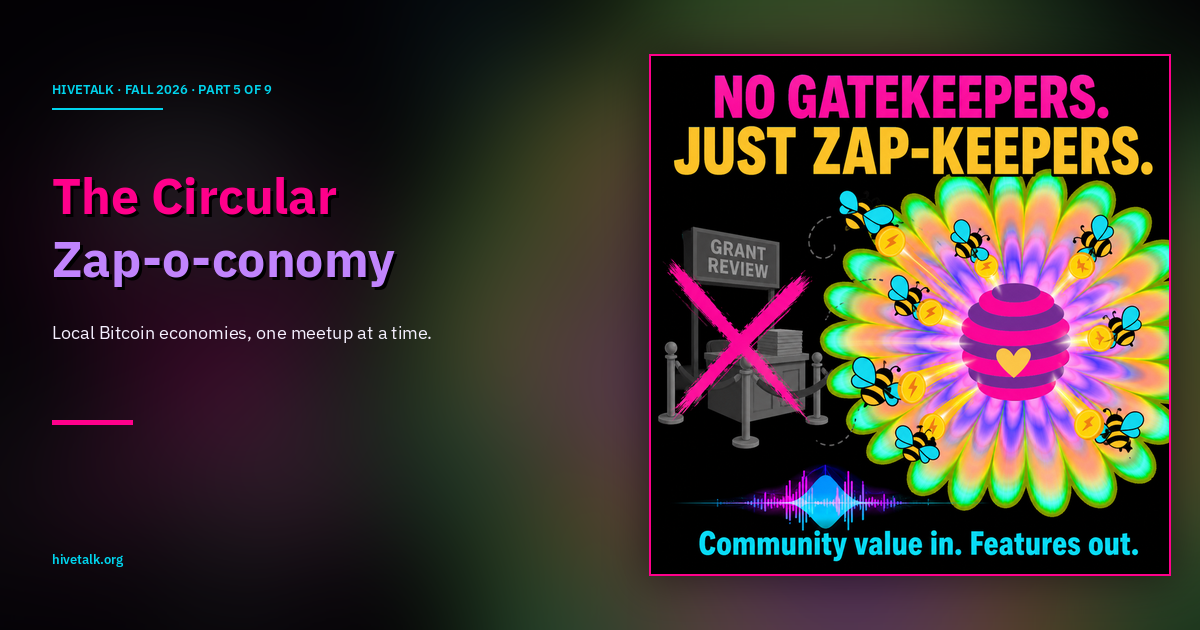
The Circular Zap-o-conomy#
The talk’s proposed model, in the deck’s own words:
“We need more locally driven and virtual circular economies. Each local meetup should run their own relay and Purple Pill. Let’s drive Nostr usage via meetups & encourage micro business.”
What that means in practice:
- Every local meetup is a node in a real economy, not just a social gathering.
- The meetup runs its own relay — its own piece of infrastructure — so it isn’t dependent on anyone else’s servers.
- Members zap each other, buy and sell to each other, and keep sats circulating within the group before they leak out to exchanges.
- The apps that help: AQSTR (zapvertising — pay-per-attention instead of ads), plus marketplaces like Plebeian Market and Shopstr.
My framing is old-school: meetups were always the beating heart of Bitcoin. What’s new is that a meetup can now own its own communication rails, its own payment rails, and its own event calendar — all open, all interoperable, none of it owned by a platform.
What a meetup host should do#
The practical starter list from the slides:
- Get everyone a Nostr keypair. Onboarding starts with keys, not emails.
- Set up a relay and add everyone. Your meetup’s little piece of the network.
- Active engagement is key. Tools without usage are dead.
- Explore apps that circulate sats. AQSTR, Plebeian Market, Shopstr.
And the “Nostrized Meetup sites” idea, for anyone still using Meetup.com: events you publish show up across apps, not just on your site.
One important detail the talk kept coming back to: the missing piece is relays. Specifically, can a non-technical person run one? My answer: yes — and that’s the whole point. (More on the how below.)
Freedom of speech, connected to freedom of commerce#
The closing line of the deck is the one that ties it all together:
“Freedom of Speech — is connected to — Freedom of Commerce.”
A meetup that can talk on its own rails, pay on its own rails, and organize on its own rails isn’t just a club. It’s the smallest viable unit of a parallel economy — and it’s reproducible in every city that wants one.
Read the full post on Substack: https://bitkarrot.substack.com/p/the-circular-zap-o-conomy
Comments
No comments yet. Start the conversation.