
I have some alternative facts
As someone who has lived for decades in both the USA and Germany, I have deep insight into the similarities and differences between the two healthcare systems.
The similarities#
If you are really rich or you have excellent, generous, private health insurance (i.e. you are really rich), then you can get world-class healthcare in fancy clinics that serve you espresso and give you a manicure while your personal oncologist arrives to tell you all about how you will soon be receiving the same world-class healthcare most of the other people in the same country also receive, but a bit sooner and your room will have a most excellent view and high threadcount bedsheets.
In both countries, if you are employed full-time, your employer probably pays at least part of your health insurance costs out of pre-tax wages.
In both countries, nearly everyone has some form of health insurance coverage.
In both countries, the health insurance companies and healthcare service providers (hospitals, doctors' offices, pharmacists, dentists, etc.) are under licensing regimes and must follow federal and state regulations for coverage and care.
The differences#
In Germany, that "nearly-everyone" is 0.1% of the residents, and in the USA it's 8%. That is a distinction with a tangible difference. That is due to the USA -- alone among all developed countries -- having no universal coverage compulsion.
The reason the USA has such a weird gap in their health care system is because:
- They use healthcare provision to push people toward certain employment sectors, such as civil service, large multinational corps, and the military. Health care is reduced to being a job perk, along with getting 10% cash back at Walmart and a free company parking space.
- Employers struggled with wage controls during WWII and got around them by offering health insurance, to sweeten their contracts.
US health insurance is both bizarrely expensive and tax-advantaged. So, if you raise your employees salaries by $5 of wages they may only net $2, but if you raise them by $5 of health insurance, then they net $5 more of insurance. What they do not get is $5 of additional health care.
Now that these two things are entrenched, there are massive federal lobbies arguing for them to stay in place, due to "the free market". In a free market, consumers would tend to get more of what they want (better health and longer life-expectancy), but the US market structure gives them more of what they don't want (worse outcomes, financial ruin, mounds of paperwork and legal stress, etc.)
And once the employer-provided healthcare recipients started aging and moving toward retirement, everyone realized that they would fall off of the health insurance and they were too old to be attractive to private insurers, so they stuffed that hole with government-provided Medicare. And it also dawned on them that some people would never work, so they added Medicaid.
Military-associated people get Tricare and VA (Veterans Affairs), about 4% of healthcare recipients.
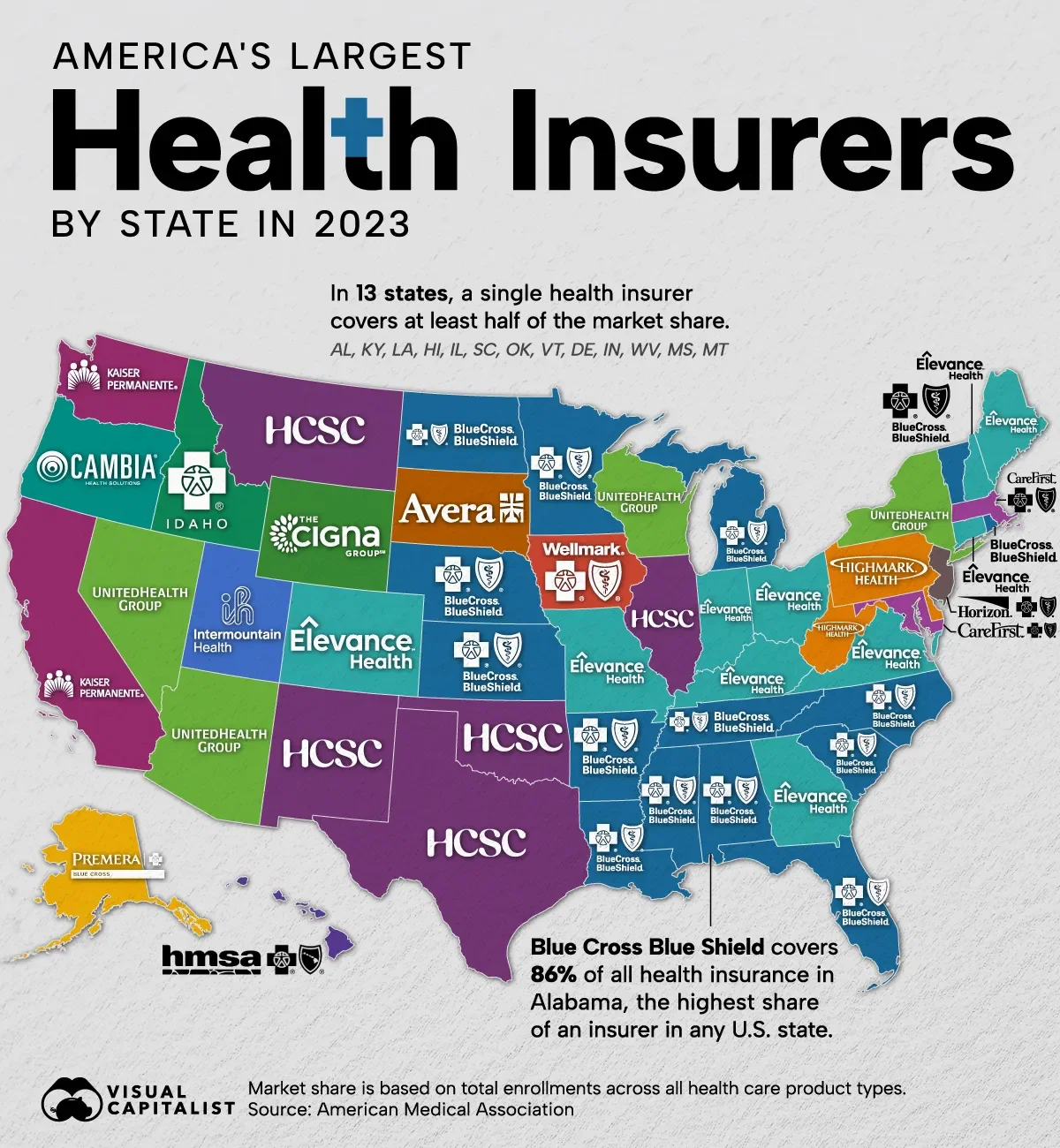
In this "free market" for healthcare, only circa 10% of people of people purchase insurance directly, mostly over a government-run, subsidized market (ACA). The market is highly-concentrated at the regional level, so there is often merely the Illusion of choice.
The great irony is that the USA doesn't have universal healthcare due to government regulations and chronic market interference. This is not the sort of healthcare system anyone would choose to have.
Comments0
No comments yet. Start the conversation.