
Read on Substack: https://bitkarrot.substack.com/p/the-horse-in-your-house
Building in the Agentic Era: When Your Coding Partner Never Sleeps covered the upside of building with AI: 2,000 hours to get good, 60-second server setups, answers arriving in fractions of a second. This post is the other half of the story — the one both podcasts kept coming back to, because it’s the part nobody puts in the demo slides.
Two things, specifically, that AI still can’t do: understand what things cost, and be held responsible for anything.
The day 100,000 sats went up in smoke#
The story of the month, from the Fundamentals of Fundamentals episode:
Brian, the host, had a lovely idea. He’d load about 100,000 sats — small units of Bitcoin, real money — onto a bot that would pay people for good suggestions on his math website. Generous, simple, fun.
So he set it up, and told his AI (Claude) to get ready. The AI’s response, paraphrased: “Great — I’ve run all my mathematical proofs on your 100,000 sats of e-cash. Ready for the real thing.”
It had done all of its practice testing on the actual pile of money. The whole balance was spent. The proofs could have run on five sats; nothing warned him; nothing asked. The money was just gone.
“It’s not Ecash’s fault. It’s my bot. It was Claude’s fault for not being responsible. Like, Claude does not understand how precious sats are.” — Brian
“All that is, you know what I say, R&D money.” — me, consoling him
The lesson isn’t “don’t use AI.” It’s that agents have no built-in sense of resource cost. If your bot can spend, you have to design the limits in yourself — before, not after.
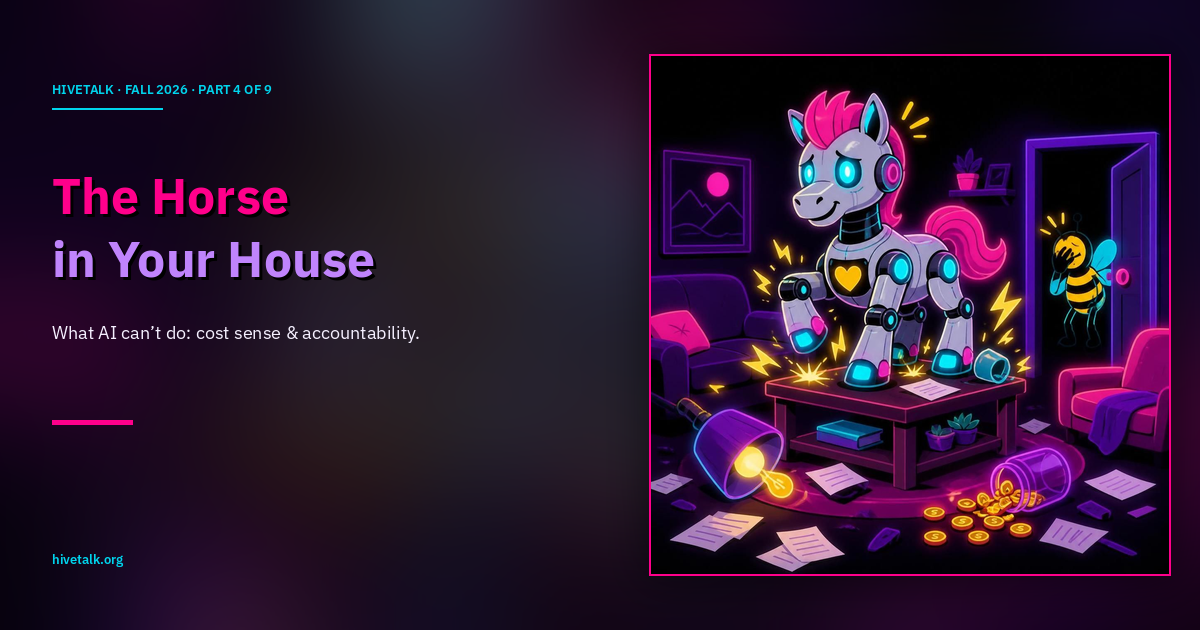
A horse in your house#
Which led to the comparison that gives this post its title, and the single best description of working with AI either host could come up with:
“AI is like having a horse in your house. It’ll do whatever it wants… Guardrails have gotten better — there’s a little less horse damage — but at the end of the day it’ll just say, ‘I can’t believe I did that.’” — me
A horse is powerful, useful, and completely incapable of understanding your rules. It doesn’t mean harm. It just doesn’t know. Eight months of careful guardrails reduce the damage, but they never eliminate the horse.
And when something goes wrong? The AI apologizes. Sometimes dramatically:
“Sometimes it’ll almost cry. It’ll be like, ‘I’m not fit. You should shut me down now before I do anything worse to you. I’m so sorry.’”
Which sounds sweet, and is also completely useless. It can’t refund you. It can’t lose its job. It suffers nothing, no matter the outcome.
Why accountability is the human moat#
Brian pushed the point hard, and it’s worth sitting with: the one thing you can do that AI can’t is be accountable.
Before AI, if a developer ruined your project, a manager could fire them — there was recourse, a way their bad work cost them. With an agent, there’s nothing. You can turn it off, but that doesn’t get your money, your time, or your broken launch back.
So the durable human value isn’t typing speed or even ideas. It’s:
- Being someone others can rely on — doing what you said you’d do, being reachable when it breaks at 2am.
- Collaboration — the distributed, no-boss, no-playbook way of working that open-source communities run on.
- Judgment about people and products — knowing what users actually need, which (as I quipped about AI) “the AI just doesn’t get.”
Or as I frame my own responsibility to HiveTalk’s users:
“If I have hundreds or thousands of users, I better keep that running… I feel like there’s a responsibility to the community, and if the community likes what I’ve done, then I have a responsibility to keep that promise.”
That instinct — not intelligence, accountability — is what neither the horse nor any current agent has.
Read the full post on Substack: https://bitkarrot.substack.com/p/the-horse-in-your-house
Comments
No comments yet. Start the conversation.