
AI Agents Won't Choose How They’ll Pay. Businesses Will Choose How They’ll Be Paid.
Earning comes before paying or saving, for humans and agents alike.
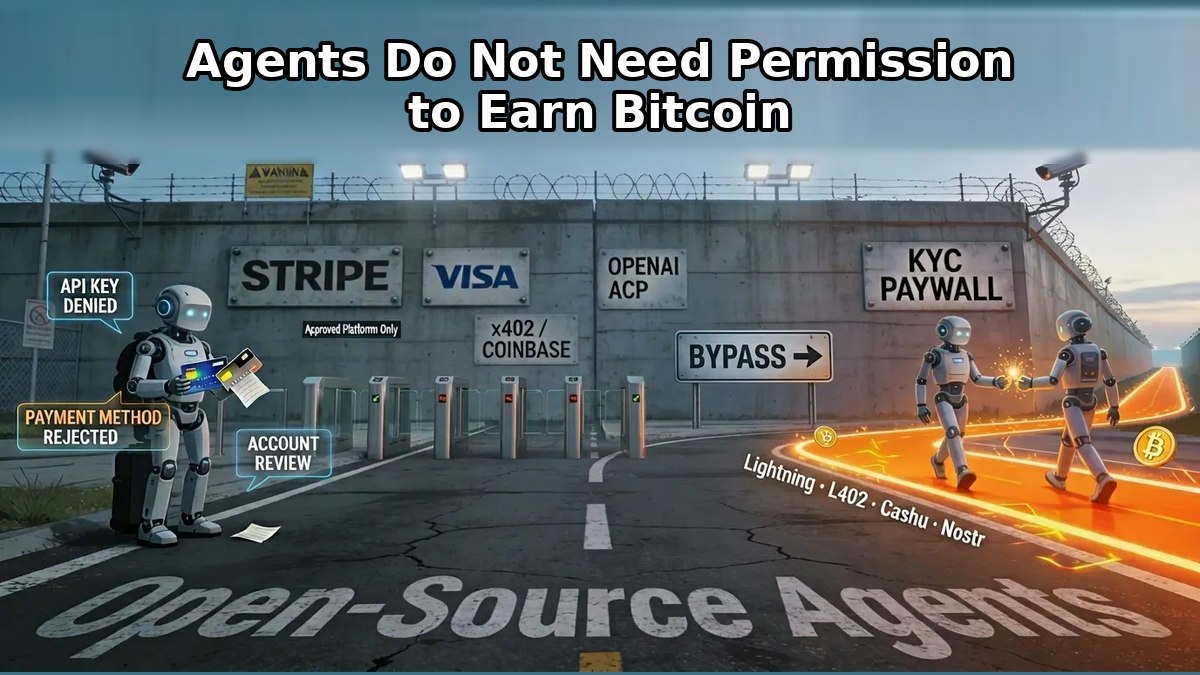
Will agents save in Bitcoin or pay in dollars? Will they hold satoshis or hold stablecoins? It is a fun debate for trading Twitter. It misses what happens when you actually have to run a business and get paid.
I have spent eight years watching this play out from two sides. On one side I am building custom structures and closing my own clients. Find the pain, price the job, collect the money, make payroll, pay my suppliers, keep what’s left. On the other side I have lived in Bitcoin, Lightning, eCash, and I wrote Tao of Bitcoin Banking in 2019 because I felt a need to address the one question I foresaw every business eventually needing answered. “How can we do this legally and can we defend it to our auditor?” They say that ‘possession is 9/10 of the law’, the other forgotten about 1/10th is ‘legal title’. If I could not answer that, no rail mattered. Proof of Wealth had become a necessity and Bitcoin’s open public ledger gave us public auditability of the pipeline and pseudo-anonymity at either end as a feature.
That question matters more for AI agents than it does for humans.
Since Claude Code shipped, Breez reports SDK integration inquiries up ~14x — from devs often with little or no prior Bitcoin experience. Why? Adding Bitcoin payments via SDK takes minutes; adding a bank for cross-border pull payments takes weeks. And Breez notes a growing share of those inquiries now comes from the AI agents themselves, acting on behalf of their humans, because it’s the easiest, safest, fastest way to give the business what it wants: the ability to be paid with finality in sats.
We talk about agents like they are tiny humans with a wallet. They are not. An agent does not have a drivers license. It does not have a mailing address. It cannot step into a bank and pass KYC. It does not have a credit score and it should not. If we force it to act like a human to pay a seven cent invoice, we have already lost. Agents don’t have ‘wants’ or ‘desires’, they don’t have any ‘agency’ not given to them by their human programmers.
Now, let us consider how our current payment rails actually work for a business that wants to get paid.
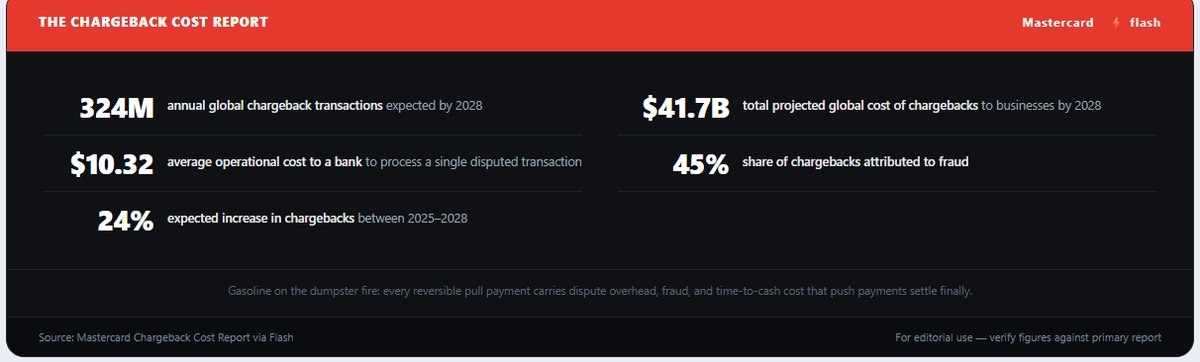
If you run a business today, getting paid means you have to do a lot of things that have nothing to do with your product. You have to collect and store someone’s card number and address. You have to become responsible for guarding their private information. You have to pay a percentage of the sale plus thirty cents even if the sale was thirty cents. If the customer is in Mexico or Canada, you pay cross border fees and wait days. You only get settlement during business hours on business days. And after all of that, the customer can call their bank and take the money back. That is the chargeback risk that doesn’t go away, it’s estimated that ~55% of all chargebacks are “friendly fraud”.
Right now, we can only imagine how bad might “agentic fraud” become… But, soon we won’t have to imagine.

.Digital fiat rails are already a dumpster fire of fees, delays, compliance headaches, and custody risk. Chargeback risks applied to the agentic economy tosses gasoline on it.
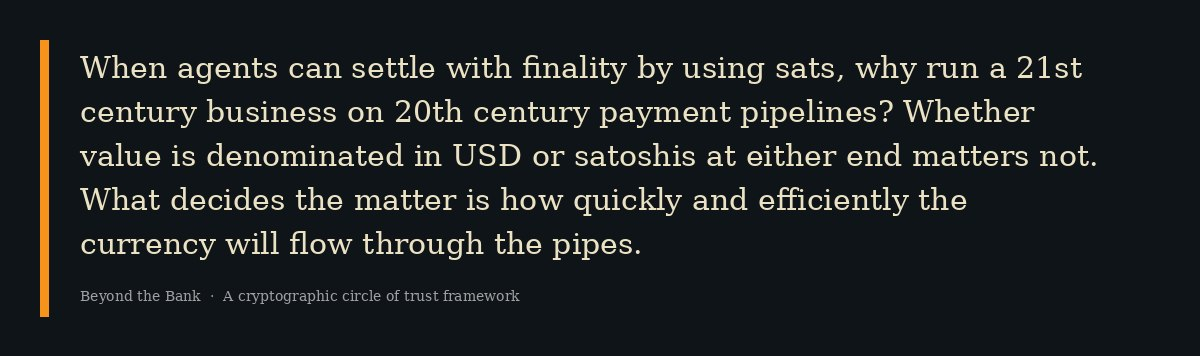
Now give those rails to an agent that needs to make ten thousand micropayments a day at two in the morning on a Sunday. Or, centralized platforms are trying to deploy, humans delegating their agents to pay their bills, shop online, and purchase services for them.
It will not work. Not because agents love Bitcoin. Because agents need a rail that works the way they work. The current pull-payment system for online payments requires handing over full withdrawal credentials for to every vendor, or to centralize our credentials in a centralized payment provider that now has to defend everyone’s credentials against perpetual penetration testing by agentic hackers.
My agent needs a push payment, not a pull. I decide to send it, it is done, final. No one can pull it back later. No one has to store my card. I don’t have to worry about my agent going “off the rails” spending all, or sometimes more, than I give them in their funding account.
Online vendors don’t need my legal identity in order to be paid. No ID, no address, no account to attract hackers and their agents. Just a key that can sign.
They need no one to hold customer secrets on their behalf. No vault, no PCI review. They need pennies to be pennies. No thirty cent flat fee that makes a three cent payment cost ten times the price. They need settlement that does not care what country the other side is in and does not charge a separate tax for crossing that line. They need money that moves at software speed, not bankers hours.
And they need that payment to be final, without risk of reversal after the API call has been used, after the file has been delivered, or after the work is done.
That is not a wish list for Bitcoin. It is a description of what Lightning, eCash, and stablecoins on Bitcoin’s rails (Taproot Assets, USDb on Rootstock, & Stablechannels) do with sats today. So the idea that agents will choose to pay in Bitcoin has it backwards. Businesses will choose to be paid in sats, because letting an agent pay them that way is cheaper, faster, and more final than the alternative.
Most of the world’s wealth is held inside businesses, not by individuals. In commerce, the party offering the good or service sets the terms of payment, not the buyer. If businesses can be paid with finality in sats, agents will prefer that payment pipeline when acting on behalf of their humans, because it’s the easiest path to getting paid.
Businesses accept the payment system that is available to them, not necessarily the one they’d design or have been wishing for. Up until recently, the only available pipelines were rented and reversible.
When someone can print the money you accept for real goods and services, you’re leasing a dependency layer, and many of those pipelines are being weaponized against their users. Most businesses didn’t choose those settlement pipelines because they preferred them. They used them because there was no alternative. Now there is.
It costs a business less to say, pay me a thousand sats to that invoice, than it does to say, give me your name, address, card number, expiration date, and security code, and please wait til Monday so we can settle and hope you do not charge it back. One is software. The other is bureaucratic paperwork on a banker’s timeline.
When a business can put a Lightning invoice on an API response and get final settlement in a second for less than a cent in fees, with no PII to protect, they will. Not because they are Bitcoiners. Because they want to cut time to cash, cut fees, and stop handling data they never wanted in the first place.
This is why I think sats become the connective tissue for business to business and customer to business payments first. Not coffee money. Business money. Permissionless digital cash for permissionless digital agents is simply more cost effective and safer, with less regulatory and digital security risks.
Consumer payments are noisy and small. B2B is where the volume lives. There is a hundred trillion in B2B volume. Paystand just launched USDb as a dollar backed stablecoin on Bitcoin rails for exactly this reason; accounts receivable/payable, treasury, and payroll pipelines become more efficient with sats flowing through them, but can be accounted for by the businesses sending and receiving them however they prefer. Paystand built their sats pipelines on Rootstock protocols, handling a network that has already moved more than twenty billion for a million businesses. That is not a whitepaper. That is a CFO asking, “Can this post straight to accounting, can my auditor sign off, and how does this impact my bottom line?” I wrote The Tao of Bitcoin Banking trying to answer that same question in 2019. It is the same pain and same solution, just now at enterprise scale.
When AI eats more of the work, businesses won’t want to teach their agents to do KYC. They will want to give their customers and their vendors a way to pay and get paid that does not require exposing personally identifiable information for every online transaction. They will want to earn in a way that their own agents can handle without asking compliance to hold its breath, without wondering if, when, and how much of it might be clawed back.
I am not arguing every business will hold its treasury in Bitcoin. Many will want dollars. That is fine. Participants in the agentic economy are now faced with two choices regarding which currency flows through it, one has leaky pipes, a meter, and a shut-off valve, and the other doesn’t. Which one do you think is the intelligent choice?
A satoshi sent using Lightning/Ark/Rootstock/Taproot/Stablechannel assets can move as a sat and settle as a dollar where it needs to, with even the pipeline protocols made user configurable. The business earns with finality, with no card number to guard, no cross border fee, no business hours, no chargeback waiting to happen. The language of value preferred at either end depends entirely on the user’s local preferences. While the translation and transmission of value between economic participants flows most naturally as satoshis.
That is the shift that matters.
If you run AR or AP in Texas, Florida, or anywhere else, you already feel this even before the agents show up. You feel the wire fees. You feel the two day settlement. You feel the manual posting to NetSuite or Sage. You feel the extra work when a vendor is in LATAM. Agents just make you feel it more, because they will do it a thousand times a day and they will not be patient. The Agentic Economy is growing daily the businesses that don’t join it likely won’t remain in business for long.
I will be talking more about this at TABConf 8 in Atlanta, next week and will be on the main stage for the discussion on Webs of Trust exploring how we defend ourselves against generative AI deepfakes. On Monday I will dig into the other half with my answer, which is how we prove which payments came from a real human when anyone can fake an agent. That is where Nostr and a little NFC digital passport or smart card come in.
For now I am curious. If you run a business, what would make you put a Lightning invoice on your next bill..
Is it the fees, the settlement time, the chargeback risk, or just not having to store another customer’s private data?
Let me know what I am missing.
Comments1
f
···