
Heute auf DiscoverToday on Discover
Entdecke, was andere bewegt.Find what moves people.
Geschichten, Gespräche und Ideen aus dem offenen Netz.Stories, conversations and ideas from the open web.
 HörbuchAudiobookDas verlorene Bit der Berufung_Teil-1

 FolgeEpisode#024 Hol dir die Kontrolle über deine Dateien zurück mit deinem eigenen Home-Server

 ArtikelArticleIn Search of Freedom: Life, Death, and Sovereignty in the Himalaya

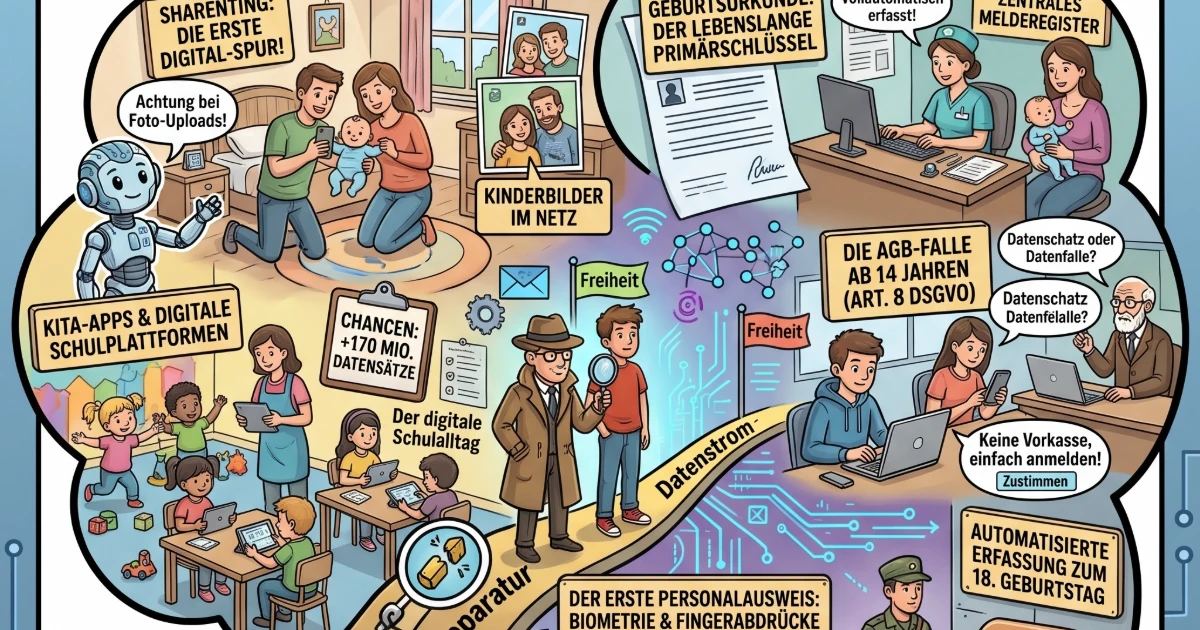 HörbuchAudiobookDer gläserne Mensch - Aza und Avatar - Die Bytes Detektive
 HörbuchAudiobookDas verlorene Bit der Berufung _ Teil-2
GeldMoney



What Bitcoin Taught Me About Patience, Consumption, and True Independence
vor 15 Mon.15 mo ago8 Min.8 min
Neu zum HörenNew to listen
Alles in HörenAll in Listen#023 Deine SIM-Karte verrät dich!
breakfree
#022 Nur so sind deine Bitcoin wirklich privat
breakfree
#021 Dein Vermögen gehört nicht dir (mit einer einzigen Ausnahme)!
breakfree
#020 So bezahlst du, ohne Datenspuren zu hinterlassen
breakfree
#019 Dein Laptop spioniert dich nicht mehr aus, ist dafür aber schneller
breakfree
#018 So entkommst du der Spyware von Microsoft und Apple
breakfree
#017 Der Algorithmus kontrolliert dich!
breakfree
#016 Wie gefährlich sind Updates wirklich?
breakfree
#015 Ist dein soziales Umfeld dein größtes Datenleck?
breakfree
#014 Unsere Wohnungen sind voll mit Technik, aber nicht verwanzt
breakfree














MenschenPeople



PublikationenPublications
Alle ansehenView all


WirtschaftEconomics
Bitcoin Mining Economics in 2026: Who Actually Profits
vor 1 Woche1 w ago3 Min.3 min

Weiter durchs NetzwerkAcross the network
Noch mehr zu entdecken.Keep exploring.
6 Beiträge geladen.6 stories loaded.

STOP! Have We Lost Our Minds? The World Needs Peace, Not Another War
A call to world leaders to stop escalating, put pride aside and choose diplomacy over war.

vor 2 Tagen2 d ago8 Min.8 min
Jack Mallers on Europe: Where the Case Breaks (Part 3 of 3)
The final part of our examination of Jack Mallers and Europe is where the case meets its limits. We name the three omissions inside his mechanism — an unused central bank backstop, France's excessive deficit procedure, and a central bank that has itself been tightening — and we test his timing against the central bank's own data, where the August calm sits in the middle of a range that held for forty-four months and the fracture arrives in October alongside a budget and a collapsed government. We correct the figure that cuts broadest, give him the yen, the direction and the dating, name the claim that cannot fail, and leave eight dated markers by which the argument settles itself in public.

vor 3 Wochen3 w ago22 Min.22 min
Jack Mallers on Europe: The Record So Far (Part 2 of 3)
Part two of three turns the earlier verdict on Jack Mallers' debt-and-dollar thesis into a comparison. Where a working operator reading real-time markets and a series triangulating documents reach the same conclusion by independent routes, both readings get stronger — and on the roll, the interest bill, the fading foreign buyer and the direction of the debasement trade, they do. Then the record beside his older claims: yields, the mortgage rate, the deficit level and the size of the debt aged well; the eight point three trillion refinancing figure, the Asian surplus flow and the demographic share never confirmed; and the claim that no country survives debt above one hundred and thirty per cent of output is contradicted by Japan and Singapore.
vor 3 Wochen3 w ago23 Min.23 min
Jack Mallers on Europe: The Case Examined (Part 1 of 3)
Jack Mallers, the founder of Strike, hosts a show arguing that the euro system breaks before the American one. This first pass states his case at full strength: a central bank that hiked into forty trillion dollars of debt, a refinancing bill that grows on its own arithmetic, an intervention that sold euros rather than dollars, and a France he calls the first crack. His numbers largely hold, and two pieces of evidence, the euro's fall of nearly five per cent against the yen and Japanese holdings of French bonds, are real. His motive for it all remains, in his own words, speculation.
vor 3 Wochen3 w ago23 Min.23 min

The M2M Endgame: Why Recursive AI Could Make Europe Structurally Irrelevant
Recursive AI, robotics, and machine-to-machine systems are not just automating work. They are changing the speed and architecture of the economy itself. As AI increasingly helps build better AI, development cycles can compress and technological progress can compound. In that environment, Europe’s main risk is not technological extinction, but structural irrelevance: institutions that move in years attempting to govern systems that evolve in months and operate in seconds. The deeper problem is economic. If machines generate more output while human labor becomes less central, the wage → consumption → tax loop that finances modern welfare states begins to weaken. At the same time, strategic power shifts toward energy, compute, chips, infrastructure, robotics, and ownership. Europe does not need to collapse overnight to lose relevance. It only needs to compound more slowly than the systems defining the next economy.

vor 1 Mon.1 mo ago5 Min.5 min

The Mathematical Collapse: Why Europe Cannot Survive the Exponential AI Curve
How near-zero-cost cognitive labor collides with a welfare state built around taxing human work.
vor 1 Mon.1 mo ago4 Min.4 min